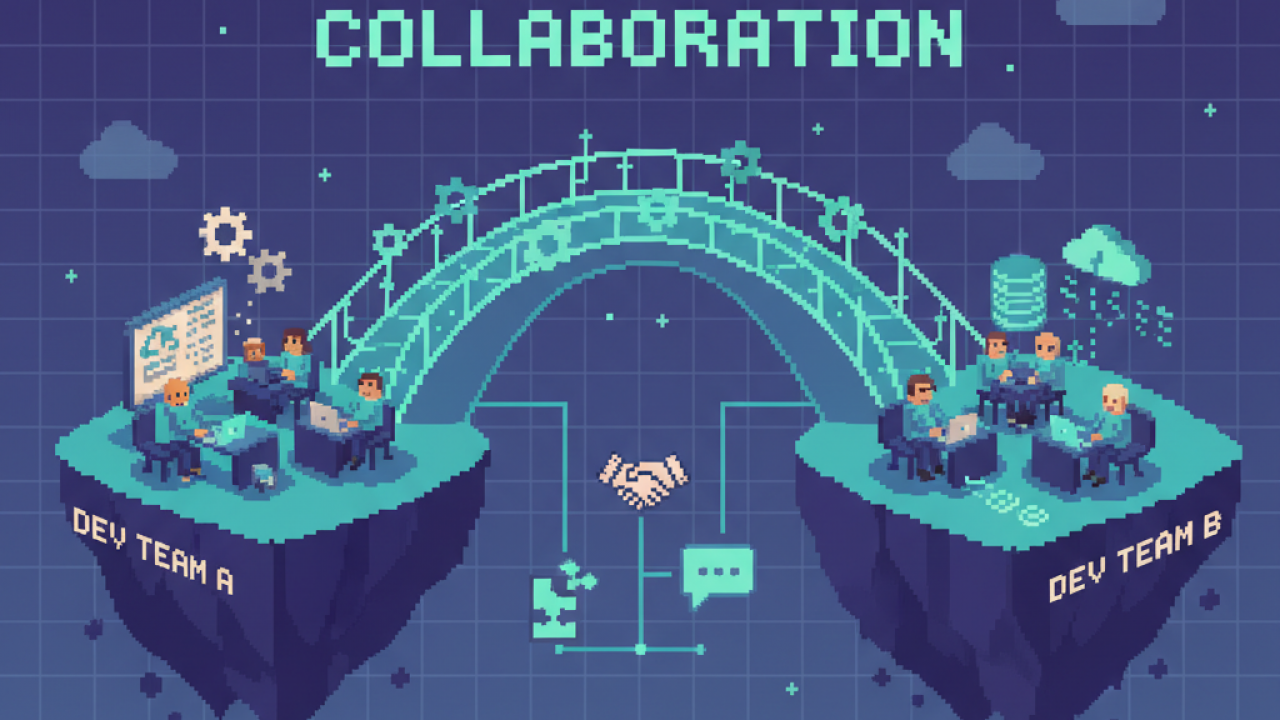
A bug report comes in involving a critical user flow. The frontend team traces the issue to an unexpected API response. The backend team insists their service is working correctly. After two days of debugging, the root cause is found in a shared authentication service that a third team updated last week, and no one on the affected teams was aware of the change. This kind of multi-day investigation for a five-minute fix is a classic symptom of friction between software engineering teams. Even with competent people, siloed work and isolation keep piling up and slowing the team down.
The Costs of Fragmentation Between Teams
When teams operate as independent units, a tax is levied on productivity. You start to see a lot of redundant work, like two different teams building nearly identical internal libraries to parse configuration files or handle authentication tokens. It’s not because people aren’t communicating; it’s because the cost of discovering another team’s work is higher than the cost of simply redoing it. This duplication goes beyond code and reaches debugging, where solving an issue across services requires pulling engineers from multiple teams into a meeting, each one trying to prove that their service isn’t the problem.
The bigger problem arises when integration stops being a planned activity and becomes a constant reinvention. One team updates a shared component and, suddenly, three other services start throwing exceptions in production because of an undocumented breaking change. Without a shared technical view, standards begin to diverge across the codebase, making it hard to reason about the system as a whole. Evolving the architecture turns into a painful and political process rather than a technical one, because every change has to be negotiated across multiple backlogs and different teams’ priorities.
Over time, this friction leads to loss of context and pushes problems from one team to another. When a production incident happens, the first question becomes “who owns this service?” instead of “how do we fix the system?”. Ownership becomes unclear, especially in components that sit at team boundaries. Information ends up isolated in specific Slack channels and team documents, making it almost impossible for an engineer from another team to investigate an issue effectively without a “guide”.
Communication Between Teams Is Not a Tool Problem
We often try to solve these problems by adding more tools or scheduling more meetings. We create a new Slack channel, buy a better project management tool, or set up a weekly cross-team meeting. But this rarely fixes the root cause. The problem is not a lack of communication channels; it’s a lack of shared understanding and predictable interaction patterns.
Throwing more meetings at the problem usually only makes things worse. Engineers are pulled away from focused work for discussions with no clear outcomes, and constant context switching becomes the default mode of operation. A weekly sync may bring status updates, but it doesn’t solve why one team’s deployment broke another team’s functionality. These meetings often fail to address the fundamental communication failures.
A better approach is to treat cross-team collaboration as a systems design problem. Instead of focusing on who talks to whom, we should focus on how they interact. Our communication flows are part of the architecture just as much as our services and databases. By seeing collaboration this way, we can start defining explicit interfaces for human interaction, just as we do with our APIs. This means shifting the focus from informal, ad-hoc communication to designing a predictable and resilient system for how teams work together.
How to Coordinate Work Across Teams
Thinking about collaboration as a design problem leads to a few practical principles that can be applied without a major reorganization or a new set of tools.
Principle 1: Design Clear Interfaces for Interaction Between Software Engineering Teams
Just as a well-designed API has a clear contract, teams need explicit protocols for how they interact. This goes beyond simply documenting endpoints. It means creating comprehensive documentation about usage patterns, service boundaries, and data contracts that other teams can rely on.
- Establish communication protocols. For any cross-team dependency, define the process. If Team A needs a change from Team B, does it become a ticket in their backlog? A formal request document? Who is the point of contact? Making this explicit removes ambiguity and saves time.
- Document proactively. When shipping a change to a shared service, the PR description or release notes should include a “How this affects consumers” section. Don’t force other teams to reverse-engineer your changes.
- Align on failure modes. Proactively discuss and document how to handle errors, rollbacks, and upgrades of shared components. What is the SLA of a critical dependency? What happens if it goes down? Answering these questions before an incident makes all the difference.
Principle 2: Cultivate Shared Context, Not Just Shared Knowledge
Shared knowledge is knowing that a service exists. Shared context is understanding why it was built that way, what its limitations are, and where it’s going. Context is what enables engineers to make good decisions without constant supervision or endless meetings.
- Hold regular architecture syncs. These are not status updates. They are forums where teams present future technical designs, discuss trade-offs, and get feedback from peers outside their own team. This builds a collective understanding of how the entire system is evolving.
- Encourage cross-team learning. Internal talks, brown bags, or “lunch and learns” are great for this. When a data platform engineer explains how the new streaming infrastructure works, they give application developers the context they need to use it effectively.
- Treat documentation as a shared asset. Encourage engineers to contribute to documentation outside their own codebase. If you’re integrating with another team’s service and find the docs confusing, send a PR to improve them.
Principle 3: Simplify Feedback Loops
The longer it takes for the consequences of a change to become visible, the harder it is to learn and adapt. Fast, well-closed feedback loops are essential for multiple teams working on the same system.
- Automate integration tests. Whenever possible, create automated tests that cross service boundaries. This provides immediate feedback when a change in one service breaks a contract with another, catching issues long before they reach production.
- Set up shared monitoring dashboards. For any critical dependency, create a dashboard with key metrics (such as latency, error rate, and saturation) that is visible to both the provider and consumer teams. This creates a single source of truth and helps diagnose issues faster.
- Create low-friction request channels. Make it extremely easy for one team to report a bug or request a feature from another. A dedicated GitHub label, a simple form, or a specific Jira project can work well, as long as there is a clear and well-communicated process for triage and response. The goal is to make cross-team requests as simple as internal ones.
When these structures are in place, many problems stop happening. Incidents are resolved with less friction, changes create fewer side effects, and collaboration between teams no longer depends on constant alignment.