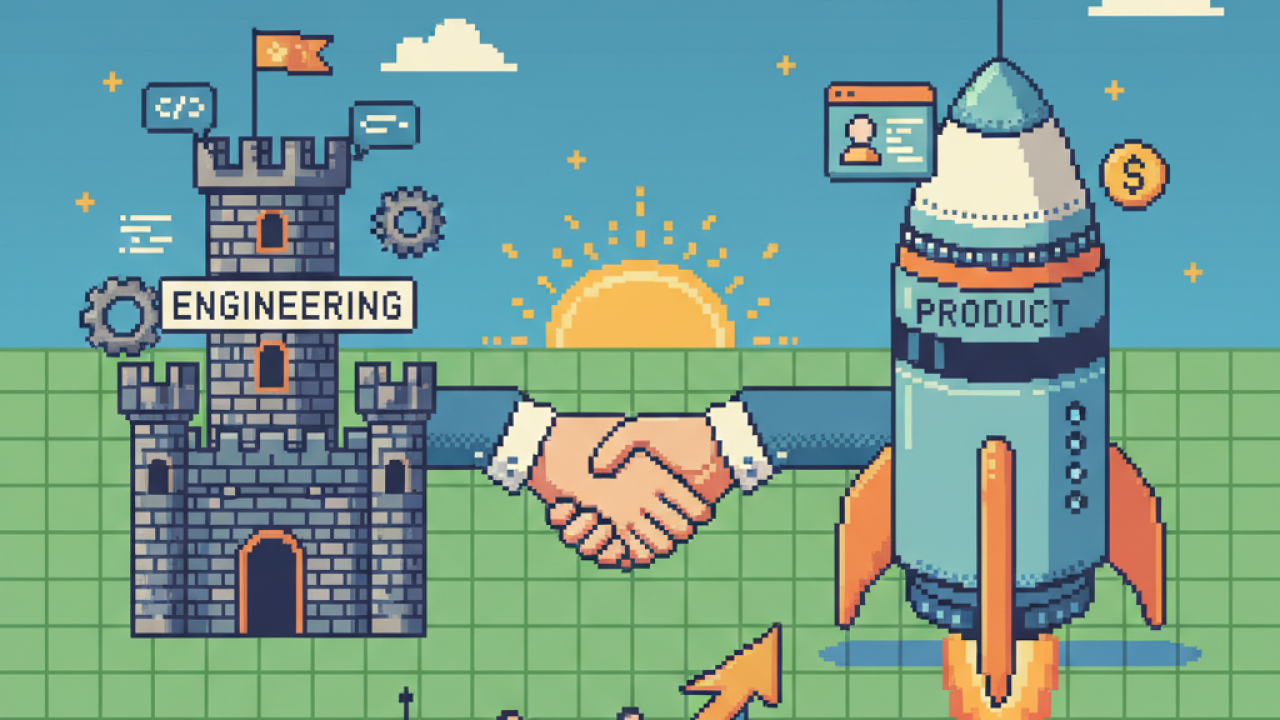
As a company grows, the way engineering and product teams work together begins to wear down. What used to be quick hallway conversations and shared assumptions turn into missed deadlines and runaway scope. You start seeing features shipped without the user impact everyone expected, and the engineering team begins to feel like a feature factory, processing tickets without a clear connection to the “why.” This isn’t just a process problem; it’s the gradual loss of alignment between product, engineering, and the business, where product decisions stop reflecting technical reality and technical work feels increasingly disconnected from the value it creates.
This friction between engineering and product gets worse when teams try to solve it with more process. The default solution is usually more documentation, more tickets, and more asynchronous hand-offs. But relying solely on written specifications is a trap. A well-written document transfers requirements, but it doesn’t transfer context or build shared understanding of the problem. When communication is reduced to tickets and comments, direct dialogue disappears, and teams start optimizing for output instead of outcomes.
Building Shared Context
True alignment comes from deep, mutual understanding across disciplines. It happens when engineers don’t just know what to build, but understand the user problem and the business motivations behind a feature. It also requires the product team to understand the system’s architecture, the real cost of technical debt, and the constraints of the solution space. Without this two-way street, product makes technically naive requests, and engineering can’t offer creative solutions because it lacks the full picture.
Why Traditional Hand-offs Don’t Scale
The classic model where a product manager writes a detailed specification and “hands it off” to engineering is where problems begin. It treats the relationship as transactional, not collaborative.
Over-reliance on documentation:
- Specifications can’t capture every nuance or edge case. When engineers run into ambiguities, they either have to make assumptions or block progress waiting for clarification, slowing everything down.
Focus on deliverables, not problems:
- Instead of starting from a user need, discussions begin with a pre-defined solution. Engineering joins the conversation late, just to execute, which limits its ability to contribute better alternatives.
Lack of shared accountability: When a feature fails to meet its goals, it’s easy to start pointing fingers. Product may blame execution, while engineering points to poor requirements. In practice, the failure happened long before a single line of code was written.
How to Integrate Engineering and Product
Fixing this requires creating intentional collaboration routines that build shared context from the start and continuously. The goal is to ensure that product and engineering make decisions together from the earliest discussions, not just during execution.
Bringing Product and Engineering into the Same Conversation Earlier
Instead of waiting for a specification to be finalized, you need to bring collaboration into the earliest stages of ideation and planning. This means moving away from a waterfall-style information flow toward continuous, two-way dialogue.
- Joint discovery spikes: For complex or ambiguous problems, have an engineer and a product manager work together on a discovery spike. They can explore the user problem and possible technical solutions side by side, aligning expectations before deciding what to build.
- PMs in technical reviews: Invite product managers to technical design reviews, especially for features with major user impact. They don’t need to understand every line of implementation, but hearing engineering trade-offs firsthand provides valuable context for future planning.
- Engineering in strategy sessions: Make sure senior engineers or tech leads take part in early product strategy and roadmap discussions. Their perspective on feasibility and technical risk helps guide more realistic decisions from the start.
- “Pre-mortem” sessions for specs: Before committing to a feature, run a session where the team actively tries to find flaws in the plan. Assume the project failed and ask “why?”. This surfaces assumptions and risks from both technical and product perspectives.
- Failure analysis: When a production incident happens or a feature underperforms, bring engineering and product together to analyze what happened. Looking at user feedback, logs, and metrics as a single team builds a shared sense of responsibility for the user experience.
How to Maintain Alignment as You Scale
As the company grows, alignment that once happened naturally starts to break down. Without clear mechanisms to align decisions and priorities, product and engineering begin to operate at different rhythms. To sustain this alignment, you need to be deliberate about how you measure success and improve processes.
Measuring the health of collaboration
Use qualitative feedback from surveys and retrospectives to understand how teams feel they are working together. Simple questions already reveal a lot:
- Do engineers have enough context to make good decisions?
- Do product managers see their technical peers as partners in problem-solving?
These answers help identify invisible bottlenecks and show when it makes sense to invest in Developer Experience to improve flow and alignment between teams.
Linking metrics to objectives
Instead of separate goals for engineering (uptime, performance) and product (user engagement), create shared OKRs that require joint success from both teams. An objective like “Improve new user activation by 15%” forces coordinated effort across the entire user experience.
Iterating on your model
There’s no single model that fits every case. What works for a team of five will break for a group of fifty. Regularly revisit team rituals and processes in retrospectives, and be willing to experiment with new ways of working together.