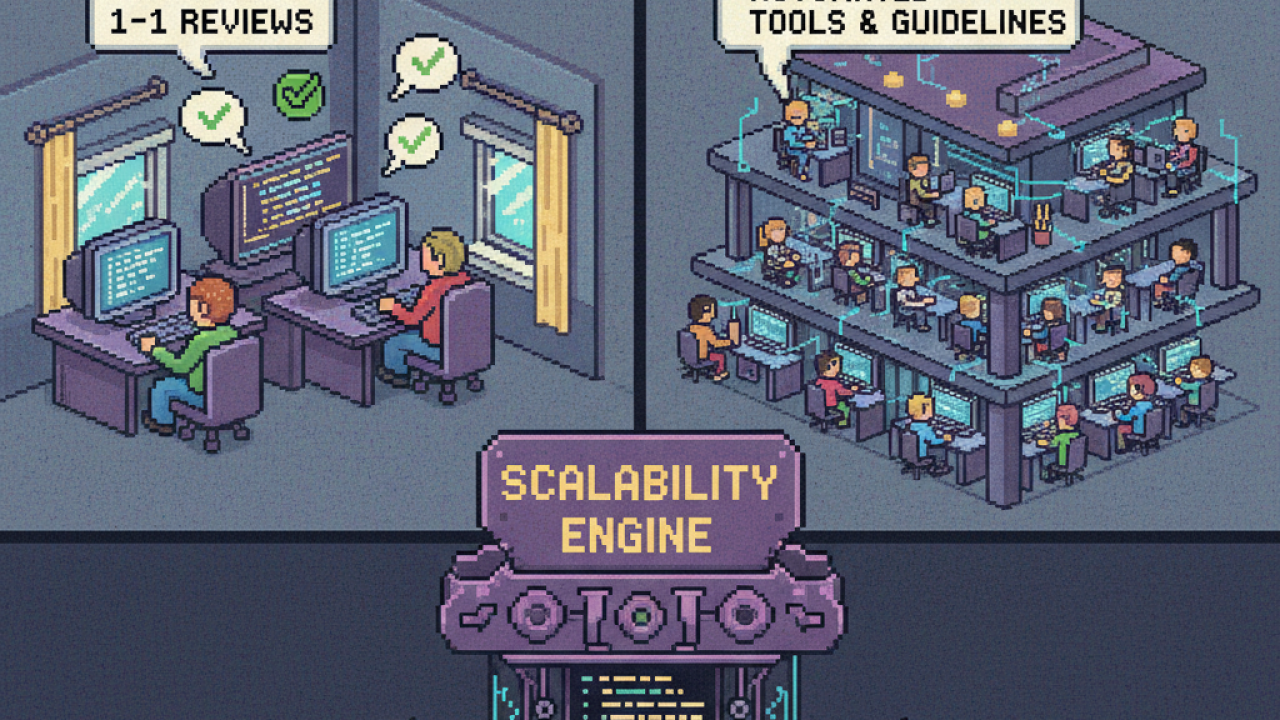
A pull request opens, and the review requests go out to the same two or three senior engineers. A day passes. Then another. Eventually, feedback trickles in, but in the meantime, other PRs have stacked up behind it, all waiting on the same people. This is the first sign that your team’s **code review** process is hitting a scaling limit. As the team grows, the problem gets worse. PR cycle times stretch out, the review load becomes visibly uneven, and the quality of feedback starts to vary wildly depending on who was available to look at the code.
The Mistake of Thinking “More Reviewers” Solves Everything
What happens next is predictable. The team defaults to relying on a few “experts” as the implicit owners of quality for certain parts of the codebase. While this feels efficient at first, it quickly creates a throughput bottleneck and a knowledge silo. The designated experts become swamped, unable to focus on their own work because they’re constantly context-switching to unblock others. They burn out, and their deep knowledge of the system stays locked away with them.
This centralization also means that the rest of the team isn’t learning. Engineers wait passively for an approval stamp instead of actively engaging with the code. The system depends entirely on the availability and attention of a few key individuals, which is a fragile setup for any growing team.
Code Review as a Distributed System
The common response is to just add more reviewers, but that doesn’t fix the underlying model. A more sustainable approach is to treat your review process like a distributed system. A healthy process has two equally important functions: ensuring code quality and propagating knowledge across the team. Every pull request is an opportunity not only to catch bugs but also to share context, explain architectural decisions, and level up the skills of every participant.
When you view it this way, the goal shifts from pure gatekeeping to shared ownership. The responsibility for the codebase’s health belongs to everyone who contributes to it. The review process becomes the primary mechanism for distributing that responsibility and the knowledge required to uphold it.
Operationalizing Distributed Code Review
Shifting the model requires deliberate changes to your team’s daily workflow. It’s about building systems that empower everyone to participate effectively and intelligently route work to the right people without overloading anyone.
Empowering Every Engineer to Review Effectively
You can’t just tell everyone to “do more reviews” and expect good results. You need to provide the structure and support to make them effective.
Establish Clear Expectations: Document what a “good” review looks like at your company. Is it about high-level architecture? Edge cases and error handling? Test coverage? Be explicit. A checklist in the PR template can guide both the author and the reviewer toward what matters.
Provide Structured Mentorship: Junior engineers are often hesitant to review a senior’s code. Create opportunities for them to do so safely. This could involve pairing on a review, having a senior explicitly ask for a newer engineer’s perspective, or doing group review sessions on particularly complex changes. The goal is to build confidence and show that all feedback is valuable.
Encourage Specific, Actionable Feedback: Coach the team to move beyond “LGTM.” Good feedback is specific, explains the “why” behind a suggestion, and offers a clear path to improvement.
How Tools Can Help Distribute Reviews More Effectively
As the team grows, manually assigning reviewers becomes its own chore. Tools can help distribute the load more effectively. Consider systems that can handle:
Skill-based Routing: Instead of just tagging the most senior person, you can route reviews based on who has recent experience in that part of the code. This taps into localized expertise without creating permanent silos. Tools that analyze git blame or file history can often suggest relevant reviewers automatically.
Distribute the Load: Some tools can track how many active reviews each person has and suggest reviewers with more bandwidth. This prevents the classic pile-on where the same few people get every request, ensuring a more even distribution of work and faster turnaround times.
Building a Code Review Culture
Tools and processes are only part of the solution. The team’s culture ultimately determines whether code reviews are a collaborative process that strengthens the code and the team, or a confrontational one that slows everyone down.
Defining Clear and Actionable Criteria
Your review guidelines should focus everyone’s attention on what actually impacts the user and the long-term health of the system.
Define Core Focus Areas: Explicitly prioritize the big things. For most teams, this means focusing reviews on architecture, correctness, security, and test coverage.
- Is the change solving the right problem?
- Does it align with the system’s design?
- Does it handle errors correctly?
Do not turn the review into a style discussion: These are the number one time-wasters in code review. Debates over brace placement, variable naming, or line length should be settled once by an automated linter and formatter, then never discussed in a PR again. The review is for human intelligence, not for tasks a machine can do better.
Measuring and Iterating on Your Review Process
You need to know if your changes are working. A few key metrics can give you a clear picture of your review process’s health.
Review Completion Rate: How many open PRs have at least one review? This tells you if work is getting stuck at the very first step.
Reviewer Diversity: Over a month, how many different people on the team have reviewed a PR? If this number is low, it’s a strong signal that you still have a knowledge silo or bottleneck problem.
PR Cycle Time: How long does it take from PR creation to merge? Pay attention to the time spent waiting for the first review, as this is often where the biggest delays happen.
Discuss these metrics in your regular retrospectives. Ask the team what’s working and what’s not.
A review process shouldn’t be static, it should evolve with the team.
How to Structure a Scalable Code Review Process
Getting started doesn’t require a massive overhaul. You can begin by taking a few concrete steps to identify and fix the biggest bottlenecks in your current process.
- Evaluate your current review load. Who is doing most of the reviews? Where are PRs getting stuck?
- Document explicit responsibilities for both authors and reviewers in your PR process.
- Implement a simple reviewer rotation or a tool-based assignment strategy to distribute the load.
- Provide training resources or mentorship opportunities to help everyone become a more confident and effective reviewer.
- Schedule a recurring meeting or retro session every quarter to discuss how the review process is working and identify areas for improvement.