Ultra-custom rules (Kodus)
— write policies in natural language and scope them by repo, folder, file or individual PR.
If you're here, you're probably deciding which AI reviewer will scrutinise every pull request your team ships. Below is a direct, in-depth comparison of Kodus and CodeRabbit, laser-focused on the things that matter most: rule flexibility, integrations, quality metrics and licensing model.

— write policies in natural language and scope them by repo, folder, file or individual PR.
— surface CI results, Jira tickets, Notion pages or Playwright tests inside the same review comment.
— official VS Code / Cursor extension gives feedback before you push.
— built-in productivity & quality metrics plus an automatic backlog of unresolved suggestions.
| Feature |
 Kodus
Kodus
|
 CodeRabbit
|
|---|---|---|
| AI-powered code summaries | ✓ | ✓ |
| In-line comments | ✓ | ✓ |
| Chat with PR bot | ✓ | ✓ |
| Rules per repo / folder / file / PR | ✓ | △ |
| External context (MCP & Plugins) | ✓ | ✕ |
| Native IDE plugin | ✕ | ✓ |
| Metrics dashboard | ✓ | ✕ |
| Technical-debt backlog | ✓ | ✕ |
| Noise filters (limit & severity) | ✓ | ✕ |
| Self-host option | ✓ | △ |
| Pricing | $10/user + BYOK | $24 - $30/user |
To evaluate real-world performance, we compared Kody and CodeRabbit reviews across several PRs from projects like Sentry, Cal.com, Grafana, Discourse and Keycloak.
Overall Performance · Kodus
Overall Performance · CodeRabbit
Use any model you want — and keep every review fully under your control.
Run with your own API keys — GPT-5, Claude, Gemini, or any model you choose.
Locked to a single provider — no model choice or cost control.
Version-controlled guidelines you can scope from the whole repo down to a single file — or import ready-made in one click.
Granular, version-controlled rules for any file, folder or PR, with a one-click community library ready to import.
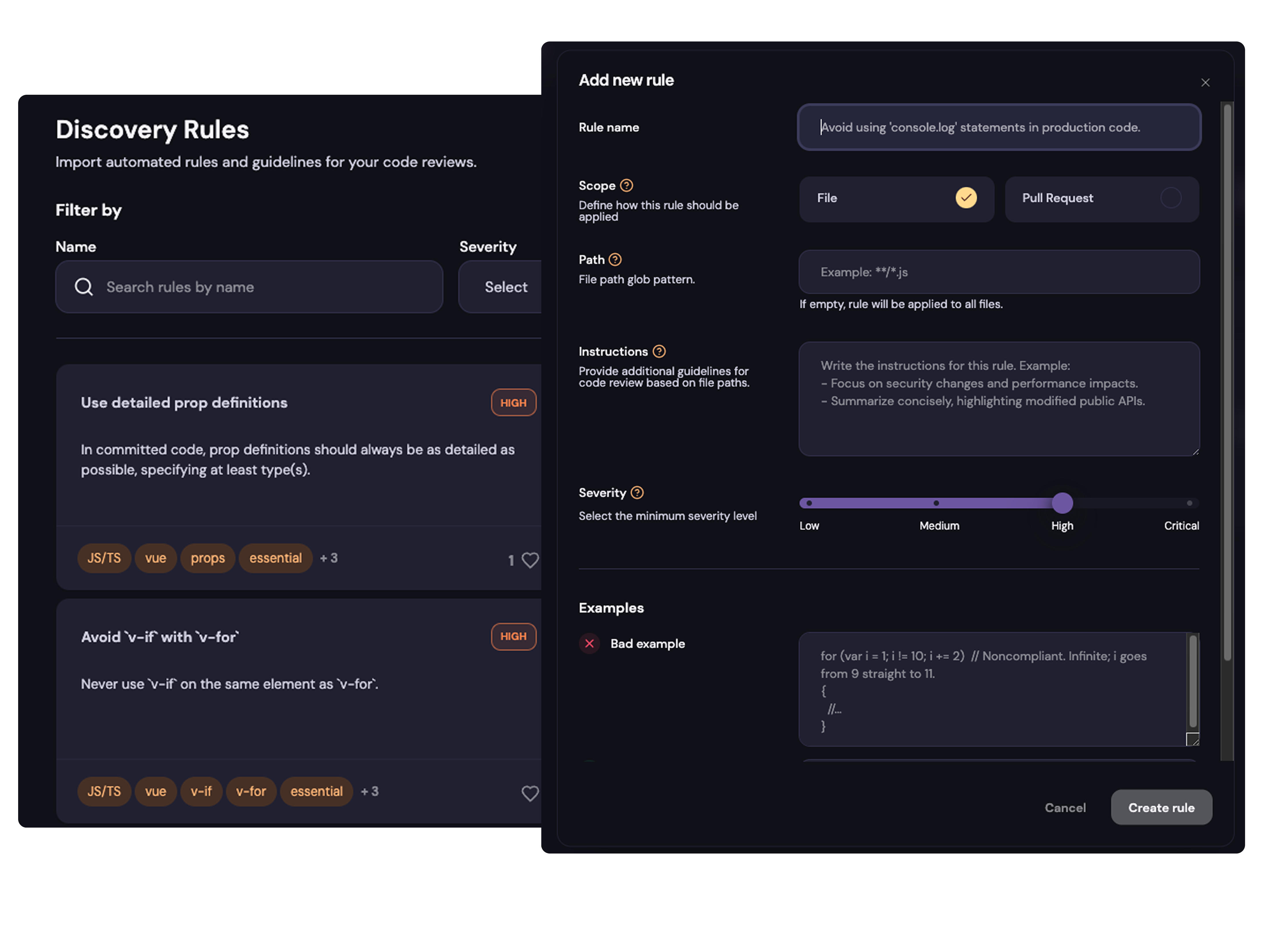
Single YAML or dashboard for the whole repo — handy tweaks, but no file-level targeting or rule library.
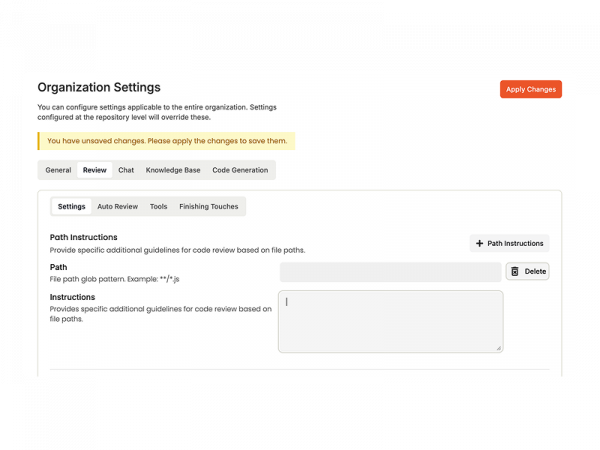
Bring the right context into every review — or get feedback before code ever hits the PR.
Pull CI results, Jira tickets, Notion docs, Playwright runs — or any custom script — into one clean comment.
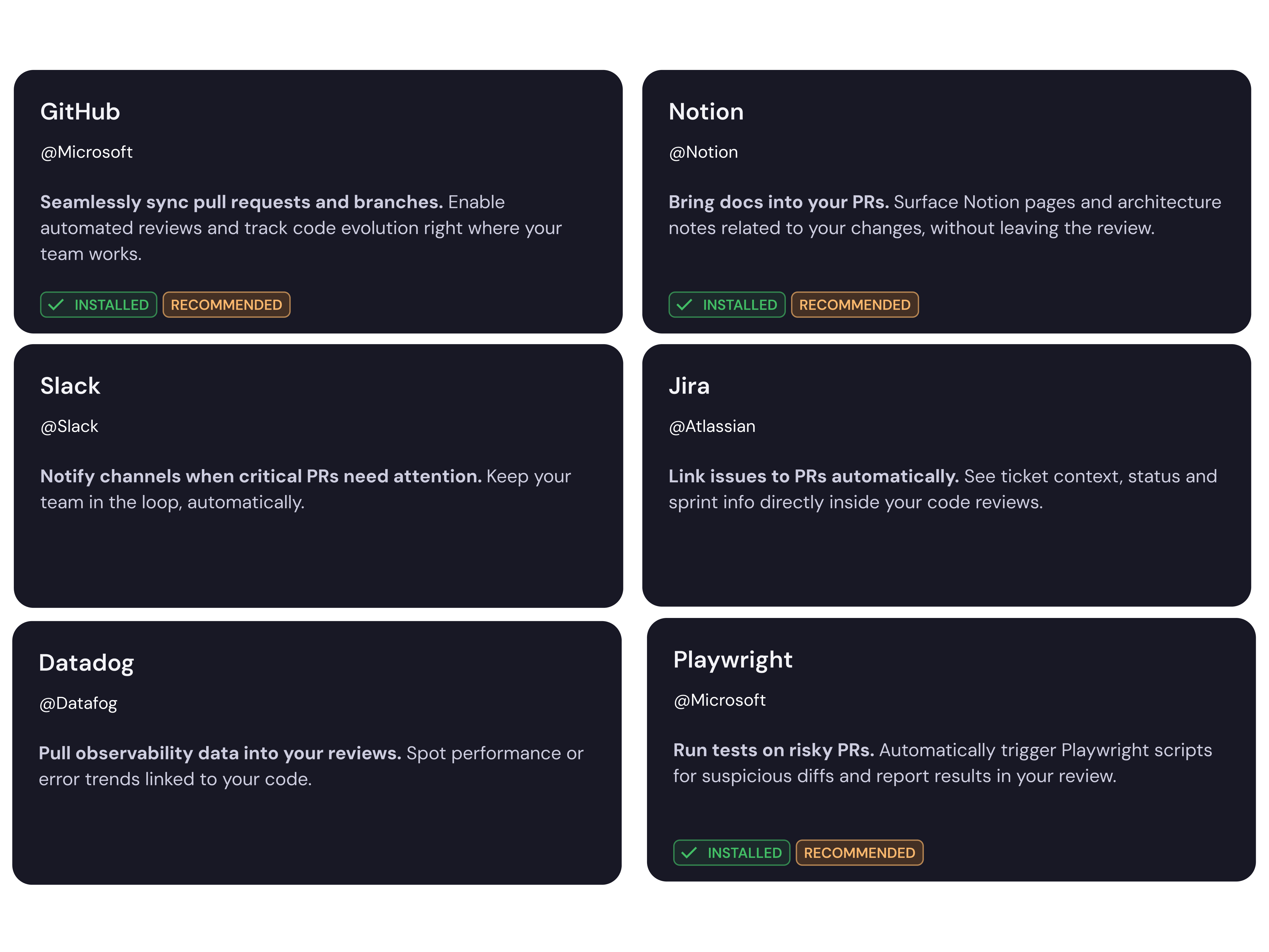
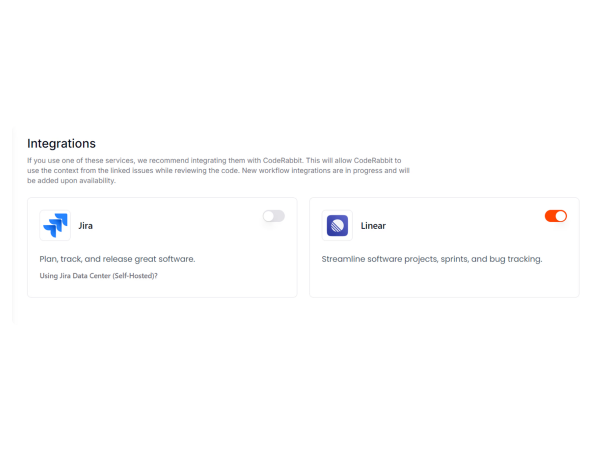
Basic semantic look-ups for Jira and Linear issues — no MCP layer, no CI or test data.
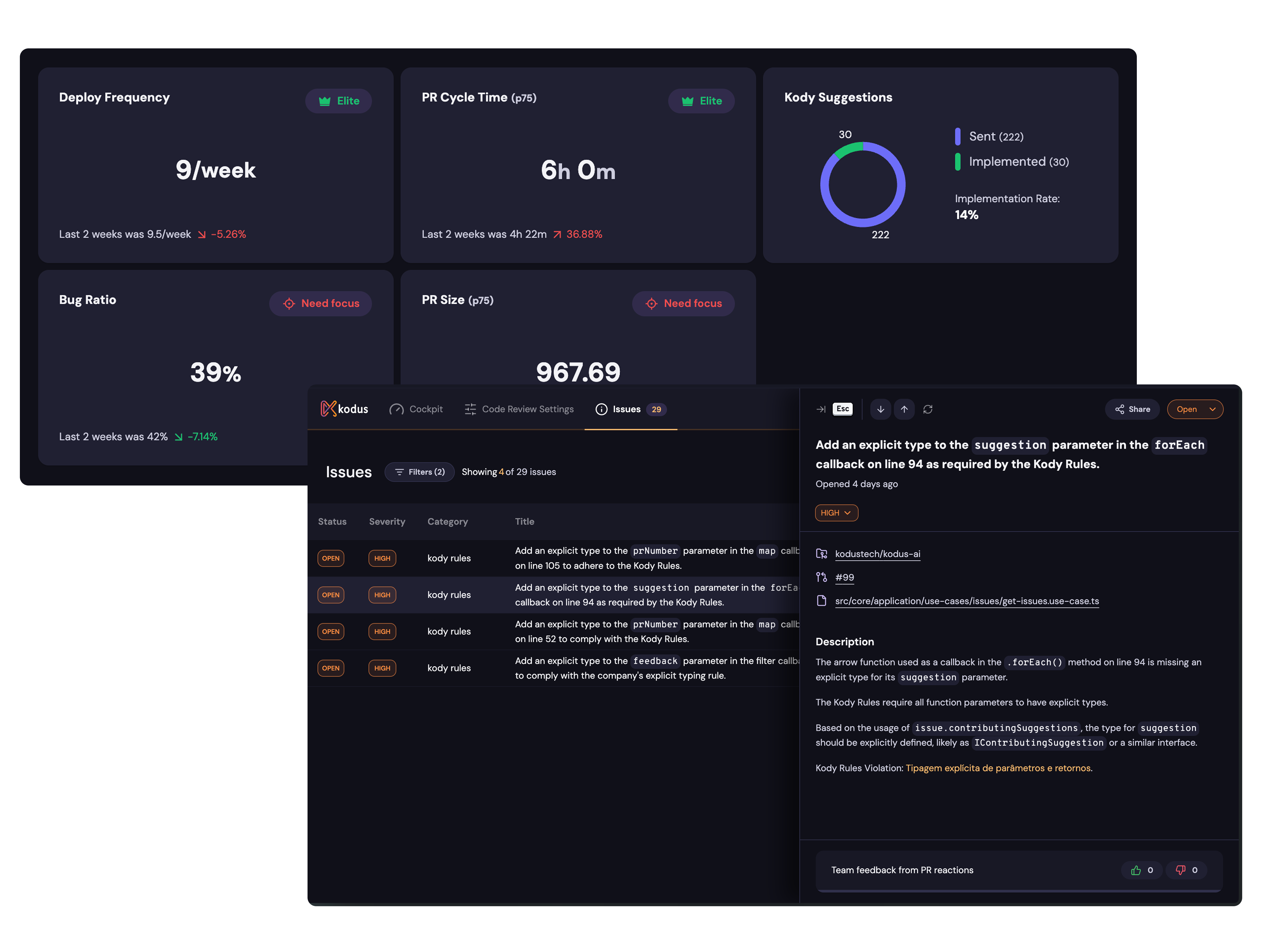
Turn review data into team KPIs — or just tally how many warnings you raised.
Cockpit tracks deploys, cycle-time and Implementation Rate, while Kody Issues turns every unresolved suggestion into a living backlog.
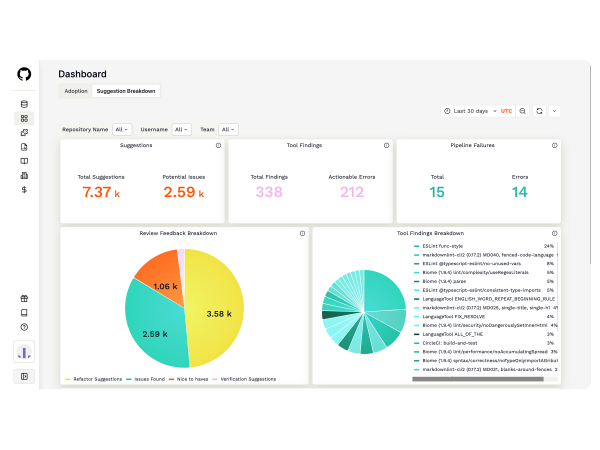
Dashboard counts suggestions and linter findings — no implementation tracking, no backlog.
If your team values precision, visibility, and control, Kodus is the clear choice.
CodeRabbit is a solid, fully managed SaaS for teams that just want “set-it-and-forget-it” reviews and are happy with a single YAML config plus basic suggestion counts.
But if you want deeper customisation, richer insight, and the freedom to run on-prem or in the cloud, Kodus delivers more — without locking you in.
Kodus Teams is $10/dev/month monthly or $8/dev/month on annual prepay, plus your own model bill (you bring your LLM key). CodeRabbit Pro is $24/dev/month annual prepay with the LLM bundled; CodeRabbit Pro Plus is $48/dev/month annual. CodeRabbit is free forever for public repositories. Kodus self-hosted is free for any repo under AGPLv3 with the same model setup. Numbers reflect public pricing pages as of 2026-05; verify before locking a budget.
Kodus is open source under AGPLv3 (github.com/kodustech/kodus-ai). You can self-host, fork, audit the code, and run it inside your own network. CodeRabbit is closed source; their agent ships as a managed service.
Kodus yes, end to end. Point three env vars at any OpenAI-compatible provider (OpenAI, Anthropic, Gemini, Groq, Cerebras, vLLM, Ollama, LiteLLM) and the agent calls your account directly with zero markup on inference. CodeRabbit bundles the LLM internally; you cannot swap the provider or see token-level cost.
Kodus self-hosted is free under AGPLv3 and runs with Docker Compose on a single VM or Kubernetes. Source code, LLM calls, and review history stay on your infrastructure. CodeRabbit offers self-hosting only on the Enterprise tier (contact sales). EU SaaS deployment is also available on CodeRabbit Enterprise.
Yes, both. Kodus uses markdown files in .kody/rules/ with YAML frontmatter (title, scope, path globs, severity_min) plus a plain-English Instructions section. Rules inherit Global to Repository to Directory. CodeRabbit uses .coderabbit.yaml with path_instructions taking natural language per path glob. Kodus also auto-detects existing IDE rule files (.cursorrules, CLAUDE.md, .windsurfrules, .github/copilot-instructions.md) and reuses them.
Three steps. (1) Install Kodus on Cloud (free trial) or self-host with the kodus-installer. (2) Convert your existing .coderabbit.yaml path_instructions into markdown rules under .kody/rules/ (one file per instruction, with the path glob in the frontmatter). (3) Point your Git host webhook to Kodus and disable CodeRabbit on the repos you migrate. Reviews start picking up on the next PR.
Both work well for public repositories. CodeRabbit offers free reviews forever on public repos (hosted only, no self-host on the free tier). Kodus Cloud has a free trial; Kodus self-hosted is free for any repo. If you want full ownership of the data path on a public repo, Kodus self-host is the option.

Spin it up in under 2 minutes — cloud or self-hosted, no credit card.