9 Best CodeRabbit Alternatives in 2026 (Open Source + Self-Hosted)
 Edvaldo Freitas

Looking for CodeRabbit alternatives? CodeRabbit is a strong AI code review tool, but it may not fit every team’s workflow, security requirements, or infrastructure preferences. Some teams need open-source options, self-hosted deployment, BYOK support, deeper repository context, or different pricing and feature tradeoffs.
This guide compares the best CodeRabbit alternatives for AI code review, including open-source, self-hosted, and team-focused options, so you can see where each one fits and choose the right one for your engineering team.
Updated on October 12, 2026
CodeRabbit alternatives comparison table
| Tool | Best for | Repository context | Custom rules | Hosting | BYOK / model control |
|---|---|---|---|---|---|
| Kodus | Teams that want more control over workflow, rules, and model choice | Codebase context, Kody Rules, review learnings, and plugins | Yes, in natural language | Cloud or self-hosted | Yes |
| GitHub Copilot Code Review | GitHub-first teams already standardized on Copilot | Repository context inside GitHub | Yes, through instructions | GitHub service | No |
| Greptile | Teams with complex codebases that need deeper context | Full codebase context and learning from feedback | Yes | Cloud; self-hosted only on Enterprise | No |
| CodeAnt | Teams that want AI review and security in the same layer | PR review with static analysis and security signals | Yes | Cloud on Premium; on-prem only on Enterprise | No |
| Qodo | Companies that want a more managed and enterprise platform | PR context, multi-repo context, IDE, and CLI | Yes, learned from past team review decisions | Cloud; private cloud and on-prem in Enterprise | Only on Enterprise |
| Bito | Teams that want good cost-benefit and a fast rollout | Review with codebase context in Git, IDE, and CLI | Yes | Cloud on Team; self-hosted add-on on Professional; included on Enterprise | No |
| Graphite Agent | Teams focused on review throughput and stacked PRs | Context inside the Graphite workflow | Yes, on Team | Cloud | No |
| Snyk Code | Teams that want security-first analysis | Security and data flow context | More limited than review-focused platforms | Cloud | No |
| SonarQube | Organizations focused on governance, quality, and quality gates | Project and PR analysis with quality gates | Yes, but through profiles and gates | Cloud or self-hosted | No |
Why teams are moving away from CodeRabbit
CodeRabbit got several things right, especially by bringing AI summaries and line-by-line suggestions into the pull request flow. But as teams grow and codebases get more complex, a few problems show up.
Teams look for alternatives for a few main reasons:
- Lack of repository context: Most AI review tools look at the diff, not the entire codebase. That means suggestions can miss the bigger context, proposing changes that are locally correct but break something elsewhere. The review does not understand your abstractions or your internal patterns.
- Limited customization: Teams have their own coding standards, architecture principles, and review criteria. A one-size-fits-all review model usually creates noise or misses important details. When you cannot define specific rules, the work gets slower.
- Control and hosting: Many organizations do not send code to a third-party service. Self-hosting or deployment in a virtual private cloud (VPC) is often a hard requirement, and not every tool supports that. Teams also want control over the AI models used underneath and the ability to use their own keys (BYOK).
- Workflow fit: A good tool should adapt to the way your team works, not the other way around. Some tools feel rigid or add extra steps that do not match the team’s review speed. They feel bolted on from the outside, instead of truly being part of the process.
- Pricing: As teams grow, per-seat or usage-based pricing models can get expensive, especially if only part of the tool’s features are being used.
CodeRabbit alternatives list
Here is a look at the tools teams consider, each one solving a slightly different part of the code review and development problem.
1. Kodus
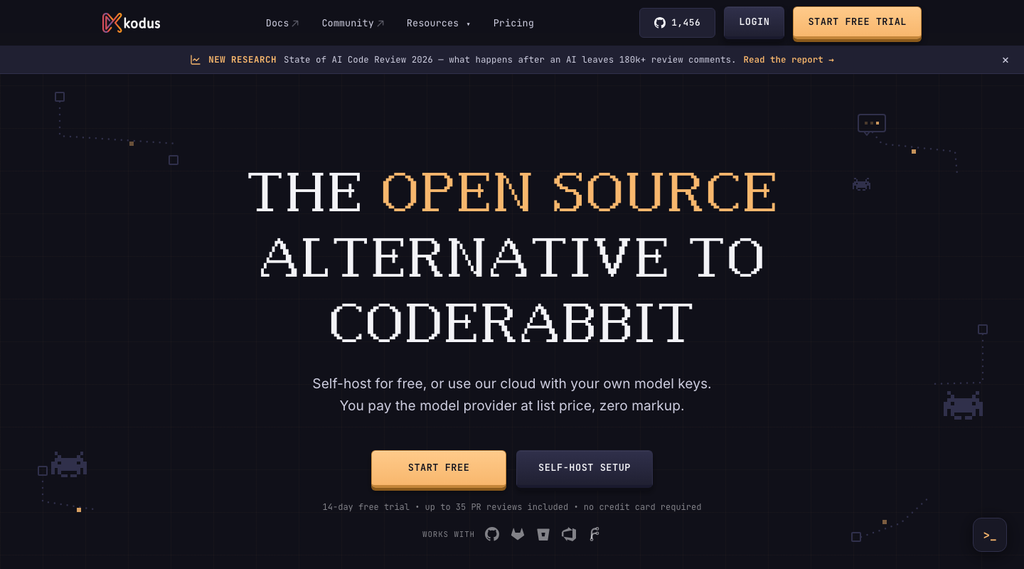
Kodus is an open source AI code review tool that understands your entire repository. Instead of only looking at the changed lines, it builds a full understanding of the whole codebase. This allows it to suggest changes that respect your existing architecture and coding standards.
In a test using real pull requests from projects like Sentry, Cal.com, Grafana, Discourse, and Keycloak, Kodus caught 79% of bugs (30 of 38) against CodeRabbit’s 39% (15 of 38), with the biggest gap on critical bugs specifically: 69% versus 38% (full comparison here).
Pros:
- Repository-level context: It analyzes the entire codebase, not just the diff. This leads to smarter and more contextual suggestions, while also helping understand internal libraries and domain-specific logic.
- Custom rules in natural language: You can define your own review rules using natural language. This makes it easier for any engineer to turn team standards into rules without learning a complex configuration syntax.
- Open source and self-hostable: The core is open source, giving you full transparency and control. You can host it on your own infrastructure for full control over security and compliance.
- Model-agnostic with BYOK: It does not lock you into a single AI provider. You can connect different models (OpenAI, Anthropic, open source models) and use your own API keys. This gives you control over cost and performance.
- Plugins (MCP): You can connect Kody to your team’s tools (Jira, Linear, Notion, internal APIs, docs…) so it understands business rules and takes them into account during review.
- Enterprise-ready governance: SOC 2, SSO, RBAC, and audit logs with analytics come with the Enterprise plan, along with Engineering Metrics (Cockpit), a priority queue for Kody Agents, and dedicated support with personalized onboarding.
Cons:
- The free plan caps rules and plugins: Community stops at 10 Kody Rules and 3 active plugins; going beyond that requires the Teams plan.
- Cockpit and engineering metrics aren’t in the free plan: that aggregated view only comes with Teams.
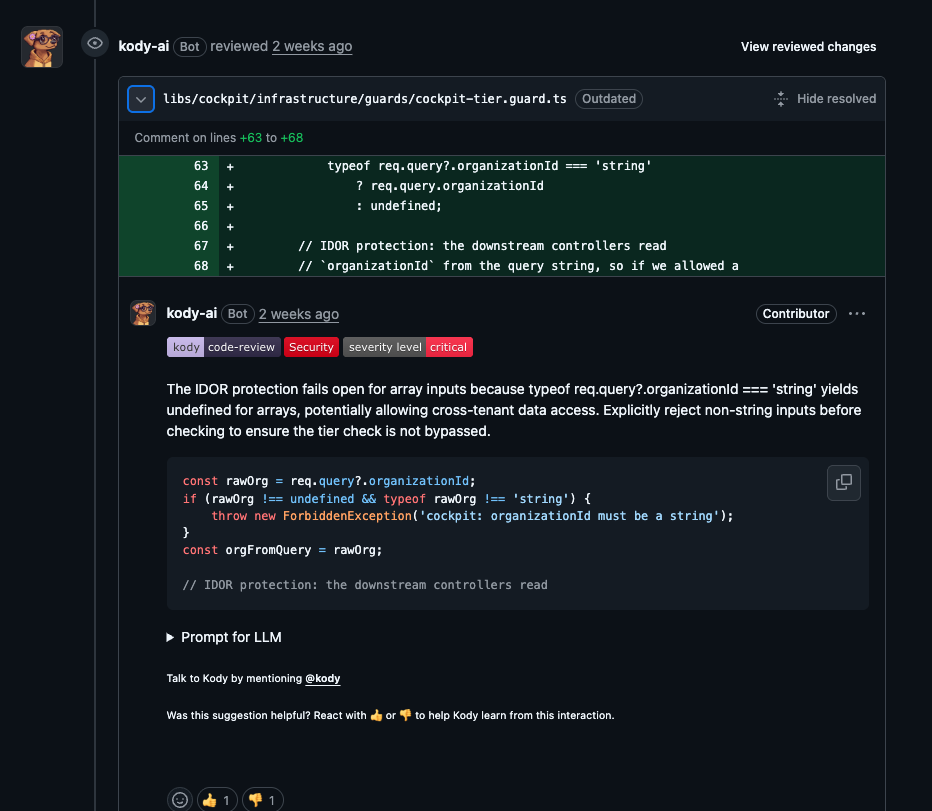
Best for: teams that want to adapt AI review to their own rules, choose their own model stack, and keep the option of self-hosting.
| Plan | Price |
|---|---|
| Community | Free, using your own API Key |
| Teams | US$10/dev/month + tokens (BYOK) |
| Enterprise | Custom pricing |
Repo: https://github.com/kodustech/kodus-ai
2. GitHub Copilot
GitHub Copilot Code Review makes more sense for teams that already work almost entirely inside GitHub. Its biggest advantage is already being inside the environment many teams use all day, not necessarily being the most sophisticated reviewer on the market.
That convenience is both an advantage and a limitation. For some teams, being natively inside GitHub already solves the problem. For others, that closeness to the GitHub ecosystem means less flexibility around infrastructure, deployment, and review process design. See other GitHub Copilot alternatives if that weighs more in your decision.
Pros:
- Native GitHub flow: adoption friction is low.
- Part of the Copilot ecosystem: it naturally connects with chat, coding assistance, and agents.
- Easy to test: many teams already have familiarity or active licenses.
- Custom instructions: you can adapt the behavior a bit per repository.
Cons:
- Very GitHub-centric: it makes less sense for multi-provider teams.
- Less control: model, hosting, and customization are more limited.
- Usage affects cost: the entry price does not tell the whole story when premium usage grows.
| Plan | Price |
|---|---|
| Free | Free |
| Pro | US$10/user/month |
| Pro+ | US$39/user/month |
| Max | US$100/user/month |
Paid tiers include GitHub AI credits; code review is available from Pro up, and usage above the included credits is billed separately.
Best for: GitHub-first teams that want integrated AI review without adding a separate platform.
3. Greptile
Greptile is one of the competitors most similar to CodeRabbit because it stays focused on the core AI review problem, but leans harder into deep repository context. The idea is simple: review gets better when the tool understands the structure of the codebase, not just the changed patch.
That makes the tool especially interesting for teams working on more complex, legacy, or multi-layered systems, where shallow feedback often creates noise instead of real help. See other Greptile alternatives to compare more options with this same profile.
Pros:
- Custom rules: there is real room to shape review behavior.
- Learning from feedback: the tool evolves based on the team’s reactions.
- Self-hosted on enterprise: helps companies with infrastructure requirements.
Cons:
- Usage overage: pricing becomes less simple when review volume grows.
- Narrower scope: it covers review itself well, but doesn’t reach into workflow or security the way broader platforms do.
| Plan | Price |
|---|---|
| Starter | Free (1 seat, 50 credits/month) |
| Pro | US$30/seat/month (50 credits/seat), extra credits at US$1 each |
| Enterprise | Custom pricing, with an option to self-host |
Best for: teams with large or complex codebases that want a reviewer with more contextual understanding.
4. CodeAnt
CodeAnt is an AI code review tool focused on direct suggestions, test generation, and code improvement inside pull requests. It is a simple solution to fit in for teams that want to automate common review tasks.
Pros:
- Easy setup: getting started is fast; you connect it to your Git provider, and it starts reviewing pull requests almost immediately.
- Bug detection: it finds common bugs, performance issues, and line-by-line logic errors.
- Automated test generation: it suggests and generates unit tests for new code, helping teams improve test coverage.
- Clear and actionable feedback: the comments it leaves are usually direct and easy for developers to understand.
Cons:
- Lacks deep repository context: like many tools here, it mainly focuses on the diff, so its suggestions can sometimes miss the broader system architecture.
- Can create noise: without careful configuration, it can generate too many comments about small style issues, distracting from more important feedback.
- Limited rule customization: you have less control to define complex, project-specific review rules compared to more flexible tools.
- On-prem only on Enterprise: the Premium plan stays cloud-only; VPC or on-prem deployment requires the Enterprise plan.
| Plan | Price |
|---|---|
| Trial | 14-day free trial |
| Premium | Custom pricing |
| Enterprise | Custom pricing |
Best for: small and mid-sized teams that want a simple, easy-to-use AI reviewer to find common issues and generate tests without much setup.
5. Qodo
Qodo runs agentic PR review. Before flagging anything, its agents gather context from the wider codebase, dependent repositories, PR history, and linked tickets, then rank findings by severity so blockers surface first. See other Qodo alternatives to compare more agentic review options.
Pros:
- Context gathering before review: agents pull in related repos and ticket history, not just the diff, before producing feedback.
- Fix prompts for coding assistants: for each finding, it generates a prompt with the issue, the affected code range, and a suggested approach you can paste into an AI coding assistant.
- Standards learned from team history: it generates rules from past review decisions instead of shipping a fixed rule set, so enforcement adapts as the team’s own choices accumulate.
- Requirement checks: it compares a pull request against the requirements in its linked ticket and flags partial implementations.
Cons:
- Credit-based pricing: the entry plan caps out at 2,500 credits, about 18 reviews, per month; heavier review volume means buying more credits or moving to Enterprise.
- BYOK only on Enterprise: bringing your own key and choosing the model only shows up documented on the Enterprise page; Pro Team doesn’t have it.
- On-prem only on Enterprise: private cloud and on-prem deployment require the Enterprise plan; Pro Team is cloud only.
| Plan | Price |
|---|---|
| Trial | 14-day free trial, no permanent free plan |
| Pro Team | US$30/month for 2,500 credits (~18 reviews), with more credits available |
| Enterprise | Custom pricing |
Best for: teams that want agentic PR review with deep context gathering and don’t mind credit-based pricing.
6. Bito
Bito takes a more pragmatic path. Instead of competing only on architectural depth or enterprise positioning, it tries to offer a useful AI review layer in Git, IDE, and CLI at a price that is easier to justify for smaller teams.
That makes a lot of sense for teams that want to improve automated review without turning it into a major internal change project. It’s one of the easiest products to adopt without much resistance, even though it’s not the deepest in the category. See other Bito alternatives to compare more entry-level options.
Pros:
- Low entry price: it is one of the more accessible commercial options.
- IDE integration: it works directly in VS Code, JetBrains, and other IDEs, becoming a natural part of the development flow.
Cons:
- Less architectural control: it is not as open or configurable as Kodus.
- Review is a feature, not the core product: Bito’s focus is elsewhere, so it doesn’t manage the PR workflow or enforce policy the way dedicated tools do.
- Context is usually file-based: although it can be trained on a repository, in day-to-day use its context is often limited to the files you have open. This can limit its architectural awareness.
| Plan | Price |
|---|---|
| Team | US$12/seat/month (annual) |
| Professional | US$20/seat/month (annual), self-hosted as a US$5/seat/month add-on |
| Enterprise | Custom pricing, self-hosted included |
Best for: small and mid-sized teams that want a practical upgrade to AI review, with good value for money.
7. Graphite Agent

Graphite is on this list for a simple reason: many teams think they need a better AI reviewer when, in reality, they need a better review system. Graphite is strongest when the bottleneck is in stacked pull requests, merge queues, notification flow, and review throughput.
Its AI reviews matter, but Graphite’s real advantage is operational. It helps teams ship faster by improving how changes are structured, queued, and merged.
Pros:
- Stacked PRs: this is where it stands out most.
- Workflow-oriented product: review, merge queue, and AI live in the same system.
- Helps with throughput: it solves review bottlenecks, not just comments on code.
- Useful AI layer: summaries, reviews, and automations add real value.
Cons:
- Very GitHub-centered: it was not designed for broad support across multiple providers.
- Best when the team buys into the whole workflow: if the team does not want to adopt that model, the value drops.
| Plan | Price |
|---|---|
| Hobby | Free, limited AI reviews |
| Starter | US$20/user/month (annual) |
| Team | US$40/user/month (annual), unlimited AI reviews |
Best for: GitHub-first teams that want to increase review throughput and adopt stacked PRs.
8. Snyk Code
Snyk Code is on this list because many teams looking for a CodeRabbit alternative are really looking for better code analysis, especially from a security point of view. It’s the best choice when the main problem is vulnerability detection, not general review quality, even without replacing a dedicated review platform.
In practice, Snyk Code makes more sense when security is at the center of the decision. It brings semantic analysis, data flow reasoning, and workflows that are more AppSec-oriented than most general-purpose AI reviewers. See other security-focused alternatives if that’s your main criterion.
Pros:
- Security-first analysis: goes deeper into vulnerabilities and misuse patterns.
- IDE, repository, and pipeline coverage: works across the whole developer workflow.
- Less noise than older scanners: semantic analysis helps with practical usefulness.
- Fits AppSec teams: especially for platform and security teams.
Cons:
- Not a 1:1 review replacement: at its core, it is still a security analysis product.
- Less flexible as a review system: it was not designed to become your main customizable reviewer.
| Plan | Price |
|---|---|
| Free | Free, 100 tests/month |
| Team | US$25/month flat, up to 10 developers, 1,000 tests/month |
| Enterprise | Credit-based pricing |
Best for: teams that want to put security analysis at the center of the review process.
9. SonarQube
SonarQube is not trying to be a conversational AI reviewer in the same way CodeRabbit is. Its strength is in systematic static analysis, quality gates, security checks, and quality governance. For many larger organizations, that is more valuable than a PR comment-oriented AI reviewer.
If your engineering organization already thinks in terms of quality programs, maintainability, profiles, and formal gates before merge, SonarQube may make more sense than a tool centered on AI review conversations. See other governance and code-quality alternatives to compare.
Pros:
- Quality gates as the product’s core: quality gates and static analysis are what SonarQube has always done, not a feature bolted on later.
- Broad language support: works well in larger engineering estates.
Cons:
- Less conversational: it does not feel like an AI reviewer inside the PR discussion.
- A different kind of customization: it is powerful, but not in the same sense as natural language rules and an adaptable workflow.
| Plan | Price |
|---|---|
| Developers | Free, up to 50k private lines of code |
| Cloud Team | US$32/month, up to 100k private lines of code |
| Enterprise / Data Center | Custom pricing |
Best for: organizations more concerned with quality gates, static analysis, and governance than AI-based review conversations.
Self-hosted alternatives to CodeRabbit
Not every tool on this list lets you run the review on your own infrastructure, and among those that do, the level of access changes a lot by plan:
| Tool | Self-hosted available on | Model running in your network | Air-gapped deploy | Self-managed Git |
|---|---|---|---|---|
| Kodus | Any plan, including the free Community | vLLM, Ollama, TGI, LiteLLM | Possible, with manual setup | GHES, GitLab Self-Managed, Bitbucket DC |
| SonarQube | Developers tier (free, up to 50k private LOC), Enterprise, and Data Center | Ollama, vLLM, LiteLLM | With your own LLM | GitHub, GitLab, Bitbucket DC |
| Bito | Paid add-on on Professional (+US$5/seat/month); included on Enterprise | Not documented | Not documented | Not documented |
| Greptile | Enterprise only, by quote | Custom base URL | Documented | GitHub, GitLab, Bitbucket |
| Qodo | Enterprise only, as private cloud or on-prem | Not documented | Enterprise | GitHub, GitLab, Bitbucket, Gerrit |
| CodeAnt | Enterprise only (VPC/on-prem) | Not documented | Not documented | Not documented |
What are the open source alternatives to CodeRabbit?
If you’re looking for an open source AI code review alternative to CodeRabbit, here are five options that help narrow it down.
| Tool | License | What it is | Repo | Note |
|---|---|---|---|---|
| Kodus | AGPLv3 (enterprise modules under a separate license) | Full AI code review, with repository context | Repo | The only one on this list that’s open source and built as a general-purpose AI reviewer |
| SonarQube Community Edition | Open source (LGPL) | Static analysis and quality gates | Repo | Not conversational; focused on governance, not generative AI |
| Qodo PR-Agent | Open source (MIT) | AI PR reviewer (/review, /improve, /describe) | Repo | Community-maintained legacy project; the repo itself says it’s distinct from Qodo’s current commercial offering, not “the engine behind” Qodo Merge |
| Semgrep (Community Edition) | Open source (LGPL-2.1) | Static security analysis | Repo | Analyzes per function/file; cross-file context is in the paid product (Semgrep AppSec Platform) |
| reviewdog | Open source (MIT) | Posts any linter’s output as inline PR comments | Repo | Lint automation, no AI model behind it; for teams that want to build their own review pipeline |
How to choose the right CodeRabbit alternative
Finding the right tool means identifying the specific problem you are trying to solve. Here is a simple way to decide.
If you need deep code context and custom rules
Your main problem is that reviews miss the broader context. You need a tool that understands your entire repository and lets you define what a “good” change means for your team. Kodus does that. Its repository-level context and natural language rules give you granular control that other tools do not have.
If security is the main concern
CodeAnt and Snyk Code make more sense when the decision is truly tied to security.
If your team struggles with lack of context in review
Kodus and Greptile are the best options when the biggest frustration is shallow feedback. Both go beyond diff-only review, but Kodus offers more control over rules and infrastructure, while Greptile remains more focused on review quality itself.
FAQ
Is Kodus a good alternative to CodeRabbit?
Yes, Kodus is a great alternative, especially for teams that feel CodeRabbit reviews do not have deep context. If your main frustration is getting suggestions that do not align with your existing architecture or internal libraries, Kodus’s repository-level context directly solves that problem. It also makes more sense if you need more control through custom rules, self-hosting, or an open source platform.
What is the cheapest CodeRabbit alternative?
For teams with a tight budget, open source tools are usually the most cost-effective option. You can self-host the open source versions of Kodus or SonarQube with no license cost, using your own API Key when needed.
Can I migrate from CodeRabbit to Kodus?
Yes. The migration process is simple. Since Kodus integrates with your Git provider (GitHub, GitLab, Bitbucket), you usually install the Kodus app, configure your repositories, and then uninstall the CodeRabbit app. You can define your initial set of review rules in a configuration file inside the repository, allowing you to get started quickly.
What if my biggest problem is review noise, not missed bugs?
If noise is the real problem, the most important thing is to look at tools that give you more control over rules and context. Kodus and Greptile are the best options in this scenario because they were designed to make review more contextual, which usually matters more than simply generating more comments.
Are there self-hosted alternatives to CodeRabbit?
Yes. Self-hosted alternatives to CodeRabbit include Kodus, SonarQube, Greptile, Qodo, Bito, and CodeAnt, but deployment options and costs vary a lot.
Kodus lets you run AI code review on your own infrastructure, including on the free Community plan, with support for local models via Ollama, vLLM, and LiteLLM. Tools like Greptile, Qodo, and CodeAnt offer private or on-premises deployment mainly aimed at Enterprise customers.
Are there open source alternatives to CodeRabbit?
Yes. Open source alternatives to CodeRabbit exist, but they don’t all work the same way. Kodus and Qodo PR-Agent are options for teams looking for AI code review directly in pull requests. Kodus supports multiple Git platforms, custom rules, and self-hosting, while PR-Agent lets you automate reviews using your own AI models.
Other tools, like SonarQube Community Edition and Semgrep, focus on static analysis, quality, and security of the code. reviewdog, meanwhile, lets you plug linters into pull requests and post comments directly on the changed lines.
If you’re looking for an alternative closer to CodeRabbit, Kodus and PR-Agent are the place to start. For static analysis and security checks, SonarQube and Semgrep can round out the review process.
Final verdict
Choosing a code review tool is not about finding the one with the most features. It is about finding the one that removes the most problems from your team’s specific workflow.
If you are a small team looking for simple AI suggestions to find common errors, tools like CodeAnt fit well. If your main concern is security, Snyk is the right choice. And if your team is deeply embedded in the GitHub ecosystem, GitHub Copilot is a natural extension.
But for teams that are reaching the limits of diff-focused AI, the choice becomes clearer. When you need reviews that understand the architectural consequences of a change, apply your team’s specific coding standards, and give you full control over your data and toolchain, a platform like Kodus makes more sense. Its combination of repository-level context, natural language customization, and open source, self-hostable architecture directly addresses the reasons teams are using AI in the review process.