How to avoid technical debt in day-to-day work
 Edvaldo Freitas

Technical debt is part of the game in software development. Ignoring it, however, turns a calculated shortcut into a bottleneck that suffocates productivity, drives up costs, and stalls the ability to innovate. The goal is not to eliminate debt entirely, but to manage it intelligently, without sacrificing the delivery speed the business requires.
This guide shows the strategies and tradeoffs for managing technical debt and keeping it from getting out of control, while maintaining a balance between speed and quality in development.
What is technical debt and why does it happen?
In the development process, the decision to prioritize delivery speed over code quality or architecture creates a debt that will need to be paid in the future. When that choice is made repeatedly, whether because of deadline pressure or lack of alignment, it is a sign that the project’s processes and priorities need to be reviewed.
The interest metaphor and the cost of technical debt
The concept, coined by Ward Cunningham, compares poor solutions in code to financial debt. Failing to address a design or implementation problem today means paying “interest” tomorrow. That interest shows up as extra time spent on maintenance, fixing bugs that could have been avoided, and the growing difficulty of adding new features. As with financial debt, the longer it takes to pay down the principal, the more interest accumulates, until maintenance costs outweigh the value generated by the system.
Types of technical debt: intentional, accidental, and domain-specific
Not all technical debt is the same. Understanding where it comes from is the first step to managing it.
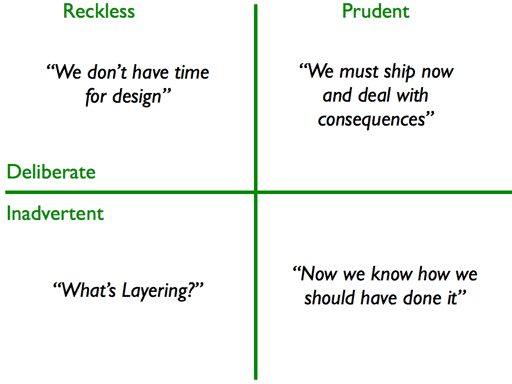
- Intentional debt (or deliberate debt): A conscious choice to speed up delivery, such as launching an MVP. The team knows it is taking a shortcut and, ideally, plans to pay off that debt at the right time. The danger is forgetting to follow through on the repayment plan.
- Accidental debt (or unintentional debt): It comes from lack of knowledge, an unforeseen design mistake, or product evolution that makes an old decision obsolete. It is the kind of debt that builds up quietly because of lack of visibility or experience.
- Domain-specific debt: Debt does not live only in the code. It can show up in different areas:
- Code: Duplication, lack of standards, high cyclomatic complexity.
- Design and Architecture: Excessive coupling, violation of principles such as SOLID, architectural decisions that do not scale.
- Testing: Low coverage, flaky tests, or lack of integration and E2E tests.
- Infrastructure and DevOps: Manual and slow deployment processes, lack of monitoring, inconsistent environments.
- Requirements: Ambiguity or constant changes in requirements that lead to patched-together implementations.
The business impact
Technical debt is a business problem with concrete costs. Market reports from McKinsey and Stripe indicate that developers may spend 30% to 40% of their time dealing with the effects of technical debt, such as maintaining complex code and fixing bugs. That time could be invested in innovation and delivering value.
The impact shows up in:
- Loss of productivity: Teams become slower at delivering new features because they have to navigate fragile and complex code.
- Higher costs: More development time means higher costs, both in salaries and opportunity cost.
- Limited scalability: Short-term architectural solutions prevent the system from growing to meet new market demands.
- Risk to innovation: The inability to experiment and iterate quickly leaves the company vulnerable to competitors.
Identifying signs of technical debt in your projects
Recognizing the symptoms of technical debt is what allows you to act before the problems become serious.
Recurring delivery delays
One of the clearest indicators is frequent delays. When deadlines are repeatedly missed, it may be a sign that the code has become too complex or that the team is spending more time fixing unexpected bugs than building. These delays affect customer satisfaction, the schedule, and project costs.
Complex code that is hard to maintain
When code becomes hard to understand and modify, it is a clear symptom of problems. Complexity may be the result of shortcuts, lack of abstraction, or non-standard structures. As complexity increases, the likelihood of introducing new errors when modifying existing code also goes up.
Lack of documentation or outdated documentation
Missing or outdated documentation makes it harder to understand the system, especially for new team members. Decisions may be made based on old information, resulting in rework and mistakes. It is a barrier to maintaining and evolving the software.
Insufficient or ineffective tests
The absence of a reliable test suite is a dangerous indicator. Inadequate tests allow problems to go unnoticed until they blow up in production. When tests are insufficient or fragile, the team loses confidence in making changes and refactoring, which perpetuates poor code quality.
How to manage and avoid technical debt
Reducing technical debt requires a combination of good practices, process discipline, and business decisions.
Invest in automated tests and code standardization
Automated tests are the safety net that allows you to refactor and evolve code with confidence.
- Early failure detection: A comprehensive test suite (unit, integration, E2E) catches regressions before they reach production.
- Quality analysis tools: Static analysis tools (linters, formatters) help enforce standards and automatically identify problems such as complexity and duplication.
- Coding standards: Defining and following a style guide and design patterns ensures consistency, making the code more predictable and easier for the whole team to understand.
Do code reviews regularly to ensure quality
Code review is an essential process for software health. It helps find bugs, but it also ensures that code is well-structured, cohesive, and sustainable.
Points that make the code review process effective:
- Clear and consistent code: The review should ensure that the code follows the standards defined by the team and is easy to understand. Confusing code today becomes a maintenance problem tomorrow.
- Validation of logic and architecture: Analyze whether the implementation solves the problem correctly and whether it is aligned with the system architecture.
- Adequate test coverage: Make sure the changes are covered by tests that validate the expected behavior and edge cases.
- Smaller and more frequent reviews: Small, focused pull requests are easier and faster to review, reducing cognitive load and the chance that errors will slip through unnoticed.
- Agility in the process: PRs sitting idle for too long become a bottleneck. A continuous review flow keeps the team productive and reduces rebase and merge rework.
Add pair programming and mob programming to your routine
Working together on the same code is one of the most effective ways to prevent technical debt before it is even written.
- Reducing errors during development: Having a second person reviewing the code in real time improves solution quality from the start.
- Knowledge sharing: Knowledge about the system spreads across the team organically, reducing dependency on specialists and information silos.
Refactor constantly in small parts
Refactoring is a continuous code cleanup practice, not a separate project.
- When to refactor: Take the opportunity to refactor whenever you are working on part of the code. Signs such as duplicated code, long functions, confusing variable names, or excessive complexity are ideal candidates.
- The role of automated tests: A reliable test suite is a prerequisite for safe refactoring. Run the tests before and after refactoring to make sure the external behavior of the code has not changed.
Technical debt as a strategic decision: MVPs and planning
In scenarios such as validating a market hypothesis with an MVP, taking on intentional technical debt can be the right decision. The key is for that decision to be explicit and accompanied by a repayment plan. Document the debt, estimate the cost to pay it off, and schedule the work in the backlog, treating it with the same seriousness as a new feature.
Prioritizing technical debt repayment: how to decide what to tackle first
With a list of identified debts, prioritization is everything. A simple cost-benefit matrix can help:
- High impact, low effort: These are the quick wins. Prioritize them to generate momentum and immediate results.
- High impact, high effort: They require planning and should be treated as projects, with dedicated time and resource allocation.
- Low impact, low effort: They can be resolved during lighter periods or between larger tasks.
- Low impact, high effort: They generally should be avoided unless they become a blocker for other initiatives.
Evaluate impact in terms of how often that area of the code is modified, the risk it represents (security, stability), and the friction it creates for developers.
Communicating technical debt to non-technical stakeholders
To get the time and resources to pay down debt, you need to translate the technical problem into business language. Instead of talking about “coupling” or “cyclomatic complexity,” use terms people outside tech understand:
- “We need two weeks to refactor this module. This will reduce the delivery time for new features by 25% next quarter.”
- “Ignoring this security vulnerability exposes us to regulatory risk that could result in fines.”
- “The instability of this service is causing a 10% drop in the conversion rate of new users.”
Metrics and tools to track technical debt
Measuring technical debt helps make it visible and track progress.
Flow metrics: lead time, cycle time, deployment frequency
Flow metrics (DORA metrics) do not measure debt directly, but they are great indicators of project health. A growing cycle time or a falling deployment frequency can be symptoms that technical debt is making the development process slower and riskier.
Specific code quality and debt metrics
- Technical debt index: Tools such as SonarQube calculate an estimated time to fix the issues identified in the code, translating debt into a “days of effort” metric.
- Code coverage: Low coverage does not guarantee test quality, but it is a clear sign of risk.
- Bug density: Tracking the number of bugs per feature or per period of time may indicate problematic areas in the codebase.
- Static analysis: Static analysis tools automatically identify code smells, complexity, duplication, and security vulnerabilities.
Specific challenges and technical debt in different contexts
Technical debt shows up in different ways depending on the architecture and the domain.
In legacy systems: refactor or rewrite with the Strangler Fig Pattern
In older systems, the debt can be so large that refactoring seems unfeasible. The decision between refactoring and rewriting is complex. A full rewrite is risky and often fails. A safer approach is the Strangler Fig Pattern, where the new system is built gradually around the old one, replacing functionality piece by piece until the legacy system can be turned off.
In microservices and distributed architectures
Microservices introduce new forms of debt, such as improper coupling between services, data inconsistency, and enormous operational complexity (observability, deployment, distributed testing). The debt here is not only in the code of one service, but in the interactions between them.
In artificial intelligence and machine learning projects (MLOps debt)
Debt in ML projects goes beyond code. There is data debt (quality, versioning), model debt (performance degradation over time), and integration debt (complexity in putting models into production and monitoring them). MLOps management is the only way to control this type of debt.
Security and compliance technical debt
Outdated dependencies, lack of input sanitization, or incorrect infrastructure configurations are debts that can turn into security vulnerabilities. In the context of regulations such as LGPD and GDPR, this debt also represents a serious legal and financial risk.
The role of leadership and culture in managing technical debt
Tools and processes help, but organizational culture is what decides the game.
Create a culture of quality and sustainability
Technical leadership needs to create an environment where quality is everyone’s responsibility, not a final stage in the process. That means allocating time for refactoring, investing in training, and protecting the team from pressure to deliver at any cost. A culture of learning and autonomy allows teams to make the best technical decisions.
The impact of technical debt on talent retention
Good developers want to build quality products and solve interesting problems, not spend all day fighting fragile and complex code. An environment with high technical debt creates frustration, burnout, and high turnover. Investing in reducing technical debt is also a strategy for retaining talent.
Building sustainable software
Managing technical debt is an act of balance. It requires discipline, clear communication with the business, and a culture that values sustainability. By treating debt not as a failure, but as a variable to be managed, teams can continue delivering value quickly without compromising the future of the product.