Best Bitbucket AI Code Review Tools in 2026: 9 Options Compared
 Edvaldo Freitas

TL;DR
- Of the nine tools we compare here, only four confirm real support for both Bitbucket Cloud and Bitbucket Data Center at the same time: Kodus, Qodo, CodeAnt AI, and SonarQube.
- Kodus is the only one of the four that also offers directory-level rules, BYOK, and self-hosted deployment, with its own webhook events for Data Center.
- The other five cover more specific scenarios: Atlassian Rovo for teams already living in Jira and Bitbucket, CodeRabbit and Bito for review across Bitbucket Cloud and other platforms, Codacy and Snyk Code for security and code quality.
More code arrives ready to review every week, and much of it was already written by an AI agent. This increases PR volume without increasing the time the team has to review it.
For teams using Bitbucket, AI code review needs to go beyond commenting on the diff. The tool needs to understand the repository context, follow the team’s standards, and avoid repeating the same feedback on every new commit.
The difference between the tools is not just that they use AI. It is how each one handles context, team rules, security, review noise, and cost. Some make more sense for teams that already work in the Atlassian ecosystem; others, for teams that need more control, self-hosted deployment, BYOK, or cross-repository analysis.
For teams using Bitbucket, that choice also depends on how the team hosts it: Cloud or Data Center.
In this comparison, we’ll look at nine options:
- Kodus
- Atlassian Rovo
- CodeRabbit
- Qodo
- Bito
- CodeAnt AI
- Codacy
- Snyk Code
- SonarQube
Updated: October 9, 2026
AI code review tools for Bitbucket compared
| Tool | Who is it for? | Main differentiators |
|---|---|---|
| Kodus | Teams that want to control how the reviewer behaves in the PR | BYOK, custom rules, learning from feedback, business logic validation, and self-hosted deployment |
| Atlassian Rovo | Teams that use Bitbucket and Jira as their main workflow | Native Atlassian integration, ticket context, and lower adoption effort inside the ecosystem |
| CodeRabbit | Teams with repositories in more than one Git provider | PR review, chat, IDE, CLI, autofix, integrations with Jira and Linear |
| Qodo | Teams that need governance and cross-repository context | Context Engine, organization rules, cross-repo analysis, and standards-based review |
| Bito | Teams that want quick adoption with assistance in the development flow | Automatic or manual review, AST, embeddings, symbol indexing, and filters |
| CodeAnt AI | Teams that combine review with security and quality | AI review, SAST, secrets, SCA, IaC, quality gates, CLI, and IDE |
| Codacy | Teams that want to standardize code quality across multiple teams | Per-repository quality grade, coverage and duplication tracking over time, AI Reviewer with PR and Jira context |
| Snyk Code | Teams that prioritize security (SAST) in the PR flow | Data-flow analysis with DeepCode AI, severity-prioritized comments, and automatic fix PRs |
| SonarQube | Teams that already use SonarQube and want to add an AI layer | Quality gates focused on new code (Clean as You Code), AI review added to static analysis, support for many languages |
Bitbucket Cloud vs Bitbucket Data Center: what changes for AI review
Bitbucket Cloud is hosted by Atlassian itself (SaaS): you access it via browser or API, you don’t have server access, and Atlassian handles updates, backup, and infrastructure. It’s billed per user/month (Free, Standard at $3.65, Premium at $7.25).
Bitbucket Data Center is self-hosted (on-premise or in your own cloud), runs in a cluster, and the team itself controls infrastructure, network, and data. It’s the product aimed at large companies with compliance or high-availability requirements.
We split the tools by level of integration here to help you quickly see which ones cover Cloud and Data Center, and which stop at Cloud.
| Tool | Bitbucket Cloud | Bitbucket Data Center |
|---|---|---|
| Kodus | Yes | Yes, with its own webhook events for Data Center (pr:opened, pr:modified, among others) |
| Atlassian Rovo | Yes, native | Not applicable. It’s a feature of Bitbucket Cloud and paid plans, not a separate product for Data Center |
| CodeRabbit | Yes | No |
| Qodo | Yes | Yes |
| Bito | Yes | Uncertain. The Atlassian Marketplace lists the integration as Cloud only |
| CodeAnt AI | Yes | Yes, with self-hosted setup via SSO |
| Codacy | Yes, on the self-serve plan | Only via Codacy Self-hosted, which isn’t self-service and doesn’t appear in public plans |
| Snyk Code | Yes, via native app | There’s a separate Snyk app for Data Center, but it hasn’t been updated since 2019 |
| SonarQube | Yes | Yes, as its own edition (Data Center Edition), priced by lines of code |
What should you compare in an AI code review tool?
When choosing an AI code review tool for Bitbucket, the most important thing is understanding how it works inside the pull request, not just the general promise of improving quality.
| Point | Why it matters |
|---|---|
| Context | If the tool only looks at the diff, it can catch simple errors, but it misses things that depend on the rest of the repository: existing patterns, internal rules, architecture decisions |
| Control | The tool needs to follow the team’s standards, not review every PR as if every repository were the same. This includes rules about logging, error handling, allowed libraries, testing style, contracts between services, and exceptions by directory. Without that control, feedback tends to become generic suggestions |
| Noise | When the tool comments too much or repeats the same feedback on every new commit, the team stops taking the suggestions seriously. Incremental review, suggestion limits, severity filters, deduplication, and ignoring by file or folder help avoid this |
| Security | If the tool will analyze private code, the team needs to understand how that code is processed, whether it can be used to train a model, how keys are protected, and whether there’s an option to run it on its own infrastructure |
| Pricing | In teams with many PRs, the billing model makes a big difference: per developer, per credit, per review, or per token |
Main AI code review tools for Bitbucket
1. Kodus
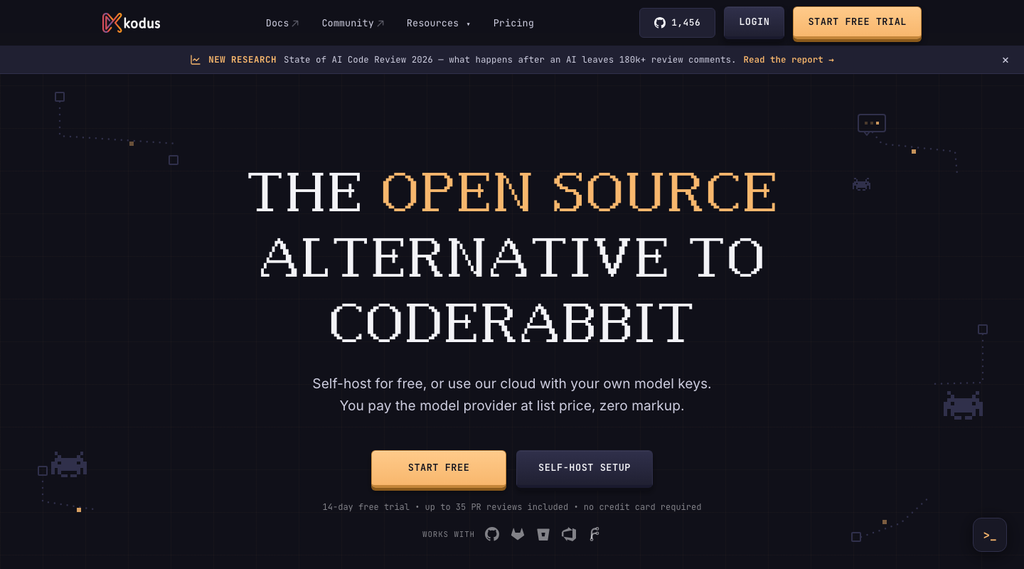
Kodus is an open-source AI code review tool for teams that want to control how review happens in the pull request.
It works with Bitbucket and other Git providers (GitHub, GitLab, Azure DevOps), reviewing PRs automatically or on demand. The review can run when the PR is opened, when a new commit is pushed, or when someone calls the review manually with a command. Kodus also remembers the last commit analyzed, so it can keep the review incremental instead of reprocessing everything on every update.
The most important point is that Kodus does not treat every repository the same way. Settings can exist at the global, repository, or directory level. In monorepos, this changes the result a lot, because a rule for apps/api might not make sense in packages/ui or infra/terraform.
Best for: teams that want AI code review with repository context, custom internal rules, BYOK, self-hosting, and more control over cost, model, and infrastructure.
| Feature | How it helps the team |
|---|---|
| Kody Rules | Guide the review with team-specific standards, covering architecture, security, tests, performance, product domain, and internal conventions |
| Context-based scope | Teams with a monorepo can apply rules by folder, so a billing folder can have different requirements than a frontend one, instead of treating the whole repository the same way |
| BYOK and model choice | Connects your own AI provider key (OpenAI, Anthropic, Google Gemini, Vertex AI, Novita, or any OpenAI-compatible endpoint), with more control over cost, model, latency, and data policy |
| Self-hosting and open source | Companies with privacy, compliance, or data residency requirements can run the review pipeline inside their own infrastructure |
| Business logic validation | Brings context from Jira or Linear tickets, or a pasted spec, to validate business logic, not just isolated code |
| Learning from feedback | Uses thumbs-up reactions and implemented suggestions to build team preference and filter out suggestions similar to ones already rejected |
Kodus stands out by treating AI code review as a configurable layer of the process, not just as an automatic reviewer.
The team can define its own rules, use repository context, and have more control over the model used in reviews.
For teams using Bitbucket, this becomes clearer in three scenarios.
The first is monorepo. When each folder has a stack, an owner, or a different standard, a generic review tends to make more mistakes.
Directory-level rules help apply different criteria to each part of the repository.
The second is privacy. With self-hosted deployment and BYOK, the team has more control over where the code is processed, which model is used, and how access keys are managed.
The third is cost. With BYOK, the team can choose different models for each type of review: stronger models for complex PRs, cheaper options for simple changes, or its own endpoints when it needs more infrastructure control.
Kodus makes more sense for teams that want to adapt review to the way engineering already works, with their own rules, repository context, and continuous adjustments to the process.
Repo: https://github.com/kodustech/kodus-ai
2. Atlassian Rovo

Rovo is the AI layer that Atlassian built directly into Bitbucket, included in the Standard, Premium, and Enterprise plans. It pulls context from Jira and Confluence to help with tasks that would normally require opening another tab: summarizing a PR, explaining what a piece of code does, pointing out why a build failed, helping someone new understand a repository, and showing the linked Jira ticket’s status right on the PR screen.
Rovo Dev is a separate product under that same umbrella: an agent that writes and reviews code, billed separately by credit, outside Bitbucket’s standard plans.
For a team that already lives inside Jira and Bitbucket, the advantage is not having to evaluate, buy, and integrate another tool: the AI is already where the team works.
Best for: teams that already use Bitbucket and Jira day to day and prefer to use what’s already included instead of adding another vendor.
| Feature | How this helps the review |
|---|---|
| Native Bitbucket integration | Less setup for teams that already use Atlassian |
| Jira context | Helps compare the code change against the ticket’s scope and criteria |
| Flow inside Atlassian | Reduces tool switching for teams already working in that environment |
| Simpler adoption | Good for teams that want to start without adding an external platform |
| Consistent experience | The team keeps using the same Bitbucket entry points |
3. CodeRabbit
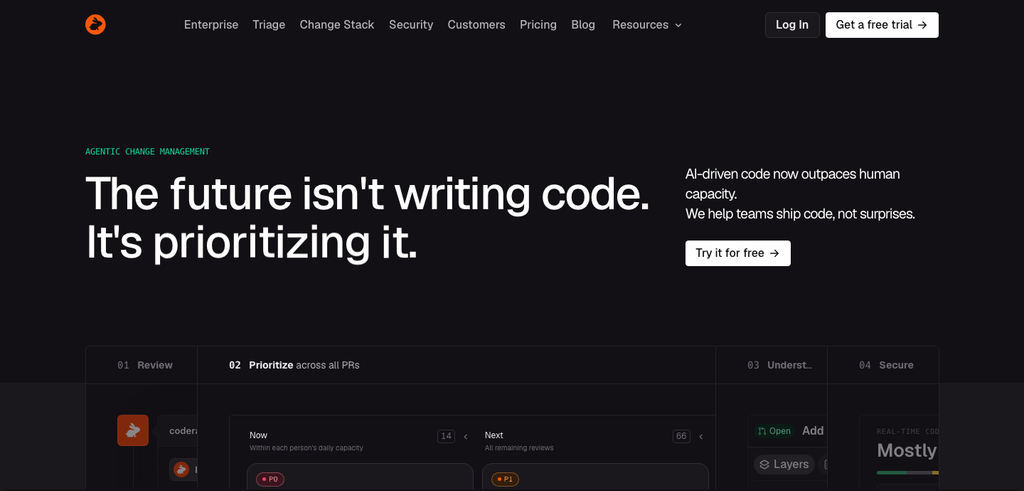
CodeRabbit supports Bitbucket Cloud, alongside GitHub and GitLab, which are its main platforms. It doesn’t support Bitbucket Data Center. On Bitbucket, CodeRabbit does automatic PR review, comments and suggestions, and chat through @coderabbitai in PR comments.
Best for: teams that want a single AI reviewer across GitHub, GitLab, and Bitbucket Cloud, with simple setup.
| Feature | How this helps the review |
|---|---|
| Support for several Git providers | Helps companies with repositories spread across different platforms |
| Automatic PR review | Analyzes changes and comments in the pull request flow |
PR chat (@coderabbitai) | The dev can ask for an explanation or adjustment to a suggestion |
| IDE and CLI | Some feedback can arrive before the PR |
| Jira and Linear integration | Connects the review to the task’s context |
| Autofix | Helps apply fixes in some cases |
| Pre-merge checks | Can add a validation layer before approval |
| Committable suggestions on Bitbucket Cloud | Come as applicable blocks right in the Bitbucket UI, without needing the Autofix command |
The point of attention is customization. In teams with very specific internal rules, the review can generate more noise and may not always stay aligned with how the team reviews code.
4. Qodo
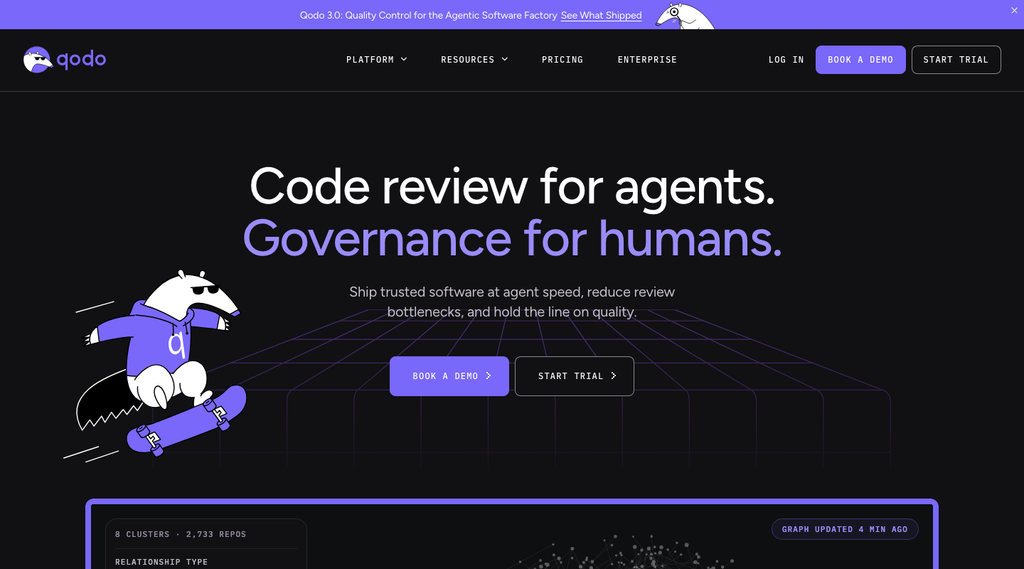
Qodo is an option more focused on teams that need broad context and code governance. It works with PR review, organizational rules, and analysis that can consider more than one repository, on GitHub, GitLab, Azure DevOps, and Bitbucket (Cloud and Data Center).
The most relevant feature is the Context Engine, also called Wisdom Base in the product’s navigation. It uses code context, PR history, and organization standards to generate suggestions more connected to the system.
Best for: mid-sized companies that want to standardize code review across multiple teams and repositories, including ones on Bitbucket Data Center.
| Feature | How this helps the review |
|---|---|
| Context Engine | Uses repository context and history to evaluate changes |
| Review Standards | Centralizes the standards that should be applied in reviews |
| Rule Miner | Helps extract rules from PR history |
| Evidence in comments | Helps the dev understand the source of the suggestion |
The point of attention is customization, especially for teams that need to adapt review to very specific rules by service, repository, or directory.
5. Bito

Bito is an option for teams that want AI code review along with developer support in their day-to-day work. It works with Bitbucket, GitHub, and GitLab, with automatic or manual reviews.
The tool uses code structure analysis, embeddings, and symbol indexing to better understand functions, classes, dependencies, and relationships between files.
Best for: teams that want to start using AI in the development flow and add automatic review to pull requests.
| Feature | How this helps the review |
|---|---|
| Automatic and manual review | The team chooses when AI should analyze the PR |
| AST and embeddings | Helps understand the structure and relationship between parts of the code |
| Symbol indexing | Improves search for functions, classes, and dependencies |
| Incremental review | Analyzes only new changes after additional commits |
| Custom rules | Lets the team define guidelines for review |
| Filters by file, folder, and branch | Reduces analysis in areas the team doesn’t want reviewed |
6. CodeAnt AI
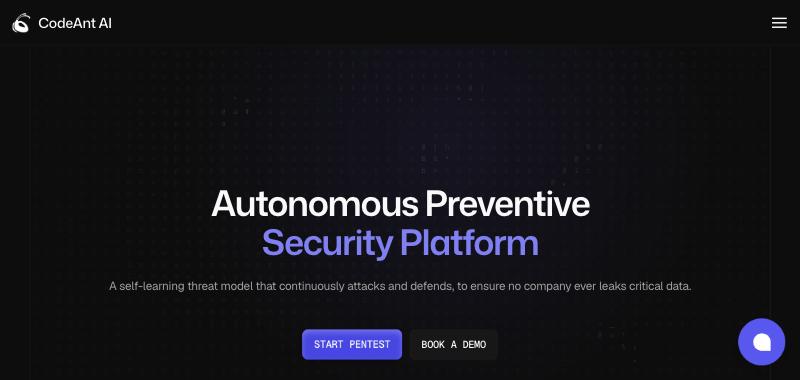
CodeAnt AI combines AI code review with security, quality, and CI/CD checks, and supports Bitbucket alongside GitHub, GitLab, and Azure DevOps, including self-hosted Bitbucket Data Center via SSO. Besides reviewing PRs, the tool also covers areas like SAST, secrets, dependencies, and infrastructure as code.
Best for: teams that want to use review as a validation step before merge, especially when security is also part of the process.
| Feature | How this helps the review |
|---|---|
| AI review in the PR | Analyzes changes and suggests fixes |
| SAST | Detects vulnerabilities in the code |
| Secrets detection | Helps prevent exposed tokens and credentials |
| SCA | Analyzes dependency risk |
| IaC scanning | Analyzes infrastructure as code |
| Quality gates | Can block changes based on defined criteria |
| CLI and IDE | Allows analysis before the PR or inside CI |
7. Codacy
Codacy combines AI code review with a more traditional code quality and security layer: static analysis, test coverage, and quality policies.
Best for: teams that want to standardize quality across multiple teams on Bitbucket Cloud, combining static analysis, security, coverage, and AI review in one platform.
| Feature | How this helps the review |
|---|---|
| Per-repository quality grade | Gives a quick view (A-F grade) of which repository needs attention, useful when the team has many repositories |
| Coverage and duplication tracking over time | Shows whether quality is improving or getting worse with each PR, not just the current state |
| AI Reviewer with context | Uses PR metadata, code context, Jira information, and Codacy’s own findings, connecting the analysis to the engineering workflow |
| Custom instructions by file | Lets you adapt the review to the team’s standard, with specific instructions by file in the repository |
8. Snyk Code
Snyk Code is Snyk’s SAST tool, built to find vulnerabilities in proprietary code before it reaches production. It uses the DeepCode AI engine to analyze data flow, insecure API use, null dereference, race conditions, hardcoded secrets, and other security issues.
Best for: teams that want to strengthen security in the PR flow, especially companies that already use Snyk for dependencies, containers, or IaC.
| Feature | How this helps the review |
|---|---|
| DeepCode AI engine with data-flow analysis | Tracks how dangerous data moves between functions and files, not just an isolated code pattern |
| Severity-prioritized inline comments | Focuses the team’s attention on the most critical findings first, instead of a huge list of warnings |
| Automatic fix PR (Snyk Agent Fix) | Generates a fix PR for the vulnerabilities found |
| Same dashboard as Snyk’s other layers | Unifies code findings with dependency, container, and IaC findings, if the company already uses Snyk for those |
9. SonarQube

SonarQube is the market standard in enterprise SAST, and has a generative AI layer for review beyond traditional static analysis.
Best for: teams that already use or are considering SonarQube for quality gates and static analysis, and want to add AI review from the same vendor.
| Feature | How this helps the review |
|---|---|
| Quality gates focused on new code | Blocks the merge based on quality criteria for changed code only (Clean as You Code), without requiring legacy technical debt to be fixed all at once |
| Test coverage imported from the pipeline | Doesn’t run the tests itself, it imports the report from your runner (JaCoCo, nyc, coverage.py) and applies the gate on top of that |
| AI review added to static analysis | Compares AI-generated suggestions with the deterministic findings from the SAST engine, reducing false positives |
| Support for many languages with the same engine | Useful for a company with a polyglot stack that wants to review everything in one tool |
Pricing comparison for AI code review tools for Bitbucket
| Tool | Price |
|---|---|
| Kodus | Community free; Teams starting at $10/developer/month + direct model cost via BYOK; Enterprise custom |
| Atlassian Rovo | Included in Bitbucket’s Standard ($3.65/user/month) and Premium ($7.25/user/month) plans; Rovo Dev has its own credit-based billing, no public pricing |
| CodeRabbit | Essentials $24/dev/month, Team $48/dev/month, Advanced $72/dev/month (annual billing), Enterprise custom |
| Qodo | Pro Team $30/month for up to 30 users (pooled credit billing); Enterprise custom for 30+ users |
| Bito | Team $12-15/seat/month, Professional $20-25/seat/month (self-hosting +$5/seat), Enterprise custom |
| CodeAnt AI | Doesn’t publish pricing for code review; quoted via demo or sales |
| Codacy | Developer free; Team starting at $18/dev/month (annual) or $21/dev/month (monthly), up to 30 devs; Business custom |
| Snyk Code | Free (100 SAST tests/month); Team $25/month up to 10 devs (1,000 tests/month); Enterprise by credit, custom |
| SonarQube | SonarQube Cloud Team starting at $34/month; self-hosted editions (Developer/Enterprise/Data Center) priced by lines of code, no public pricing |
How to decide on the best tool for Bitbucket
If the team just wants to reduce operational change inside Atlassian, Rovo can be a simple path. It uses Jira context and works well for teams that already organize work and review inside that ecosystem, without evaluating a new vendor.
If the team uses GitHub or GitLab alongside Bitbucket Cloud and wants a similar experience across them, CodeRabbit may make sense. It doesn’t cover Bitbucket Data Center, and the point of attention is the level of customization and noise in more specific reviews.
If the company wants to standardize reviews across multiple teams and repositories, including Bitbucket Data Center, Qodo comes in as a governance option. The focus is more on organization at scale than fine adaptation to how each team reviews code.
If the team wants to get started quickly with AI in the development flow, Bito can be a practical option, but Data Center support is uncertain.
If security and CI quality are the priority, CodeAnt AI, Codacy, Snyk Code, and SonarQube are worth comparing, each with a different cut (CodeAnt combines review with SAST, secrets, SCA, and IaC; Codacy leans more toward traditional quality gates; Snyk Code is pure SAST; SonarQube is the enterprise standard with its own Data Center Edition).
But if the decision is to choose an AI code review tool for Bitbucket focused on internal rules, repository context, privacy, self-hosted deployment, BYOK, and cost control at high PR volume, Kodus is the most complete option.
It doesn’t work only as an automatic reviewer. Kodus gives the team control over how review happens: which rules to apply, where to apply them, which model to use, and how to adjust the process as the team learns from its own PRs.
Frequently asked questions
Kodus is the best option when the team wants custom rules by directory, self-hosted deployment, BYOK, incremental review, and noise control. Rovo is better when the priority is staying inside Atlassian.
Yes. Kodus works with Bitbucket and can review pull requests automatically or on demand. It also supports GitHub, GitLab, and Azure DevOps, which helps teams that use more than one platform.
Bitbucket Cloud is hosted by Atlassian; Bitbucket Data Center is self-hosted, built for companies with compliance or high-availability requirements. Not every tool that supports Cloud supports Data Center: CodeRabbit, for example, is Cloud only, while Kodus, Qodo, CodeAnt AI, and SonarQube support both.
Yes. Kodus is open source and can run on your own infrastructure. This is useful for companies with network, security, compliance, or data control requirements.
BYOK means Bring Your Own Key. The team uses its own API key from the LLM provider, chooses the model, and pays for usage directly to the provider. In practice, this gives more control over cost, quality, and data policy.
Kodus is a good choice for monorepos because it allows directory-level rules, with the most specific configuration (directory, then repository, then global) resolved first. This avoids applying the same review standard to parts of the repository that work differently.
Kodus does this through business logic validation, comparing the PR against the linked Jira or Linear ticket to find missing logic before merge. Codacy also uses Jira information in its AI Reviewer, along with PR metadata and its own findings.
CodeRabbit, Qodo, Bito, and Kodus support both. The difference is how much control each gives over rules, model, and infrastructure: CodeRabbit and Bito focus on quick adoption, Qodo on cross-repository governance, and Kodus on directory-level custom rules and BYOK.
Codacy and SonarQube are the most focused options here, combining static analysis, security, and coverage in one platform. Qodo also helps, with Review Standards centralizing the standards applied across teams and repositories. Kodus does this through Kody Rules, versioning the team’s standard directly in the repository and applying it by directory, so different teams in the same monorepo follow the same bar without duplicating configuration.