The main benefits of code review
 Edvaldo Freitas
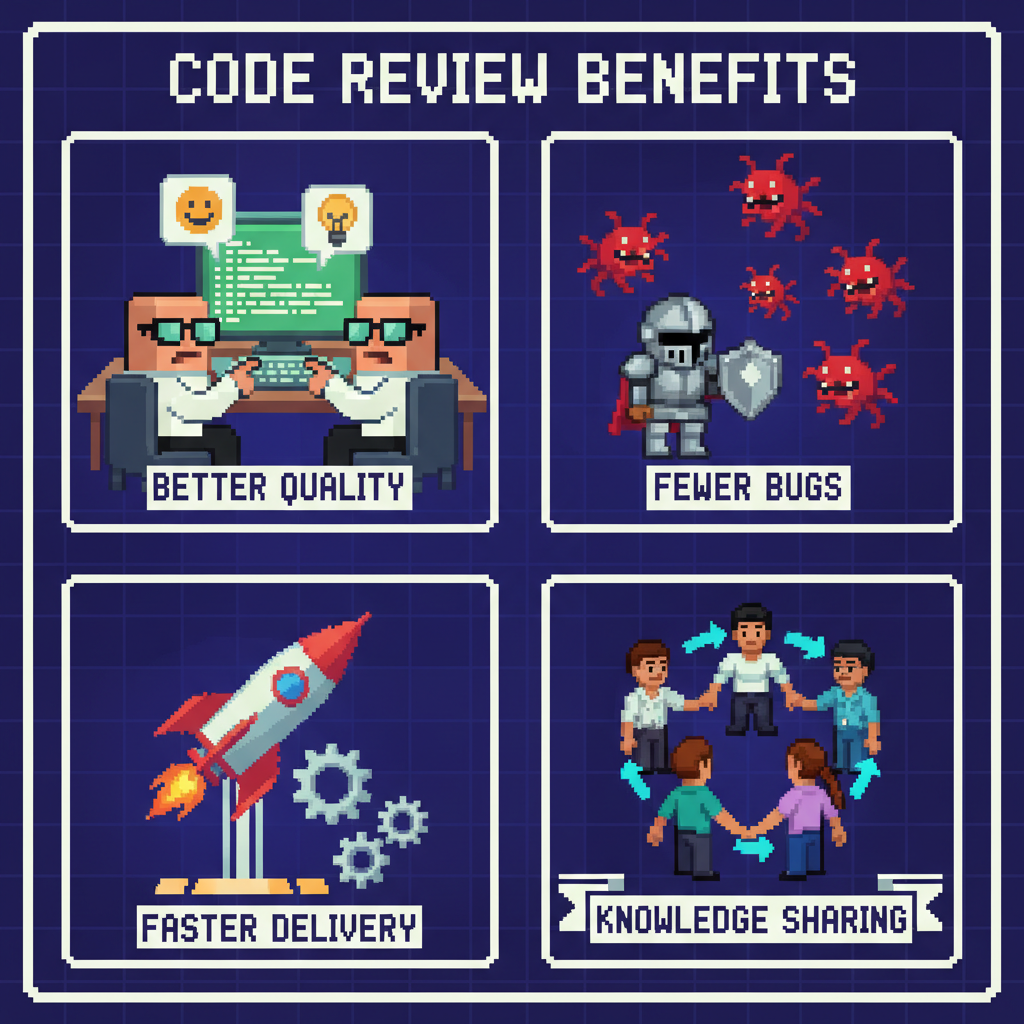
Many people see pull requests as an annoying final step before deploying. The PR sits in a queue, gets a few “LGTM”s, and is merged. This rush ignores the real benefits of code review, treating the process as a quick approval instead of a collaborative tool. When reviews become superficial, bugs that come from interactions between systems and incorrect assumptions slip through, because no one is looking deeply enough to notice. But the real cost is the missed opportunity to share knowledge. The person who wrote the code remains the only one with deep context, which creates knowledge silos and a single point of failure.
The cost of superficial reviews
When a team’s code review culture turns into just a quick typo check, the process becomes a bottleneck. Engineers end up waiting for approvals to unblock their work, and reviewers, under pressure to move fast, skim through the changes. You might catch a variable name that doesn’t follow conventions, but logic issues in how the code interacts with a downstream service go unnoticed.
This is how bugs reach production. Automated tests and linters are good at catching certain types of errors, but they don’t validate the author’s assumptions about how the system behaves. A change can pass all tests and still fail in production due to a race condition or a misunderstanding of an API contract. These are problems that another person, reviewing with attention, is better at catching.
The most harmful effect of superficial reviews is that engineers stop learning from each other. Every pull request is, in practice, an explanation of how someone solved a problem. When the review is shallow, that exchange is lost, along with the chance to share knowledge and align the team’s technical direction.
The real purpose of code review is to make the team smarter
The main goal of code review is to build a shared understanding of the system. Finding errors is just a side effect. A deeper review makes the code stop belonging to just one person. The reviewer starts to understand the intent, the trade-offs that were made, and where that change fits into the architecture.
This process creates a more resilient team. When a critical service breaks at 3 a.m., you want more than one person who knows how to debug that issue. Over time, this context accumulates. More people understand the system, and the code stops depending on a single individual. It starts to feel more consistent, as if it had been written by one person, because the team has internalized its own standards. Development becomes faster and less risky.
How code review helps engineers grow
A good review process helps every engineer on the team grow. When you truly engage with someone else’s work, you see different ways to solve problems. A reviewer might notice an interesting use of a language feature they didn’t know before, or a library that could simplify their own work. A junior engineer learns more idiomatic patterns from someone more senior, and sometimes a senior learns a new technique from a junior who comes from a different background.
Reviews are also the best place to align on architectural decisions. This is where the team ensures that every change moves in the same direction, instead of each part of the system evolving differently. It keeps the code consistent over time. It is also where naming, error handling, and logging conventions are aligned. Linters help with syntax, but it is in the review that the team defines how the code should actually be written, which makes it easier to understand and work with any part of the system.
How to build a process focused on learning
To get these benefits, the process needs to be designed for learning. It starts with how pull requests are created and how feedback is given.
A PR description should focus on the “why”. It should explain the business context, the problem being solved, and the alternatives that were considered. This context gives reviewers the information they need to evaluate the solution fully.
Feedback also needs to be oriented toward learning. It is better to ask questions than to give commands. Instead of telling someone exactly what they should change, you can try to understand why that decision was made and whether there is another approach that would make more sense for the team. This kind of approach opens space for discussion. It assumes the author had a reason and creates an opportunity for both sides to learn.
Simple habits to improve code review culture
Changing a team’s review culture can start with simple adjustments.
First, set aside dedicated time for reviews. You can’t do a good review in five minutes between meetings or while constantly switching context. Block one or two 30-minute slots in your calendar each day for reviewing code. During that time, turn off notifications and focus entirely on the PR. Check out the branch, run the code, and read it as if you were responsible for maintaining it.
Second, make room for real-time conversation. If a comment thread on a PR starts going back and forth too much, it is often better to talk directly. A five-minute call can resolve something that would take half an hour of typing. The goal is to reach the best solution, and a quick conversation is usually the most efficient way.
Finally, shift the team’s mindset toward mentorship. The reviewer is there to improve the code and help the author grow. The person opening the PR is there to present a solution and be open to collaboration. When everyone starts to see code review as a tool to improve both the team and the code, it stops being a chore. It becomes one of the most valuable parts of the development process.