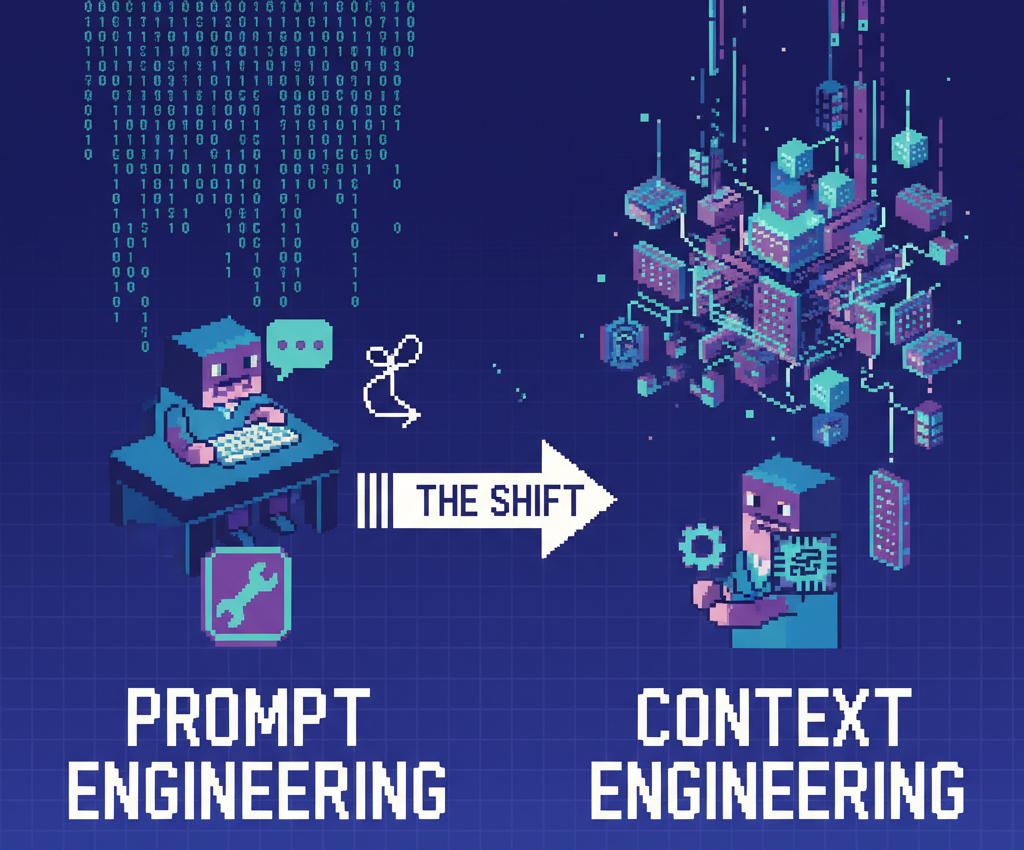
Context Engineering vs Prompt Engineering: the shift in how we build AI systems.
 Edvaldo Freitas
You receive a pull request coming from an AI. The code looks clean, follows the prompt, and all unit tests pass. Then you notice it uses a library the team deprecated last quarter. And a design pattern that violates the service’s architecture document. The code looks right, but it is completely wrong in the context of your system. This is the absolute limit of prompt engineering. The whole “context engineering vs. prompt engineering debate” comes down to a practical problem: our AI tools keep delivering code that requires careful manual fixes.
Prompt engineering works well for isolated tasks. Building software is not a sequence of isolated tasks. It is a chain of decisions constrained by existing code, team habits, and business rules. The problem is not a poorly written prompt. The problem is that the model has no idea what is happening outside its small window. Asking a better question does not help when the model cannot see the rest of the codebase.
The costs of prompt engineering at scale
Using prompt engineering for anything larger creates a fragile, high-maintenance system. You get stuck in a loop of tweaking prompts to fill gaps in the model’s knowledge, and then everything breaks when the model gets updated or the problem becomes harder.
A maintenance nightmare
When an AI system depends only on the prompt, the system becomes hard to maintain and easy to break. Engineers write absurdly complex prompts to get the right behavior, and those prompts turn into a mess that is impossible to maintain, full of assumptions about how the model “thinks”.
This fails in a few ways. A small change in the output means you have to go hunting for which prompt to modify, which is even worse when prompts are chained. When a provider releases a new model version, your carefully tuned prompts can break. An instruction that worked perfectly yesterday can produce a completely different format or a logical error today. And when something fails, it is hard to debug. You end up guessing whether the problem was the prompt or the lack of context, because you cannot easily reproduce the exact state the model was in.

You can only optimize a prompt so far
There is a limit to what you can achieve by only refining a text prompt. Building software requires awareness, not just a good instruction. A prompt cannot contain a project’s dependency graph, the reasoning behind an old architectural decision, or how the team prefers to handle asynchronous operations.
You end up with code that is technically correct, but in practice is useless. Error handling is a perfect example. A model will generate generic `try/catch` blocks because it knows nothing about structured logging, error types, or the system’s metrics patterns. The code works, but it is incomplete and does not fit, which means a developer will need to fix it. Without system awareness, AI produces unpredictable results that make people lose trust in the tool.
Context Engineering vs. Prompt Engineering: a different way to think
We need to stop trying to cram everything into the prompt. We should focus on designing the environment the model works in, not just optimizing the instruction. This means building systems to provide the model with the specific and explicit information it needs to make decisions that actually fit.
Context engineering is the work of designing, building, and maintaining the systems that collect, filter, and provide this information to the model.
More than just a prompt
An interaction with an LLM should not be `prompt -> output`. It should be `(context + prompt) -> output`. The prompt is just a small part of a much larger package. This operational context can include data, like relevant code from other files, database schemas, or API contracts. It can also include tools, which are functions the model can call to get more information (like running a linter or checking user permissions). It can even include state, like which files the user has open or which commands they just ran.
This completely changes the work. We are architecting an AI environment, not just writing prompts. The real work is deciding which information needs to be explicitly provided and what the model can be expected to know. A code style guide is explicit context. Python syntax is implicit knowledge.
Context engineering is system design
This approach changes how we build with AI. Instead of endlessly tweaking text, we move to building structured and predictable components. A context engineer thinks about the whole system, while a prompt engineer focuses on a single interaction.
A prompt engineer tries to improve a response. They might change a prompt from “write a function that does X” to “acting as a senior software engineer, write a pure function that does X, follow functional programming principles, and include property-based tests.” This might give you a better answer in that specific case.
A context engineer wants to make the entire system more consistent and reliable. They build the infrastructure that automatically finds the team’s functional programming principles in the wiki, pulls examples of existing property-based tests from the code, and provides all of that as context. The prompt can stay simple. The system becomes more reliable because the model’s decisions are now based on real project data.
The real intelligence is not in the model. It is in the system that feeds it. Building AI products that are sustainable depends on this.
Principles for building with context engineering
This requires a more disciplined way of passing information to models. It looks a lot like system design, which is a good sign.
Design your system to deliver context
The first step is to treat context as a core part of your system architecture. The code that fetches the database schema should not be mixed with the code that formats the prompt. You should create separate modules or services that only provide specific pieces of context. This makes the system much easier to test and maintain.
Whenever possible, provide context as JSON or YAML, not just as a large block of text. This helps the model interpret the information more reliably. For example, provide the style guide as a JSON object of lint rules instead of pasting raw text.
You also need versioning for your context. API schemas change, documents get updated. Your system should be able to point to specific versions of these sources. This is the only way to reliably reproduce a past generation for debugging.
Thinking in layers of context
It helps to think of context as a stack of layers. Each layer provides a different type of information. This helps prioritize and filter what you send to the model, which matters for staying within token limits and avoiding noise.
A context stack for a coding task could look like this:
- Layer 0 (Global): The model’s built-in knowledge of a programming language.
- Layer 1 (Organization): Company engineering standards or preferred libraries.
- Layer 2 (Project): Architecture patterns for this project, lint rules, and dependency list.
- Layer 3 (Local): The content of the current file and other related files the user has open.
- Layer 4 (Dynamic): Real-time feedback from a compiler or test runner.
A feedback loop is already embedded in this idea. If the model generates code that fails a lint check, that failure becomes dynamic context for the next attempt. The system can self-correct using immediate and factual feedback.
Applying context engineering in practice
To make this work, you need to build the infrastructure to manage context as code.
Managing context with code
Orchestration tools can help, but a well-defined set of functions or microservices also works. The point is to have a programmable way to assemble and provide context. An orchestrator can call different context providers depending on the user’s request, assemble the final package of information, and send it to the model.
You also need to validate and monitor your context. Before sending information to the model, check it. Does the API schema parse? Does the file path exist? Keep an eye on the quality of your context sources. Outdated or incorrect context is worse than no context.
Finally, the system needs to adapt the context to the task. A request to refactor a function needs different information than a request to write a new database migration. Your code needs to be smart enough to fetch the right context for each type of work.
A checklist for building with context
When you are designing a new AI feature, ask these questions:
- What information is needed? Identify every piece of information the model needs to make a good decision (source code, docs, schemas, git history, team patterns).
- What is the scope? For a specific task, what is the boundary of the context? The current file, the package, the entire repository? How do you define this in code?
- How do we know the context is good? How do you ensure the context is correct and up to date? What is the fallback if a source is unavailable?
- How does it stay updated? When and how is the context updated? On every request, on a time interval, or after an event like a git commit?
- Can we debug it? Are you logging exactly which versioned context was sent to the model along with the prompt? Can you perfectly reproduce a past generation
Answering these questions shifts the work from guessing the magic words in a prompt to building a software system that is reliable and easy to debug. Small improvements in a prompt lead to small improvements in the output. Improving the context changes the reliability of the entire system.