When should you invest in Developer Experience?
 Edvaldo Freitas
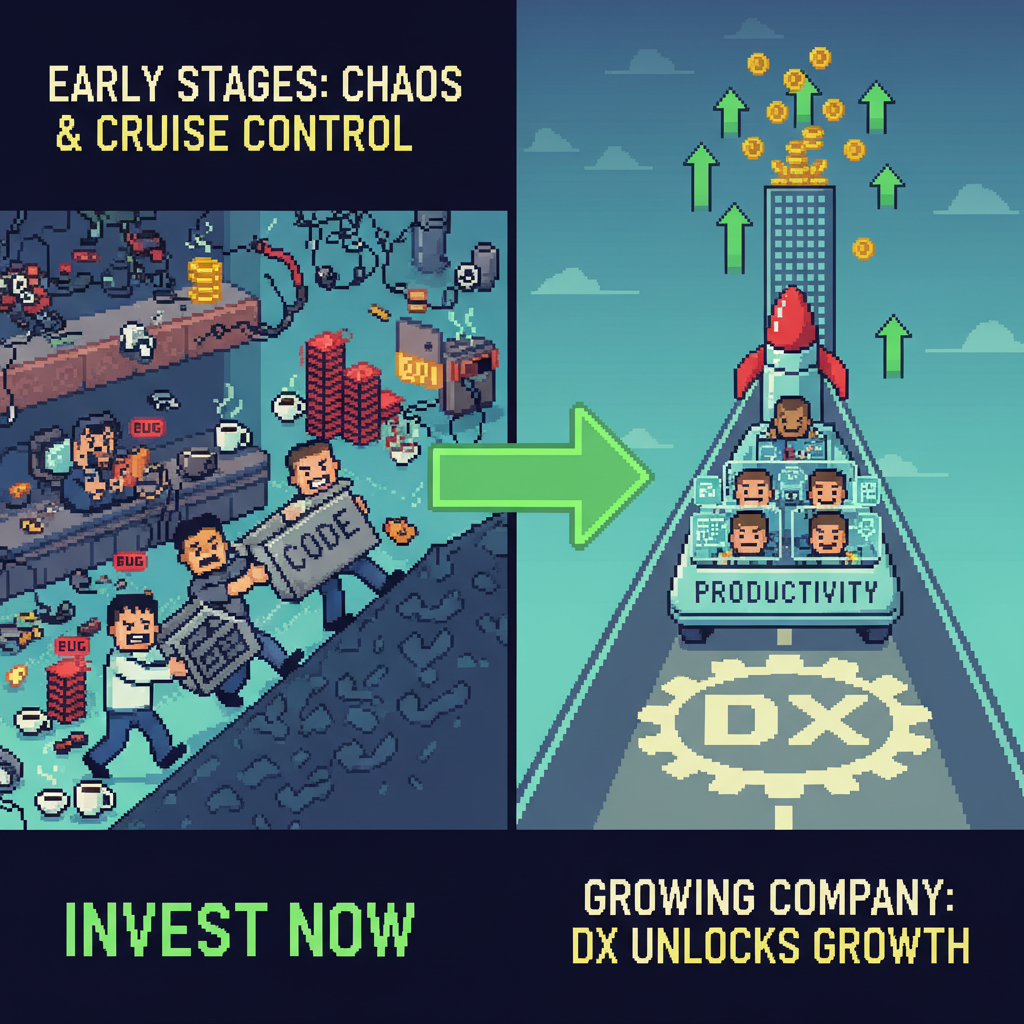
At a certain point in a company’s growth, you start to notice some strange things happening. Adding more engineers doesn’t seem to make the team any faster. The first month of a new hire is spent just trying to get the local development environment running without errors. Simple bug fixes that should take an hour end up taking a full day because the CI pipeline is slow and unstable. This collection of small cuts, bottlenecks, and daily frustrations is usually a sign that your Developer Experience is starting to buckle under the weight of scale.
Developer Experience, or DX, is the sum of all interactions a developer has with the tools, processes, and systems required to do their job.
The cost of neglecting DX
Early on, a loosely structured development process can work just fine. The priority is shipping features, not refining workflows. But as the team and the codebase grow, those early shortcuts start to come due. That cost doesn’t always show up on the financials, but it becomes obvious in delivery speed and team morale.
When scaling code and teams starts slowing everything down
As you add more people and services, the complexity of the development loop increases. What used to be a simple git push and deploy turns into a multi-step process involving multiple teams and hard-to-maintain scripts. This leads to some predictable outcomes:
- Longer onboarding time. New engineers can’t just clone the repository and start contributing. They need days or weeks of help from more experienced engineers just to navigate setup scripts, access permissions, and undocumented dependencies.
- Slower iteration cycles. When running tests takes 30 minutes or deploying to a staging environment is a manual, multi-step process, developers naturally become more hesitant to experiment and ship small changes.
- Lower code quality. Faced with tight deadlines and rigid workflows, even the best engineers start taking shortcuts. They might skip writing a more thorough test because running the full suite is too slow, or avoid a refactor because it touches a part of the system that’s notoriously hard to deploy.
- Higher cognitive load. Developers have a limited amount of mental energy. If a large portion of it is spent fighting tools, debugging CI failures, or coordinating with other teams, there’s less energy left to solve real business problems.
Productivity plateaus despite hiring more people
You keep hiring engineers, but velocity doesn’t increase at the same rate. This is a classic sign that the underlying system is the bottleneck. Engineers spend more time on repetitive work, like manually provisioning resources or debugging environment inconsistencies, than writing code. Without clear and standardized development patterns, each team starts solving the same problems in different ways, which makes collaboration across teams and long-term maintenance much harder. Over time, this wears people down, hurts morale, and eventually leads your most experienced engineers to look for work elsewhere.
Identifying the turning point to invest in DX

So when is the right time to stop and fix the workflow? The answer is usually “earlier than you think.” Waiting until developers are complaining out loud means you’ve already been losing productivity for months. The real signals are often hidden in your operational metrics.
Signals beyond developer complaints
Instead of just listening to frustrations, look for quantitative changes in your delivery process. These are the indicators that are much harder to ignore:
- An increase in post-deploy bugs. An unstable or slow testing process often lets bugs slip into production. If the number of bugs is going up with each release, that can be a symptom of poor DX.
- More dependencies between teams. Do simple features now require meetings between three different teams to coordinate a release? This communication overhead is a tax on productivity, usually caused by a lack of clear boundaries between services or self-service tooling.
- Rising cloud or infrastructure costs. Inefficient systems can get expensive. Think about all the CI runners executing unnecessarily long builds, or the multiple abandoned staging environments that are still running because they were too hard to shut down.
- High turnover among experienced engineers. Good engineers want to be effective. If they spend most of their time fighting tools, they’ll eventually leave for a place where they can focus on building. High turnover is one of the most expensive and delayed indicators of poor DX.
DX is a business multiplier, not a luxury
Investing in internal tools and workflows directly impacts business outcomes. It allows the entire engineering organization to move faster, innovate more, and respond to market changes with greater agility. A lean development process makes it possible to ship features more predictably and with higher quality, which is a clear competitive advantage. Treating DX as a cost center is a mistake; it’s a foundational investment that pays dividends across the company.
A framework for investing in Developer Experience
A dedicated effort to improve DX doesn’t have to start with a full platform team. It can begin with a focused, iterative approach to removing the most painful bottlenecks. The key is to be intentional and treat it like any other product initiative, with clear goals and metrics.
Quantifying return on investment
To get buy-in and prioritize correctly, you need to connect DX improvements to tangible outcomes. Start by collecting some baseline data:
- Measure key metrics. Track things like CI build time, deployment frequency, change failure rate, and time to merge a pull request. These numbers give you a clear view of your current state.
- Survey developers. Ask simple questions like, “What’s the one thing that slowed you down the most this week?” or “On a scale from 1 to 10, how easy was it to get your code into production?” This qualitative feedback is valuable for identifying the highest-impact areas to fix.
- Connect DX to business KPIs. Frame your proposals in business terms. For example: “Cutting CI time by 50% will allow us to increase deployment frequency, getting features to customers faster,” or “Automating staging environment setup will reduce our monthly cloud bill by X.”

A phased approach based on company stage
The right DX investments depend on where your company is in its growth. What works for a 10-person startup is different from what a 200-person engineering organization needs.
- Early stage (searching for product-market fit): The focus should be on removing immediate blockers from the critical path. Is the main branch constantly broken? Fix the CI checks. Is spinning up the database a nightmare? Write a simple setup script. Don’t overcomplicate things; just solve the most urgent problems.
- Growth stage (scaling teams): As you hire more people, consistency becomes essential. This is the time to standardize tools, create a documented onboarding process, and build self-service infrastructure for common tasks. A developer should be able to create a new service or spin up a test environment without opening a ticket. This is usually where the idea of a dedicated platform team starts to make sense.
- Maturity stage (optimization): With a solid foundation in place, you can focus on refining workflows and eliminating inefficiencies. This might involve building specialized tools, implementing automations, or creating paved paths that make it easy for developers to do the right thing by default.
Building a Developer Experience roadmap
Once you decide to invest, treat it like a product. Create a roadmap, prioritize the work, and iterate based on feedback. Your roadmap should be a living document, but a good starting point includes these principles:
- Prioritize high-impact, low-effort changes first. Find the quick wins that immediately give developers significant time back.
- Involve developers in the solution. The people who feel the pain every day are best equipped to help design the solution. Don’t build an internal platform in isolation.
- Secure buy-in with data. Use the metrics you’ve collected to make your case to leadership and show progress over time.
- Iterate and gather feedback. Ship small improvements continuously and talk to developers to make sure what’s being built actually helps. A DX initiative is never truly “done.”
At the end of the day, a great Developer Experience creates a virtuous cycle. When developers can work with fewer daily obstacles, they build better products, faster. That leads to better business outcomes, which in turn justifies further investment in the tools and processes that make it all possible.