Balancing delivery speed and code quality in scaling startups
 Edvaldo Freitas
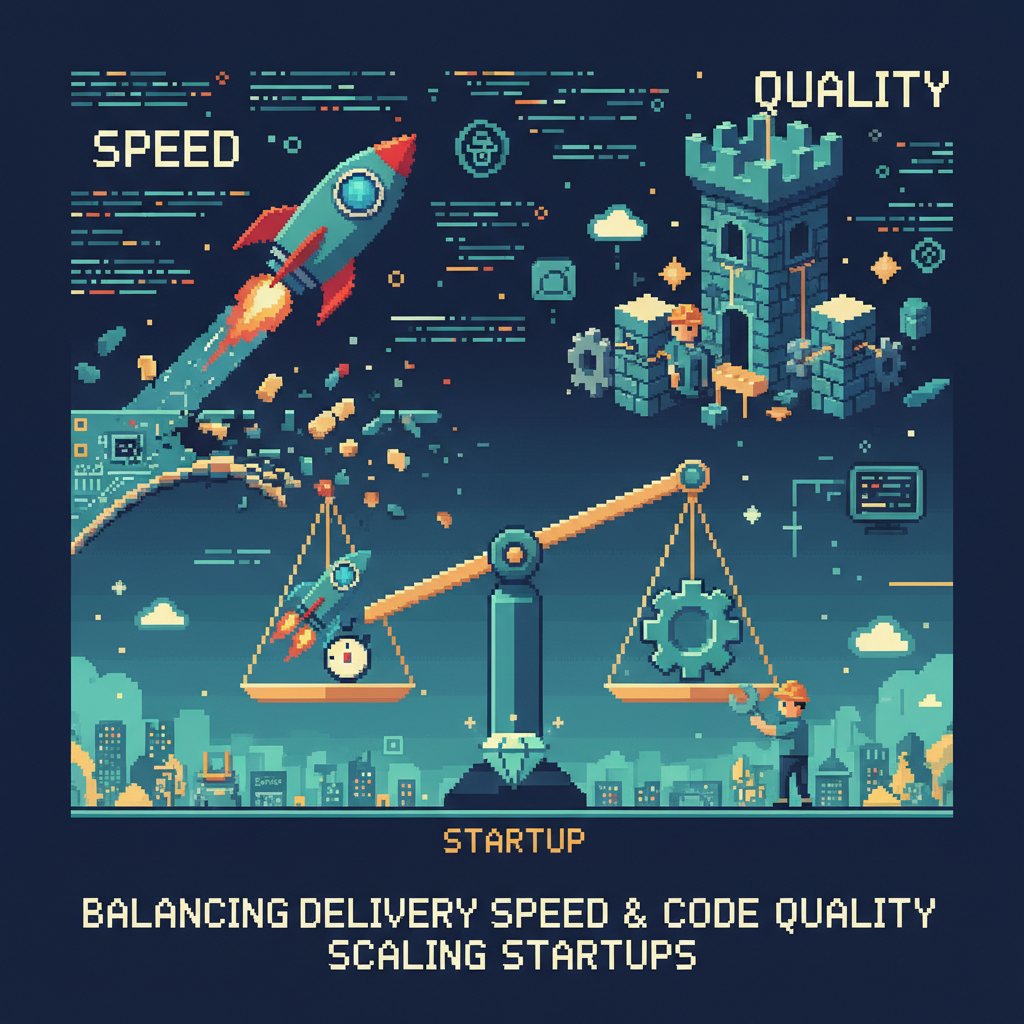
In a fast-growing startup, the default mode is to ship as fast as possible. A new feature needs to go out for a critical demo, a bug fix is blocking a major customer, or you’re just trying to find product-market fit before the runway gets short. This constant pressure creates a natural tension with maintaining a high standard of code quality best practices, and most of the time, speed wins the argument. The problem is that small compromises, made one pull request at a time, start to add up and slow everything down later.
What starts as a pragmatic choice to skip writing different kinds of testing in software or to put off a necessary refactor eventually becomes the default way of working. This isn’t about a single “bad” decision. It’s about hundreds of small trade-offs that feel reasonable in the moment but create a system that becomes progressively harder to work with.
The Inevitable Tension: Speed vs. Code Quality
The Pressure Cooker of Startup Growth
When you’re on a small team with limited resources, everything feels like the highest priority. The product roadmap is ambitious, the market is competitive, and the business depends on delivering new value to users quickly. In this environment, engineering is often pushed to iterate in rapid cycles, and early wins are measured by what gets shipped, not by how well it was built. Code that is “good enough to work” becomes the standard because the immediate cost of building something properly feels too high.
The conversation often goes something like this: “We can do it the right way, which will take two weeks, or we can do it the fast way, which will take three days.” When a big deal or a funding round is on the line, the three-day option almost always wins.
The Hidden Costs of Neglecting Quality
At first, cutting corners seems to work. You ship fast, close deals, and the business grows. But after a few months, the friction starts to show.
A simple bug that should take an hour to fix turns into days of investigation. The logic is scattered, full of edge cases, and no one is quite sure why certain decisions were made.
Onboarding a new developer takes weeks instead of days. The codebase relies on institutional knowledge and unwritten rules that live only in a few people’s heads.
Every new feature seems to break two or three existing ones. The test suite, if it exists at all, is flaky, and the team stops trusting it.
This slowdown is not just a technical problem. It directly affects team morale. Engineers get frustrated when they spend more time fighting the code than building on top of it. The work becomes less rewarding, constant context switching wears people down, and burnout becomes a real risk. Over time, some of your best engineers may start looking for places where they can do work they’re proud of.
Code Quality as an Enabler, Not a Bottleneck
Reframing the “Speed vs. Quality” Fallacy
The idea that a team has to choose between shipping fast and maintaining quality doesn’t really hold up in practice.
What usually happens is that skipping tests, refactors, and code clarity does speed up the next few deliveries. Two, maybe three at most. After that, every change starts to cost more. PRs get bigger, people become afraid to touch critical areas, and a lot of time goes into understanding side effects instead of actually building the feature. The real trade-off isn’t speed versus quality. It’s speed now versus speed a few months from now. Quality is what lets a team keep a steady, predictable pace over time, without relying on heroes or taking unnecessary risks on every release.
It helps to split what we mean by “quality” into two different things.
External quality is what the user experiences. Does the feature work as expected? Is it stable? Is it fast?
Internal quality is what the team feels day to day. Can you understand the code without asking for help? Can you change something without breaking three other parts of the system? Do the tests actually give you confidence, or are they just there to check a box?
Under pressure, many teams sacrifice internal quality to preserve external quality. In the short term, that can work. But it’s a fragile balance.
Over time, poor internal quality inevitably shows up as poor external quality, as bugs become more frequent and performance starts to degrade.
The Compounding Effect of Well-Crafted Code
Writing clean, well-tested code has positive effects that build on each other. When a codebase is easy to understand, developers can make changes with confidence. This means bug fixes are faster and less likely to introduce new problems. It also means that new team members can become productive much more quickly, as they can learn the system from the code itself rather than relying on tribal knowledge.
Good internal quality reduces the cognitive load on the entire team. When you don’t have to hold the entire system’s complexity in your head to make a small change, you can focus on solving the actual business problem. This leads to better solutions, fewer mistakes, and a more sustainable pace of development.
How to make trade-off decisions in day-to-day work
The goal isn’t to achieve perfect code everywhere. That’s unrealistic and often counterproductive in a startup.
The goal is to make intentional, strategic decisions about where to invest in quality and where it’s acceptable to be more pragmatic. This requires a framework for thinking about trade-offs.
Contextual Decision-Making for Code Quality
Not all code is created equal. The level of quality you require should depend on the context of the code you’re writing. Here are a few filters you can use to guide these decisions:
Identify the “blast zone.”
Where in your system would a bug or an outage have the most severe consequences? Core business logic, authentication systems, and billing integrations have a very large blast zone. A mistake here could be catastrophic. These are areas where you should enforce the highest standards of quality. In contrast, a one-off script for an internal admin panel has a much smaller blast zone and can tolerate a lower quality bar.
Assess feature longevity
Are you building a quick prototype to test a hypothesis, or is this the foundation for a major new product line? Features that are expected to be temporary or experimental don’t need to be engineered for Enhancing Code Maintainability. Core features that will be built upon for years to come require a much more robust and extensible design.
Use the “reversible vs. irreversible” decision filter
Some technical decisions are easy to change, while others are extremely difficult. A poorly written UI component can be refactored or replaced with minimal disruption. A poorly designed database schema or a public API contract, on the other hand, is nearly irreversible once it’s in production and has users depending on it. You should invest the most time and effort in getting the irreversible decisions right.
Implementing Quality Gates and Continuous Improvement
To make these trade-offs systematic, you need to embed them into your development process. This means moving beyond vague discussions about “good code” and establishing concrete standards.
Start by defining minimum viable standards for different parts of your system.
For example, you might decide that all code in the “billing” service requires 90% test coverage and review from two senior engineers, while a new internal tool only needs basic linting and a single reviewer. Leveraging automation through CI/CD is critical here. Linters, static analysis tools, and automated tests can catch many common issues without requiring manual review, freeing up developers to focus on architectural and logical feedback. Further optimizing this process can involve exploring innovations like how to build an engine for AI Code Review
You also need to make time for deliberate improvement. Refactoring shouldn’t be something that happens “if we have time.” It should be a planned activity, integrated directly into your development cycles. This could mean dedicating a certain percentage of each sprint to understanding how to reduce technical debt or scheduling periodic “fix-it” weeks where the team focuses exclusively on improving existing code.
Fostering a Culture of Intentional Quality
Ultimately, balancing speed and quality is a cultural challenge. It requires alignment across the entire engineering team and with product and business stakeholders. The first step is to create a shared definition of what quality means in different contexts. This helps ensure that everyone is working from the same set of expectations during code review.
Engineers must feel empowered to advocate for quality where it matters most. If a proposed deadline is unrealistic for a critical piece of infrastructure, they should be able to push back and explain the long-term risks without being seen as difficult or slow. This requires leadership to understand and respect the trade-offs. The role of engineering leadership is to shield the team from unreasonable pressure while still ensuring that the business can meet its goals. It’s about consciously choosing where to make compromises, rather than letting the pressure of the moment dictate every decision.