Why you should use an AI Code Review Tool
 Edvaldo Freitas
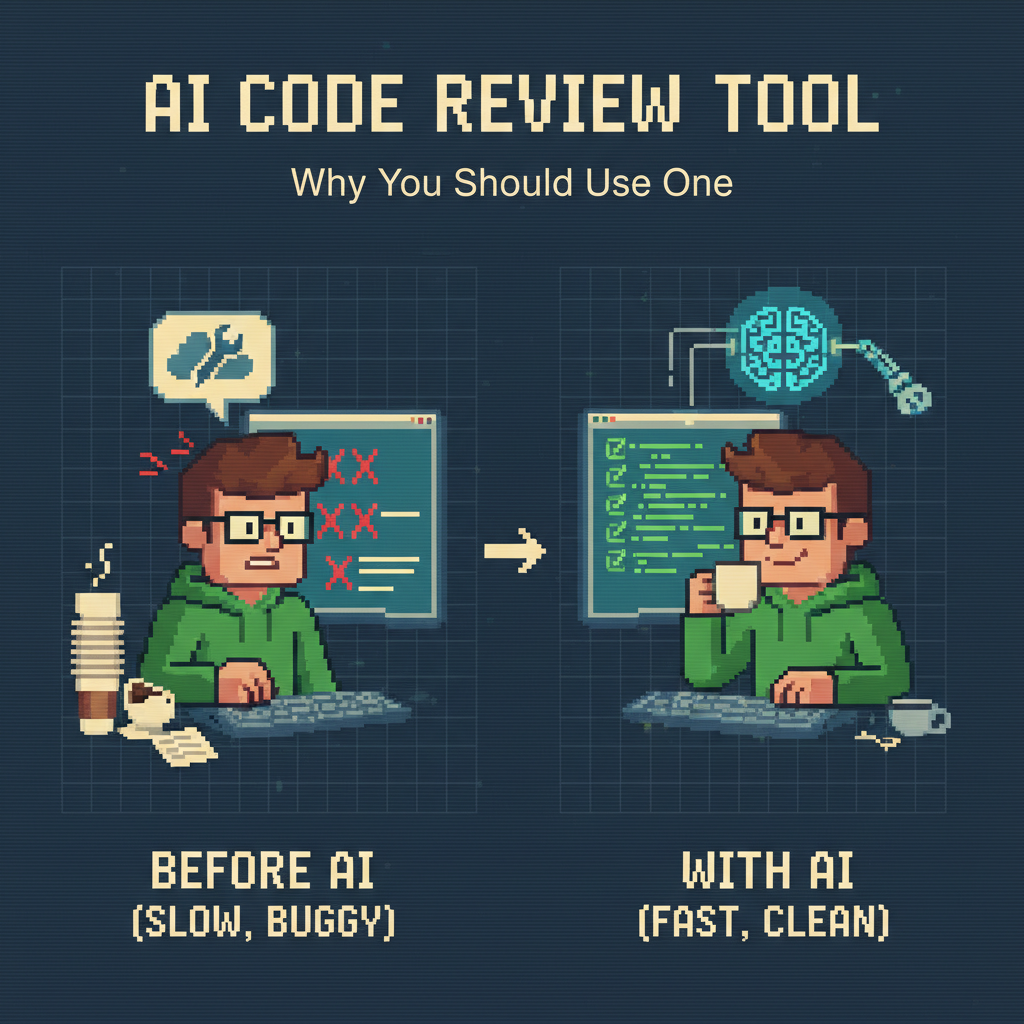
If you’re on Earth, you know code generation tools are now a standard part of the developer workflow. We’re producing code faster than ever, but this speed is creating a new, obvious bottleneck: the pull request. Reviewing a 500-line PR that was written in an hour by an AI assistant is a fundamentally different task than reviewing one written over two days by a teammate. The sheer volume and the subtle nature of AI-generated errors are putting immense pressure on our existing processes for code quality improvement, and it’s becoming clear that the human-only review model can’t keep up.
The Evolving Landscape of Code Quality
The initial productivity gain from AI coding assistants is real. It gets you from a blank file to a working prototype quickly. The problem is what comes after. That initial burst of speed often hides costs that surface later, during code review or, even worse, in production.
The Hidden Costs of AI-Accelerated Development
What we’re seeing is a new kind of technical debt. It’s not the deliberate, strategic kind where you cut a corner to meet a deadline. It’s an unintentional accumulation of suboptimal patterns, verbose logic, and missed edge cases. The code often works, but it’s brittle. Because AI models are trained on vast amounts of public code, they can easily reproduce common vulnerabilities or outdated library usages, increasing the security exposure of a codebase with every generated function.
The most challenging part is the “almost right” code. It passes the linter, it might even have some basic tests, but it contains a logical flaw that a human developer familiar with the system’s context would have caught. This code looks plausible on the surface, making it incredibly easy for a reviewer to approve it without spotting the underlying issue. Over time, these small, “almost right” additions compound, making the system harder to reason about and maintain.
The Challenge of Reviewing AI-Generated Code
Reviewing AI-generated code places a different kind of cognitive load on the human reviewer. You aren’t just checking for correctness; you’re trying to infer the original intent and ensure the AI didn’t misinterpret the context. An AI might generate a perfectly functional sorting algorithm when what you really needed was a stable sort that preserves the original order of equal elements. It doesn’t know about that implicit requirement unless explicitly told.
We’re also starting to see systematic anti-patterns. An AI might consistently favor a certain verbose pattern or use a library in a way that is technically correct but inefficient or not idiomatic for your team. When these patterns are repeated across dozens of pull requests, they become ingrained in the codebase. The reviewer is then forced to spend their time catching the same repeating issues instead of focusing on architectural soundness and business logic, which is a frustrating and inefficient use of their expertise.
Why AI Code Review Is No Longer Optional
For a while, we’ve relied on a combination of static analysis tools and human oversight. That’s not enough anymore. The nature of the code being produced has changed, so the way we review it has to change as well.
Beyond Static Analysis: A Focus on Code Quality Improvement
Traditional static analysis and linting tools are great at catching specific, predefined anti-patterns, like a variable being used before it’s declared or a potential null pointer exception. They operate on a set of rules. The problems in AI-generated code are often more subtle. They are less about syntax and more about logic, context, and intent. An AI reviewer, on the other hand, can be trained to understand the business context of the code, evaluate its logical correctness against the requirements, and spot flaws that rule-based tools would miss entirely.
Overcoming the Human Review Bottleneck
The math is simple: code generation has scaled, but the number of experienced engineers available to review it has not. This creates a bottleneck where PRs sit waiting for review for hours or even days. Teams are then faced with a difficult choice: lower their review standards to maintain velocity, or accept that development will slow down. An AI-based review system can act as a first-pass filter. It handles the initial, more automatable checks, freeing up senior developers to focus their limited time on the parts of the code that truly require human intelligence: architectural alignment, long-term maintainability, and product correctness.
📉 Code Review Bottleneck Calculator
This creates a deficit of 0.3 full-time engineers.
Saved time pays for the tool and frees up focus for architecture.
Enforcing Standards for Consistent Code
Every team has its own conventions and preferred patterns. These are often unwritten rules learned over time. AI code generators have no knowledge of this internal context, so they produce generic code that may not align with your team’s standards. An AI reviewer can be configured to understand and enforce these team-specific conventions. This ensures that even as code generation accelerates, the resulting codebase remains consistent, readable, and easy for any team member to work with.
Implementing a Robust AI Code Review Strategy
Adopting AI for code review doesn’t mean removing humans from the loop. It means creating a hybrid workflow where machines and humans do what they do best.
Structuring a Hybrid Human-AI Workflow
In practice, a good workflow involves the AI acting as an assistant to the human reviewer. When a pull request is opened, the AI performs an initial, comprehensive analysis. It leaves comments on potential bugs, security vulnerabilities, deviations from coding standards, and areas with insufficient test coverage. The human reviewer then comes in with this analysis already done. They can quickly validate the AI’s findings and then focus their attention on the more complex aspects of the change. This turns the review process from a “find the bug” exercise into a higher-level architectural and logical discussion.
Key Pillars for Effective AI Code Review
For this hybrid model to work, the AI reviewer needs to be tasked with specific, well-defined responsibilities. A good setup usually focuses on four key areas:
- Functional and Test Coverage Verification: Does the code do what it’s supposed to do? Are there sufficient tests to prove it, especially for the edge cases that AI-generated code often misses?
- Context, Intent, and Architectural Alignment: Does this change fit within the existing architecture? Did the AI correctly interpret the intent of the task, or did it generate a solution that works in isolation but violates broader system patterns?
- Dedicated Security Vulnerability Scrutiny: AI can analyze code for common vulnerability patterns (like injection flaws, improper error handling, or insecure direct object references) far more exhaustively than a human reviewer in a hurry.
- Code Readability and Maintainability Assessment: Is the code overly complex? Is it well-documented? Will another developer be able to understand and modify it six months from now? An AI can be trained to flag code that is functionally correct but difficult to maintain.
Practical Steps for Adoption
Getting started involves more than just turning on a tool. The real value comes from thoughtful integration into your existing processes. The first step is to run the AI reviewer as part of your CI/CD pipeline, so the feedback is available automatically on every pull request. This makes the analysis a natural part of the workflow, not an extra, manual step.
Next is crafting effective prompts and configurations. The quality of the AI’s feedback depends heavily on the instructions it’s given. You need to provide it with context about your coding standards, architectural principles, and common pitfalls specific to your applications. Finally, establish a clear feedback loop. When the AI provides a great suggestion, that’s useful. When it provides a bad one, it’s just as important for the team to be able to flag it. This feedback helps refine the system over time, making its analysis more accurate and relevant to your team’s needs.