DevOps vs Platform Engineering: what is actually changing?
 Edvaldo Freitas
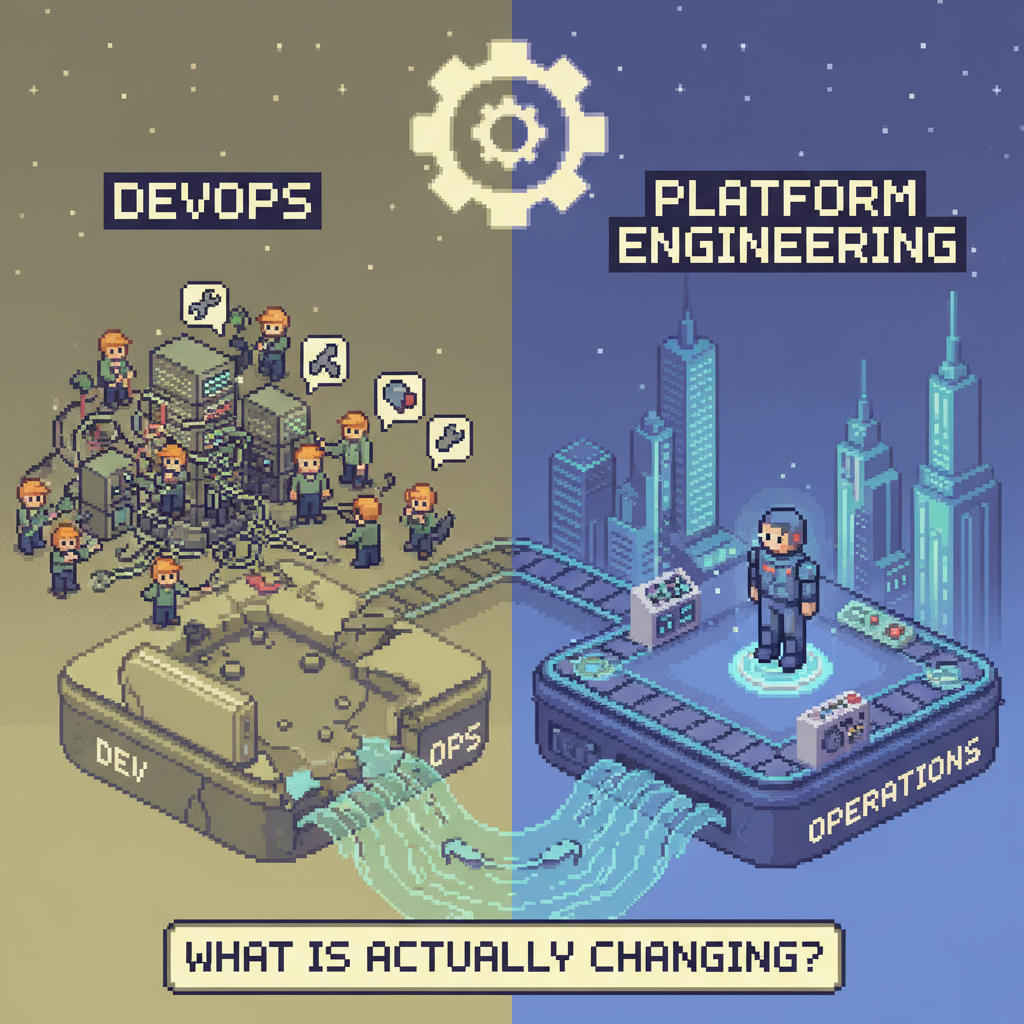
The conversation around DevOps vs Platform Engineering usually misses the point. We’re not just debating definitions. We’re recognizing a breaking point in how we build and ship software. DevOps culture gave us speed and ownership through collaboration and automation, but as systems grew, the “you build it, you run it” mantra started creating more problems than it solved. The responsibilities piled onto application teams went far beyond their core focus, generating operational drag and bottlenecks. Platform Engineering is a structural response to that complexity, an evolution born out of necessity.
The growing developer overload
The promise of DevOps was to break down silos between development and operations by giving teams end-to-end ownership. That worked well when the operational surface area was manageable. Today, a single team is expected to own application code, CI/CD pipelines, cloud infrastructure provisioning, security scans, monitoring, and incident response. That accumulation of responsibilities comes with a direct cost.
The reality of “you build it, you run it”
For an application developer, “run it” now requires deep knowledge across a broad stack of technologies. A simple feature deployment might mean switching between Go, Terraform, Kubernetes YAML, Prometheus queries, and cloud provider IAM policies. Every context switch carries a high cognitive cost, draining focus from the main task of delivering business value.
This overload creates several hard-to-solve problems. Application developers spend a large portion of their time on tasks unrelated to the product’s domain logic. That’s more than inefficiency; it’s a recipe for burnout and shallow knowledge spread across too many domains. Despite automation, teams often end up with their own custom scripts and manual processes. When each team builds its own deployment workflow or monitoring setup, the company loses the benefits of shared and reinforced automation. Expertise also becomes trapped within teams. The engineers on Team A who figured out the right way to configure Istio for their service hold knowledge that doesn’t automatically transfer to Team B, slowing everyone down.
Cracks in the model
As the organization grows, the weaknesses of a “every team for itself” DevOps model become clear. Shared infrastructure such as Kubernetes clusters, service meshes, or observability platforms turn into conflict zones. Without clear ownership, these systems either stagnate or become no-man’s land, leading to instability.
Inconsistent tools and practices create friction. One team uses GitHub Actions while another uses Jenkins. One defines infrastructure with Terraform, another with Pulumi. This fragmentation makes it harder to enforce security standards, manage costs, and move engineers between projects. The effort to balance feature development with operational stability grows exponentially, because each team is solving the same foundational problems on its own.
The idea of shared responsibility only works when the scope of that responsibility is limited. When a developer has to be a security expert, cloud architect, and reliability engineer just to do their job, the model has reached its limit.
The shift toward Platform Engineering
Platform Engineering addresses this overload by changing how infrastructure and tooling are delivered. It introduces a specialized team whose role is to build and maintain an Internal Developer Platform (IDP). This approach treats infrastructure as a product for internal developers, rather than reverting to a pre-DevOps “ops” silo.
The platform as an internal product
The key shift is viewing the platform team as a product team. Their customers are the organization’s application developers. Their product is the set of tools, services, and automated workflows that help developers ship code quickly and safely.
That mindset changes everything. The primary metric for a platform team is developer productivity. They should constantly ask how to reduce time from commit to production and how to eliminate manual work from the development cycle. Instead of opening a ticket to request a new database or CI pipeline, a developer should be able to provision what they need through a simple interface, API, or configuration file. The platform provides a paved path for common tasks, exposing its capabilities through well-defined interfaces. That allows teams to use services without needing to understand how everything works behind the scenes.
From shared practices to managed services
DevOps culture encourages shared practices, and Platform Engineering turns those practices into managed services.
For example, a DevOps approach might be a wiki page detailing how to set up a new microservice with proper monitoring and logging. A Platform Engineering approach is offering a service template where the developer runs a single command and the platform generates a new service with CI/CD, observability, and security controls already configured.
The platform abstracts complexity. An application developer shouldn’t have to write Terraform boilerplate to get a staging environment. They should simply declare their needs, and the platform handles provisioning, networking, and security. Standardizing deployment and operational patterns is what allows a company to grow effectively without sacrificing speed or security.
Finding the right approach for your team
A full platform team isn’t necessary for every company. A healthy DevOps culture may be enough for smaller organizations or those with less complex architectures. The need for a platform emerges from specific, observable problems.
When do you need a platform?
It may be time to invest in a platform when you start noticing certain signals. Your most valuable engineers might be spending their days debugging CI pipelines or fighting infrastructure configuration instead of writing code. You may see some teams deploying multiple times a day while others can barely release once per sprint because of operational hurdles. Or perhaps there are multiple CI/CD systems, monitoring tools, and deployment scripts solving the same problems in different ways across the company. If all infrastructure requests have to go through a central team that can’t keep up with demand, that’s a clear sign that self-service automation is needed.
Building a platform strategy
A successful platform is built iteratively, not as a big top-down project.
First, define your internal customers and identify their most urgent needs. Talk to your application development teams.
What is the main thing slowing them down today? Is it creating new environments? Database provisioning? The complexity of the deployment process? Solve that problem first. Build a small piece of the platform that delivers immediate value.
Measure the platform’s impact with concrete numbers. Track deployment frequency, lead time for changes, and time spent on unplanned work. These are direct indicators of whether your platform is actually increasing developer productivity.
Your platform team should have a product manager responsible for the roadmap and for collecting feedback from developers. The engineers on the team should combine software engineering and systems skills. Their job is not to operate production, but to build the tools that allow others to operate production safely and efficiently.
Avoiding common pitfalls
Building an internal platform comes with its own challenges. Avoid the temptation to create a broad, generic platform from day one.
Start with concrete, opinionated solutions to real problems. A simple and functional platform that solves 80% of your teams’ needs is better than a complex platform that solves 100% of hypothetical needs.
The platform should promote autonomy. Define a standard, but don’t block those who need to do something differently for a good reason. The platform team succeeds when developers choose to use its product because it’s the easiest option.
Finally, the platform is a living product. Developer needs change and new technologies emerge. The platform team needs a continuous feedback loop with its users to ensure the platform remains relevant.
Platform Engineering puts DevOps principles into practice at scale. It preserves the core ideas of ownership and automation, but adds structure to handle the complexity of modern systems. It reduces developers’ cognitive load, allowing them to focus on what they do best: building great software.