How to manage technical debt in a fast growing environment
 Edvaldo Freitas
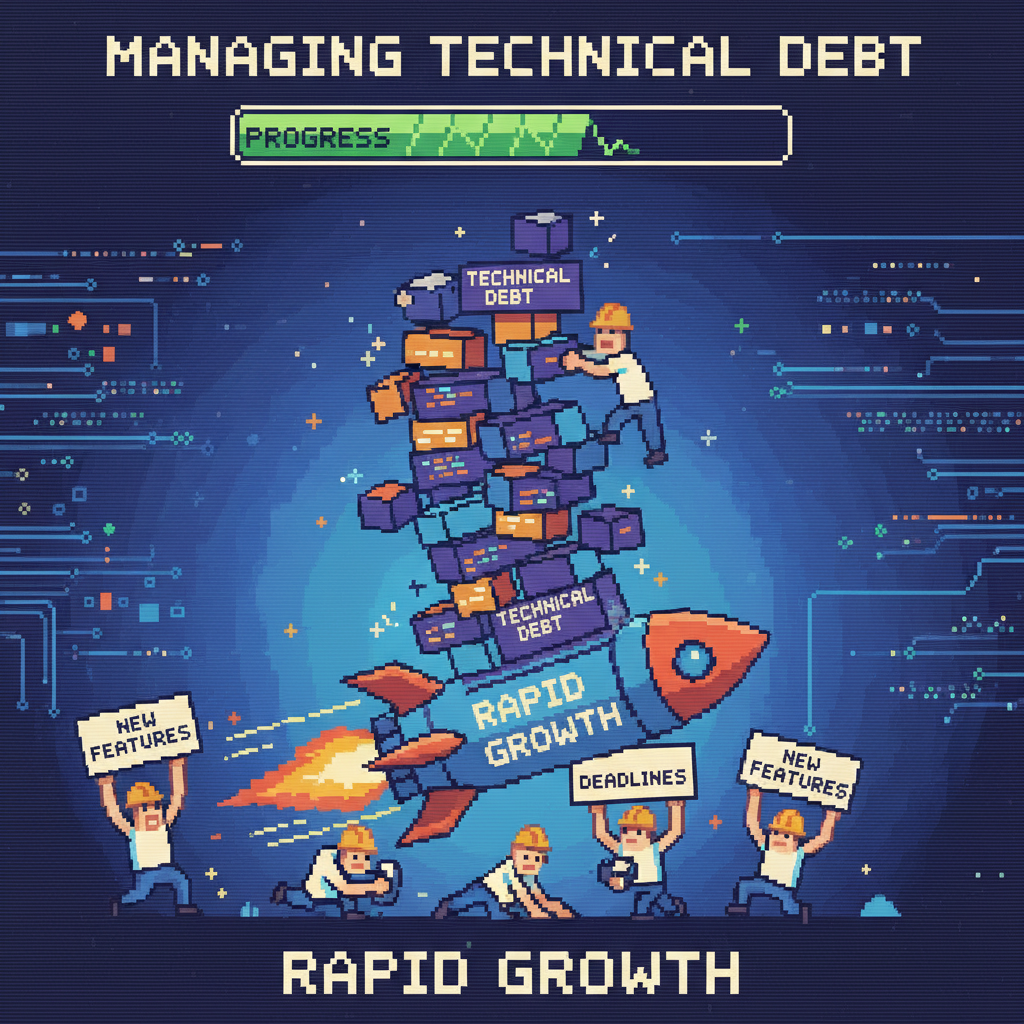
When you are scaling fast, the pressure to ship new features is constant. At first, it feels like everything is moving at an incredible pace. Then, almost without you noticing, things start to slow down. A change that should take a day now takes a week, hard to reproduce bugs start to become routine. This is the practical effect of unmanaged technical debt and one of the biggest risks for a growing product.
Over time, the small shortcuts and trade offs that made sense to get to market start to pile up. The team’s capacity slowly gets eroded by this invisible tax.
Instead of creating new value, the best engineers spend their days putting out fires and dealing with poorly resolved dependencies. In practice, this affects time to market and makes innovation harder, because every new idea has to be built on top of a foundation that is becoming less stable.
Of course, not all technical debt is a mistake.
Deliberately choosing a simpler and faster solution to validate a market hypothesis is a valid business decision, this is a calculated loan.
The real problem is inadvertent debt, the kind that comes from unclear requirements, tight deadlines, or a lack of standards. This is the type of debt that creates friction across the system without anyone having consciously chosen to take it on.
Making Technical Debt Visible
You cannot manage what you cannot see. The first step is to have a clear and honest view of where the problems really are.
This usually starts by listening to developers, they know which parts of the codebase are painful to work with.
Practical Ways to Find and Measure Debt
Developer feedback is a great starting point, but you need to combine it with more objective data to build a complete picture.
Static analysis tools
Tools like SonarQube can scan the codebase and point out code smells, complexity issues, and duplication. The volume of alerts is usually high, so the idea is not to fix each one individually. Use this data to identify hotspots and trends over time. If the complexity of a critical module increases with every release, that is something worth investigating. Depending on the scenario, evaluating SonarQube alternatives can also make sense.
Structure a solid Code Review process
A good PR process is one of the best defenses against new debt. Encourage reviewers to go beyond “does it work?” and ask “is this understandable? is it easy to maintain? does it follow our established standards?”.
Pair programming can serve a similar purpose, catching design issues before they even reach a PR. These practices are key to understanding how to scale code review in a growing team.
Code quality metrics
Go beyond just lines of code. Look at maintainability metrics in software engineering that correlate with day to day pain.
High code churn combined with high cyclomatic complexity usually points to a fragile and hard to understand module. If that area also has low test coverage, operational risk increases significantly.
The goal is to translate these technical metrics into business impact, showing for example that these same modules are responsible for most production bugs or for performance issues noticed by users.
How to Truly Prioritize Paying Down Debt
Once you have a list of technical debt items, the next question is always “what do we fix first?”. Trying to fix everything at once is not going to work, I can guarantee that.
You need a framework to make decisions, and it needs to be anchored in business value.
Frameworks to Decide What to Fix Next
A simple Impact versus Effort matrix is a great place to start. Place each debt item based on the positive impact the fix will bring versus the effort required.
Quick Wins (High Impact, Low Effort): Fix immediately. These are things like updating a critical library with a known security vulnerability or refactoring a single function that is a constant source of bugs.
Large Projects (High Impact, High Effort): Require planning. A major architectural refactor falls into this category. You need to break it into smaller parts and schedule it as part of the roadmap.
Fill Ins (Low Impact, Low Effort): Nice to have improvements. Tackle them when there is slack or alongside related feature work. Think of things like improving code comments or renaming variables for clarity.
Low Value Initiatives (Low Impact, High Effort): Avoid. A full rewrite of a stable legacy component that is not causing real problems is a good example. The desire to make everything technically perfect often leads here, but it rarely generates business value.
Making Debt Repayment Part of Daily Work
Treating technical debt as a separate, one off project is a common mistake.
Inevitably, it gets pushed aside when the next urgent feature comes up.
The only sustainable approach is to integrate debt management into the team’s development rhythm.
Sustainable Models
Embed refactoring into feature work
The “boy scout rule” is a great principle here: always leave the code a little better than you found it.
When working on a new feature, set aside a bit of time to refactor adjacent code. This creates small, incremental improvements over time.
Dedicate time explicitly
Another approach is to allocate a fixed percentage of each sprint to non feature work.
The 70 20 10 split (70% features, 20% platform or debt, 10% bug fixes) can be a good starting point.
Some teams use dedicated “Tech Debt Fridays” or entire refactoring sprints once a quarter.
The specific model matters less than consistency. What matters is that this time is explicitly scheduled.
Make ownership clear and set boundaries
As the team grows, it becomes less clear who is responsible. Define clear owners for critical services or code components. These people take care of the long term health of the component.
In addition, use automated tests to ensure that important architectural rules continue to be respected.
Talking to Leadership About Code Quality
One of the hardest parts of managing technical debt is communicating its importance to non technical stakeholders.
They do not see maintainability problems, they see delayed features. You need to close this language gap by translating technical issues into business outcomes.
That is why you should frame the conversation around the cost of not acting. Quantify it whenever possible.
For example, you can track how much developer time is spent fixing recurring bugs caused by a specific debt hotspot.
This turns an abstract technical discussion into a concrete business case, with a clear return on investment.
Getting a small budget for a dedicated refactoring initiative becomes much easier when you can show that it will increase feature delivery speed by 20% over the next six months.
Building a Healthy Development Culture
At the end of the day, tools and processes only take you so far.
A sustainable approach to dealing with technical debt requires building a culture where quality is a shared responsibility. That means moving away from blame when something goes wrong and focusing on prevention.
A production incident retrospective should not end with “who shipped the code?”. It should end with “what can we change in the process to prevent this kind of error from happening again?”.
This also requires finding the right balance between team autonomy and standardization.
Empower teams to make technical decisions, but provide clear principles that guide areas like security, reliability, and observability.
When teams manage to pay down a meaningful chunk of debt that unlocks new features, celebrate that achievement publicly. This reinforces the idea that this work is valued and critical to the company’s long term success.
Managing technical debt in a fast growth context is not about chasing a perfect codebase. It is about making conscious decisions. By making debt visible, prioritizing what truly matters, and bringing this care into the team’s daily work, it is possible to keep shipping features without pushing engineering to the limit.