PR guidelines: best practices to improve code quality and reduce review time
 Edvaldo Freitas
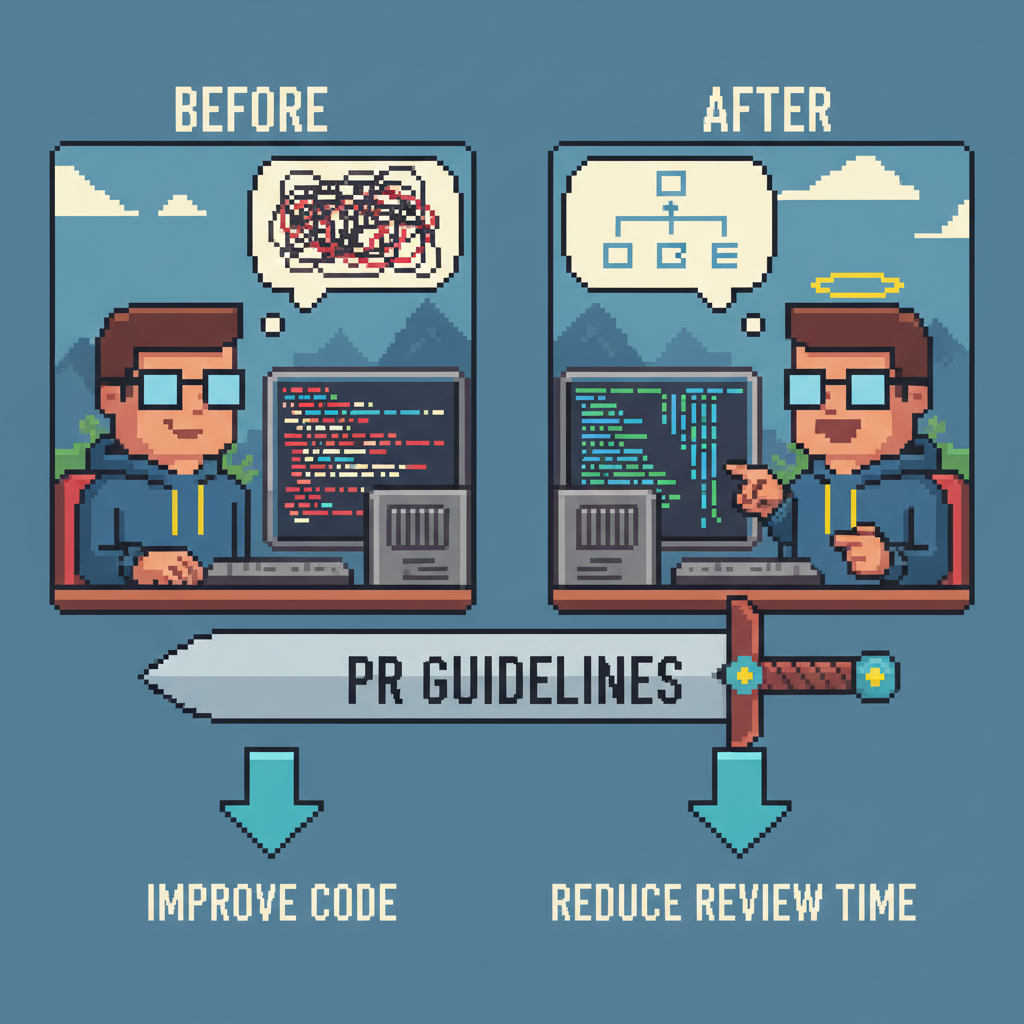
A slow code review process points to a bigger problem. Our process doesn’t define clear expectations, and the real culprit is usually vague or missing PR guidelines. When a pull request sits in the queue for days, or a review thread turns into a 50-comment discussion over small details, it affects more than just that PR. The whole team loses momentum. The real impact is the constant context switching and loss of focus that consume engineering time.
Where most teams get PR guidelines wrong
Many teams try to fix this by writing a huge document. And that document becomes the problem. It’s a long list of rules, covering everything from commit syntax to architecture principles, and developers are expected to memorize all of it. No one looks at it after the first week.
These guides usually fail because they are based on rigid rules that turn review into a mechanical checklist. They miss the point about shared intent. They also ignore how a reviewer actually works. A reviewer needs to understand the why and the risk of a change quickly. A document that only confirms the code follows a style guide is just creating noise.
Focus on intent, not just rules
Good PR guidelines should start a conversation. They give the author and the reviewer a shared language and a common starting point for discussion. The main goal is to merge a well-understood change, with quality, as fast as possible. Everything else is secondary. The guidelines should reduce doubt by answering the reviewer’s first questions before they even come up. This allows the reviewer to spend time on what actually matters, like logic, architecture, and potential side effects.
PR guidelines that actually help
Here are guidelines that can help you. This is not a complete list covering every possible edge case. It’s a set of patterns we’ve seen keep the process moving and code quality high.
Writing for the reviewer: what they need to understand quickly
The reviewer is interrupting their work to look at your code, so make it easy for them. The PR description is your best tool for a fast review. It should be a short summary explaining what they are about to see. Your description needs to answer four questions before the reviewer even opens the code:
- What is the context? Link to the ticket (Jira, Linear, etc.). Briefly explain the problem you’re solving or the feature you’re building. One or two sentences are enough.
- What changed? Describe your approach. Don’t repeat the ticket description. Explain the technical decisions you made. For example, “Added a new
UserServiceto handle user creation, moving this logic out of the controller” is much more useful than “Created the user signup page.” - What are the risks? Are there possible breaking changes? Does this touch a critical path? Is there a dependency on another team’s work? Calling out risks shows you thought about what could go wrong.
- How was this tested? Describe the tests performed. Include automated tests (unit, integration) and manual steps. If it’s a UI change, add a screenshot or a short video. Test evidence builds trust and saves the reviewer time.
Defining PR size
Large PRs are the main reason reviews get delayed. If a reviewer sees a diff with +2000 lines, they will postpone it. And even when they do review it, the quality drops. No one can review a change of that size well.
A simple rule you can define: a PR should be small enough for someone to review well in under 30 minutes.
This usually means fewer than 400 lines of relevant changes (excluding generated files, lockfiles, etc.). It’s not a hard rule, but it’s a good signal. If the PR is larger, it’s probably worth breaking it down. A large refactor can be split into smaller, sequential PRs. A new feature can be built behind a feature flag and merged in parts. The idea is that each change is a small, logical unit that someone can understand easily.
How to maintain code quality without micromanaging
The reviewer should not act as a human linter. Repetitive and objective checks should be automated.
- Linters and formatters: Code style, formatting, and simple static analysis should be automated and run in CI. A review should not be blocked by comments about brace placement or import order. If the pipeline is green, these checks are considered done.
- Reviewer focus: The reviewer should focus on what machines can’t validate:
- Does the code solve the right problem?
- Does the logic make sense? Are there ignored edge cases?
- Does this fit into the existing architecture?
- Are there performance or security risks?
- Is the code clear enough for the next developer to maintain?
- AI code review: We can use AI assistants for a first pass. These tools are good at finding bugs or suggesting refactors in more complex functions. They also help identify missing tests. This covers another layer of mechanical work, leaving people to focus on design and higher-level logic.
Rules to reduce bottlenecks
To prevent PRs from getting stuck, we need clear expectations for both authors and reviewers.
- Ready vs. Draft: If the PR is not ready for final review, open it as Draft or use the “WIP” prefix. This signals that you want early feedback, not approval. A PR is only ready when CI is green and the description is complete.
- Assigning reviewers: Assign at least two reviewers. One should be the code owner of the main files changed. And assigning is not enough — if it’s urgent, ping them on Slack.
- Response time: We expect feedback within one business day. If you can’t review in that time, leave a comment explaining and unassign yourself so the author can find someone else.
- Author responsibility: The author is responsible for taking the PR to merge. This includes responding to comments, pushing updates, and merging after approval. Don’t let your PR age.
- Blocking vs. non-blocking comments: Use prefixes
[blocking]or[non-blocking]. A blocking comment must be resolved before merge. A non-blocking one is a suggestion for future improvement and can become a ticket later. This simple habit avoids a lot of confusion.
A simple PR guidelines template
The best way to ensure adoption is to put the template directly in the repository (for example, as PULL_REQUEST_TEMPLATE.md). It shows up automatically when opening a PR.
Here’s a template that works well:
### Context

<!-- Link to the ticket (Jira, Linear, etc.) and a short summary of the work -->
Ticket: [PROJ-123](https://your.jira.com/browse/PROJ-123)

### Changes

<!-- Describe the technical approach and what changed -->
-
-

### Risks

<!-- Is there a breaking change or anything that needs special attention? -->
-

### Testing

<!-- How was this tested? Include automated tests and manual steps. Add screenshots if it’s UI -->
-
-
The goal of these guidelines is not to create more bureaucracy. It’s to build a system that helps everyone work better. When expectations are clear, the flow moves, and we can ship code faster with fewer mistakes.