The true hidden cost of slow and inefficient PR reviews
 Edvaldo Freitas
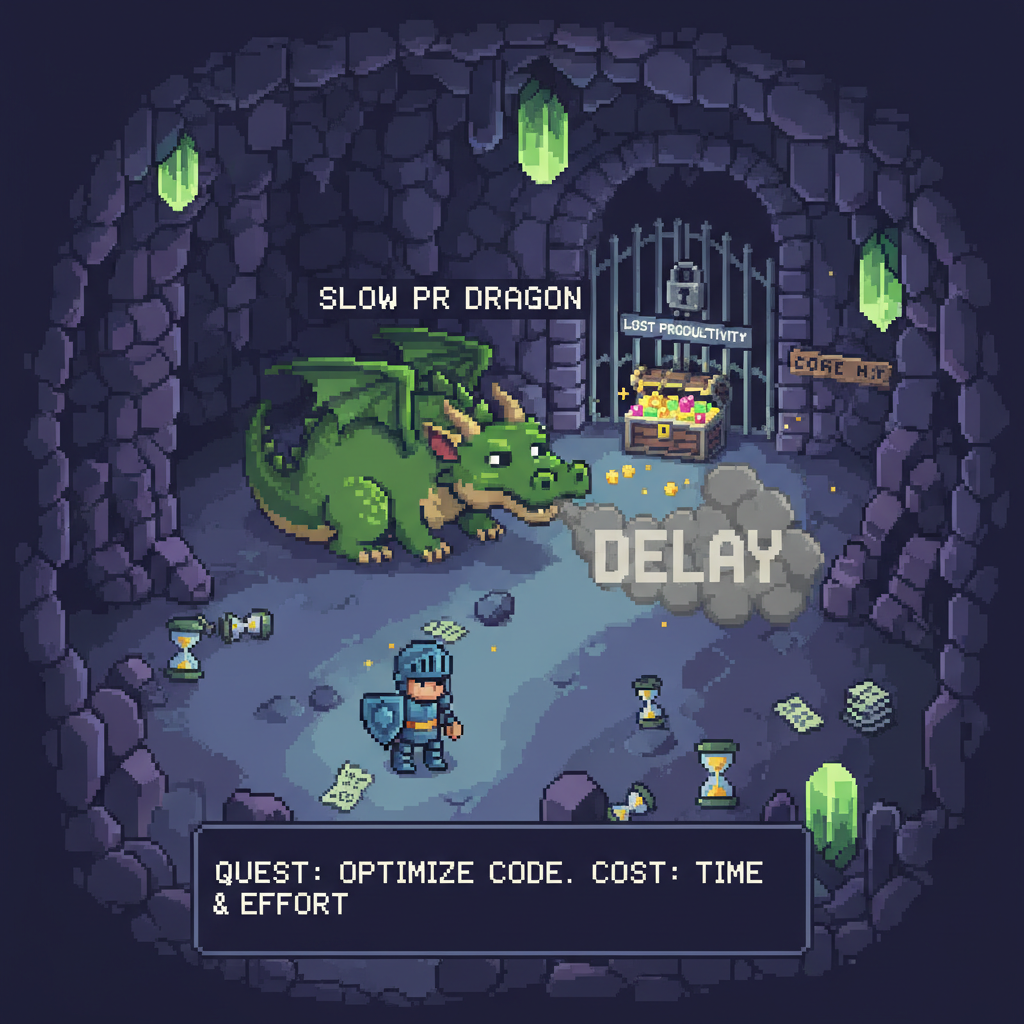
Every growing engineering team, at some point, hits a limit that has nothing to do with code quality or test coverage. It’s the PR review bottleneck. The code is ready, tests are passing, CI isn’t failing, but everything comes to a halt waiting for someone to review.
This delay doesn’t trigger alerts, doesn’t show up on a dashboard, and doesn’t catch anyone’s attention. It just keeps piling up and, in day-to-day work, turns into delivery delays. The team works all the time, produces code nonstop, but the speed at which you deliver real value to users only goes down.
Why Slow PR Reviews Hurt Development
The most visible impact of delayed reviews shows up in delivery metrics. Lead time increases because PRs sit in the queue. Cycle time becomes an unknown, since no one knows how long a change will take to be reviewed. Planning gets harder, and deployment frequency drops, because work piles up in the “review” column.
What starts as a small delay in one PR keeps multiplying. While waiting, the developer picks up another task, stacks more changes, and ends up creating a large, hard-to-review PR. In other cases, the branch becomes so outdated that resolving conflicts turns into a separate job.
When the review finally happens, it’s often in “let’s just get this done” mode. The pressure to ship leads to shallow analysis. And that’s how bugs start slipping through, and production failure rates go up.
Context switching, fatigue, and burnout in code review
Beyond metrics, there is a clear human cost. Coming back to a PR two days later to reply to comments completely breaks your focus. You have to spend time trying to remember the context, re-understand the code, and rebuild your line of reasoning. This interrupts the work you were doing and creates frustration.
When this becomes routine, wear and tear shows up. Stress increases, satisfaction drops, and good engineers start looking elsewhere. Teams with broken processes end up losing great people.
Often, the problem starts when a few people become “owners” of reviews. A small group of more experienced engineers ends up responsible for most PRs. They get overloaded, the queue grows, and the entire team starts depending on them.
Their experience is important, but turning them into the only point of validation creates a bottleneck. This slows everyone down and, in the end, leads to burnout among the reviewers themselves.
When a stalled PR blocks the rest of the work
A stalled PR is almost never an isolated problem. It usually starts blocking other things. A teammate waits for the merge to start a dependent feature. Or you yourself need that change before moving on to the next part of a larger epic.
Little by little, multiple pieces of work begin to depend on that review that isn’t moving. An invisible queue of blocked items forms, one that doesn’t show up on any board. From the outside, it looks like everyone is working in parallel. In practice, a lot of work is stuck waiting for approval.
As a result, the team’s speed becomes an unknown. Everything starts to depend on the reviewers, and that responsibility almost always ends up concentrated in a few people who are already overloaded.
What slow reviews do to team velocity
The friction caused by slow reviews doesn’t stop at delaying a single PR. Over time, it reduces the team’s ability to deliver. What starts as small delays turns into a rhythm problem.
How this shows up in DORA metrics
If you track DORA metrics, you’ll see the impact of slow reviews show up first in your Lead Time for Changes. This metric measures the time from the first commit to production deployment, and “time waiting for review” is usually the largest and most volatile component. Even if your team is extremely fast at writing code and your CI/CD pipeline is fully optimized, a multi-day review cycle will destroy your lead time.
Your Deployment Frequency also suffers. When changes take longer to pass through the review process, fewer of them make it to production in a given period. This leads to larger and riskier deployments, because features end up being bundled out of necessity. You enter a cycle where long reviews create large PRs, and large PRs create even longer reviews.
How slow reviews affect team morale
Nothing drains an engineer’s motivation faster than feeling that their work is stuck in a queue. When you put effort into solving a problem and the result just sits there, it sends the message that your contribution isn’t a priority. That’s a major demotivator.
Over time, this wears down team morale. When reviews turn into long discussions about personal taste, style, or undocumented rules, people start to hesitate and think twice before opening a PR.
They start holding back changes, bundling everything into one big PR to “suffer less,” or avoiding refactoring because they know the review will be painful. As a result, the team takes fewer risks and innovates less.
The business impact
The final cost of a slow review process is measured in missed opportunities. Longer lead times mean slower feedback cycles from users. The longer it takes for a change to go from an engineer’s laptop to production, the longer it takes to find out whether you built the right thing.
A company that learns slowly can’t adapt quickly.
Competitors that iterate faster keep pulling ahead.
A slow review process doesn’t just delay new features. It delays team learning, hypothesis testing, responding to market changes, and delivering value to customers.
Improving the PR review flow
Fixing a slow review process requires treating it like any other engineering system. It needs clear goals, defined processes, and the right tools to support the people involved.
Setting clear SLAs and PR size limits
Predictability is the first goal. Your team needs a shared understanding of what to expect from the review process.
- Review SLAs: Set a team agreement on review response times, such as a first review within four business hours for PRs below a certain size. This isn’t about blaming individuals, but about making the process predictable for everyone.
- PR Size Limits: Keep PRs small and focused. A pull request should represent a single logical change. A 1,000-line PR is hard to understand and almost impossible to review properly.
- Define a flexible or fixed line limit to encourage the team to break up work. Small PRs are faster to review, easier to understand, and carry less risk when merging.
Making reviewers’ work easier
Code review is a difficult skill, and reviewers need support to be effective and consistent.
- Automate the Small Stuff: All discussions about style, formatting, and lint rules should be handled by a machine before the PR is even opened. Use automated formatters and linters in pre-commit hooks or CI checks. This removes noise from reviews and lets people focus on what matters.
- Define What “Good Enough” Means: Document what a good review should aim for. Is the goal to catch every possible flaw, or to confirm that the logic is sound, tests are sufficient, and the change doesn’t introduce obvious bugs? Creating a clear checklist or set of guiding principles can help a lot.
- Distribute Ownership: If only one or two senior engineers can review critical code, you have a bus factor, not a process. Use ownership tools to route reviews automatically to the right people, and invest in knowledge sharing so more team members can review different parts of the codebase.
Using automation and AI
Automation is the key to scaling your review process without exhausting the team. The goal is to remove repetitive, operational work from human reviewers. AI-based tools can provide immediate and consistent feedback on common issues, freeing senior engineers for higher-level concerns.
Instead of a human pointing out that a variable could have a clearer name or that an edge case lacks a test, an AI tool can do that instantly. This brings feedback forward for the author and cleans up the PR before a human even sees it. The human reviewer can then focus on the things machines can’t handle:
- Is this change aligned with product direction?
- Is this the right architectural approach for our long-term goals?
- Are potential failure modes and user impacts well understood?
AI doesn’t replace the reviewer. It acts as a tireless, experienced assistant that performs the first pass, allowing humans to focus on complex, contextual decisions that truly require their expertise.
How to improve the PR process gradually
Your review process shouldn’t be static. It needs to evolve along with the team and the codebase.
- Measure What Matters: Track key metrics like “Time to First Review” and “Time to Merge” for each PR. Identify outliers. Do certain types of changes always take longer to review? Is one person consistently a bottleneck?
- Run Process Retrospectives: Regularly discuss the review process in team retrospectives. Use collected data to guide the conversation. What’s working well? What’s creating friction?
- Experiment and Iterate: Test small changes and measure the impact. Maybe you try a “no-review Friday” policy to create focus time. Maybe you test a new AI review tool in a single repository. Treat your engineering process with the same iterative, data-driven approach you use for your product.
When you take care of the review process, it stops being a burden and becomes something that helps the team learn, write better code, and deliver more safely.