The challenge of managing multiple projects as a Tech Lead
 Edvaldo Freitas

Your scope as a Tech Lead almost never stays confined to a single, clean workstream. As a product grows, you end up responsible for a new feature initiative, a critical infrastructure migration, and a lingering performance issue, all at the same time. This isn’t a promotion; it’s an expansion of responsibility that quietly creeps in until you find yourself spread across three different stand-ups, answering questions about domains you haven’t had time to think deeply about in weeks.
The immediate result is a huge spike in cognitive load. You’re holding multiple complex system diagrams in your head, trying to recall the specifics of a data model for one project while a stakeholder from another is pinging you about their timeline. The pressure to keep all the plates spinning forces a reactive mode of operation, where multitasking feels like the only option, even though we all know the heavy penalty of constant context switching.
The Systemic Challenges of Capacity and Focus
When everything feels slow despite everyone being busy, it’s tempting to look for individual productivity hacks or better time management techniques. But the root cause is usually systemic. The problem isn’t how you manage your calendar; it’s that the system is overloaded, and the assumptions about team capacity are fundamentally broken.
Resource Allocation
Most planning starts with an optimistic view of team bandwidth. We map out projects as if they will be worked on in isolation, with developers dedicating 100% of their focus. In reality, that focus is fragmented. A developer assigned to Project A still gets pulled into on-call rotations, bug fixes from their previous work on Project B, and code reviews for Project C. The actual available bandwidth is much lower than what the roadmap assumes, and this mismatch creates a cycle of missed deadlines and rushed work. Output doesn’t just degrade linearly under these conditions; it falls off a cliff once the team hits a certain threshold of cognitive overload and fragmentation.
The Productivity Drain of Constant Context Switching
Every time an engineer has to switch from thinking about a Kubernetes operator configuration to a complex SQL query for a different project, there’s a significant mental cost. The context from the first task gets flushed, and it takes time to load the new one. When a team is responsible for multiple unrelated projects, these switches happen all day long. Interruptions from different Slack channels, competing stakeholder requests, and unexpected bugs from various domains create a constant churn that destroys any chance for deep work. As a leader, one of your most important jobs becomes creating an environment that actively protects focused time, which is nearly impossible when the team’s mandate is too broad.
Dealing with competing priorities
Without a clear framework for prioritization, the “annoying” stakeholder often wins. This leads to a reactive cycle where the team bounces between strategic initiatives, urgent customer requests, and critical maintenance. The most difficult part is advocating for the invisible work, like paying down technical debt or refactoring a brittle module. These tasks have no external stakeholder championing them, but neglecting them guarantees that all future projects will be slower and more painful. Your role shifts from technical guidance to making a business case for technical health, connecting a refactor today with the ability to deliver a key feature next quarter.
The Compounding Effects on Quality and Team Health
A perpetually overloaded system doesn’t just move slower; it starts to break down in predictable ways. The small compromises made to keep things moving accumulate, affecting the codebase, the architecture, and the team itself.
Cross-Project Dependencies and Unforeseen Bottlenecks
When you’re managing separate projects, it’s easy to miss the subtle ways they connect. A delay in one team’s API development can completely block another team’s frontend work. These dependencies are often unmapped, living only in people’s heads until something goes wrong. A single person who is the sole expert on a legacy service becomes a bottleneck for three different initiatives. The only way to manage this is to stop viewing projects as independent silos and start mapping them as an interconnected system, proactively identifying and tracking the dependencies between them.
The weight of accumulating technical debt
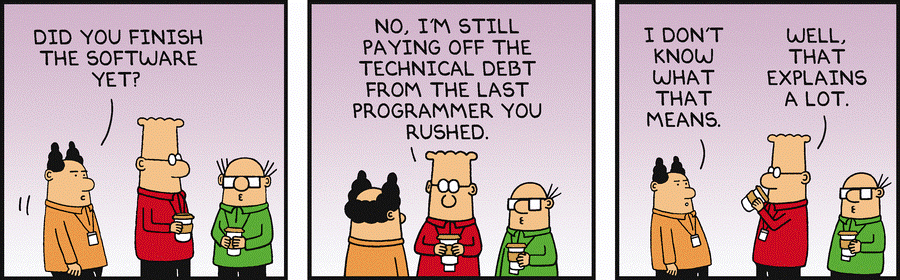
In a multi-project environment, “cutting corners” becomes a rational survival strategy. When faced with a tight deadline for one project and an urgent request from another, it’s almost always easier to write the quick hack than to do the “right” thing. Each of these small decisions adds up, and the accumulated technical debt acts as a drag on all future development. Simple changes start requiring complex workarounds, and the team’s velocity slows down.
Preserving Team Morale and Preventing Burnout
The human cost of chronic overload is severe. Engineers become demoralized when they can’t take pride in their work because they’re always rushing. Unclear priorities and constantly shifting goals create a sense of chaos, leading to frustration and burnout. Adding more pressure never accelerates delivery in these situations; it only accelerates attrition. As a leader, your most critical responsibility is to model sustainable work practices and be the person who protects the team from unrealistic expectations. This often means saying no, which is one of the hardest but most necessary parts of the job.
Some frameworks Tech Leads can use to manage multiple projects
Getting out of this reactive trap requires moving from simply managing projects to actively shaping the environment. This involves establishing a few frameworks that bring clarity, distribute responsibility, and create more sustainable workflows in both the short and long term.
Shifting from Project Management to Portfolio Optimization
Instead of treating projects as a checklist to be completed, view them as a portfolio of investments. This means thinking about how they relate to each other.
- Cross-project prioritization: Is it possible to organize projects so that the learnings or capabilities built in the first one directly benefit the second? For example, building a new authentication library for one project that can then be used by two others.
- Resource Constraints: Identify cross-project constraints early. If you only have one database expert and three projects need database work, that needs to be factored into the timeline for all three. Don’t pretend you can do them in parallel.
- Holistic View: Use tools like a multi-project Kanban board to visualize all work in one place. This makes the competing demands visible to everyone, including stakeholders, and forces a more realistic conversation about what’s possible.
Who decides what (and why)
A Tech Lead who is the bottleneck for every decision is a system failure. The goal is to push decision-making down to the people with the most context. Define who owns what. For example, a sub-team might own the architectural decisions for their set of microservices, while a chapter lead owns the standards for frontend development. This moves the team from endless debate to clear accountability. Empowering team members with defined boundaries of ownership not only speeds things up but also develops their skills and sense of responsibility.
Distributing decisions and responsibility
Delegation isn’t just about offloading tasks; it’s a core strategy for managing workload and growing your team. When you delegate a piece of a project, you’re also delegating the responsibility and authority that comes with it. This means providing clear expectations and the necessary support, but then trusting your team to execute without micromanagement. Doing this effectively frees you up to focus on the higher-level concerns that only you can handle, like cross-team alignment, architectural strategy, and stakeholder negotiations.
Building a culture of communication
When multiple workstreams are in flight, communication needs to be solid to avoid turning into chaos. That’s why you need to design clear protocols to manage the flow of information.
- Consistent rhythms: Create regular, lightweight mechanisms, like a shared weekly update document or a short demo. This keeps everyone aligned without adding a meeting overload.
- Shared Sources of Truth: Use dashboards or shared project boards that pull information directly from your ticketing system. This provides real-time visibility and prevents stakeholders from having to ask you for status updates constantly.
- Minimize Interruptions: Establish clear channels for communication. For example, use a specific Slack channel for urgent operational issues and direct all feature requests and planning questions to your ticketing system. This helps protect the team’s focus.
These frameworks are a good starting point because they force conversations that usually stay implicit: what’s at stake, what depends on what, who decides what, and what actually fits into the same quarter. That takes weight off your shoulders and reduces the need to be involved in everything.