Scaling DevOps Culture: From Improvised Scripts to Platform Engineering
 Edvaldo Freitas
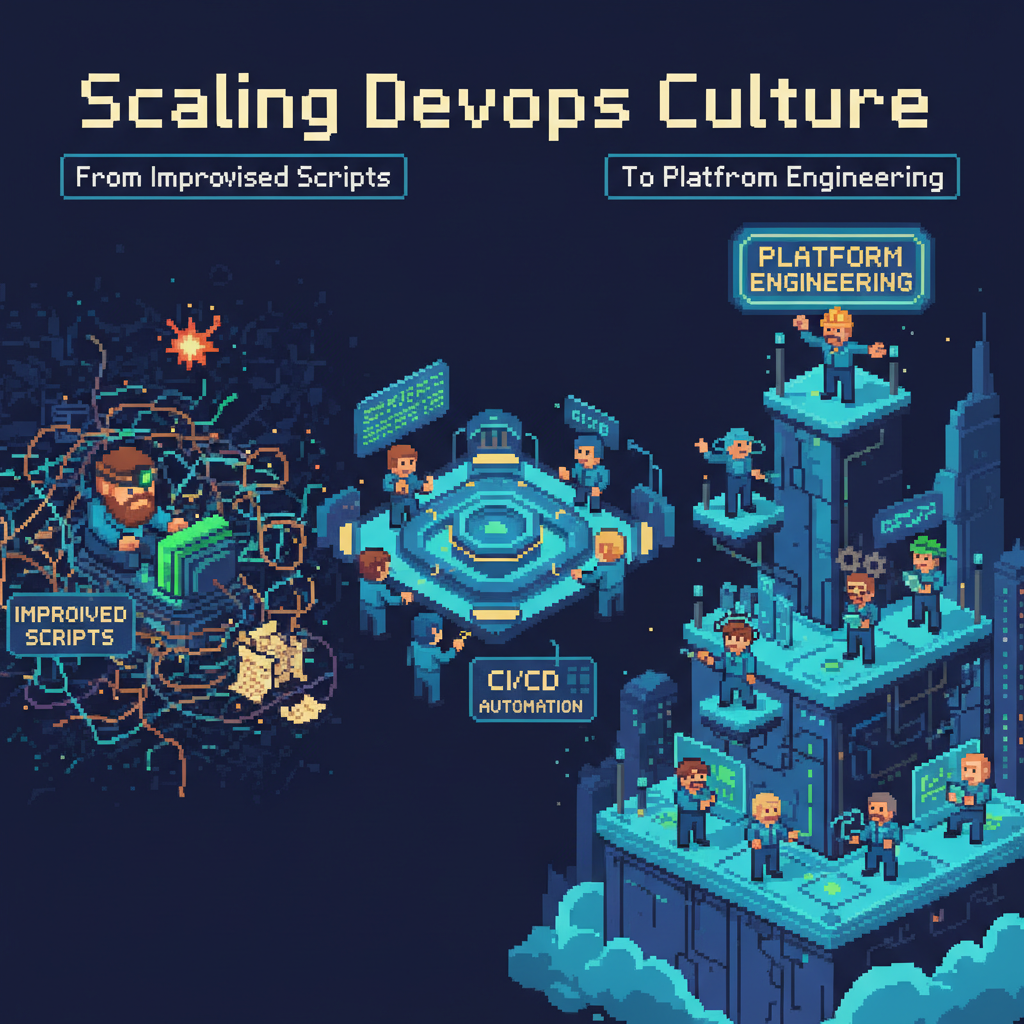
The collection of scripts, manual configurations, and unwritten rules that helped your company get started will eventually begin to hold you back. What once felt improvised and efficient becomes slow and fragile as the team grows. This is a predictable breaking point in an organization’s DevOps culture. The systems that helped a team of ten people move quickly now create friction for a team of fifty. Operational work spreads out, slowing down feature development until you are spending more time dealing with custom deploy logic than writing code.
The costs of “good enough” automation
Early automation is usually just about being practical. You write a script that solves the immediate problem, set up the CI job that gets the build running, and move on. This works for a while, but the cumulative weight of these one-off solutions eventually starts pulling the entire engineering team down.
The limits of ad hoc scripts and tribal knowledge
The first signs of trouble are inconsistencies. Team A’s services run on a slightly different base image than Team B’s because they were configured months apart. One developer’s local environment works perfectly, while a new hire spends their first week fighting with dependencies because a setup script is outdated. It is a direct tax on productivity.
These improvised and undocumented setups end up creating recurring problems. Staging environments start drifting away from production as manual changes accumulate. As a result, deploys become less predictable.
Engineers end up getting pulled into tasks that have no direct connection to the product, such as debugging infrastructure, manually provisioning resources, or investigating deployment failures caused by differences between environments.
Pipelines start depending on specific scripts run locally or CI configurations that are difficult to understand and maintain. And new engineers face a steeper learning curve, not only to understand the codebase, but also to figure out which tools and processes they need to use in order to work on the system.
When “you build it, you run it” hits a limit
The principle of “you build it, you run it” is a great way to create a sense of ownership. A product team is responsible for its service, from code all the way to production. In a small company, this works well. At scale, the problems start to show.
When you have five, ten, or twenty teams all following this principle on their own, duplication appears. Each team builds its own Terraform modules for the same S3 bucket configuration. Each team creates its own alerts for CPU usage. Each team writes its own deploy pipeline for a standard web service.
This model creates bigger problems. The company pays for the same infrastructure and CI/CD work repeatedly, solved in slightly different ways by each team. Without a centralized approach, ensuring that all services follow security best practices or compliance standards becomes almost impossible. The burden ends up falling on individual teams that may not have the required expertise. Product engineers are forced to become specialists in Kubernetes, cloud networking, and observability tools just to keep their features running. Their attention gets split between building the product and managing its operational details.
Platform engineering as an evolution of DevOps culture
The answer is to evolve the environment where developers work while keeping the principle of ownership. That is the idea behind platform engineering. It changes the question from “How do we help each team run their own infrastructure?” to “How do we provide a platform that makes running infrastructure simple and consistent for everyone?”
Going beyond tool-centric DevOps
Many organizations see DevOps only as a set of tools such as CI/CD servers, infrastructure-as-code files, and monitoring dashboards. A platform approach is more about offering shared services and clear workflows.
Instead of simply giving developers raw access to cloud provider tools, a platform offers a higher level of abstraction. A developer should not need to write a complex CI/CD pipeline from scratch. They should be able to add a simple configuration file in the repository that connects to a standard pipeline managed centrally.
This means treating your internal infrastructure as a product. Your developers are your users. The success of the platform is measured by how much faster and more reliably they can deliver value to real customers. Self-service is a huge part of this. A developer should be able to create a new testing environment or check service logs without opening a ticket and waiting for another team.
Redefining roles and responsibilities in a scaling DevOps culture
This shift changes team structure and responsibilities. A common and effective pattern is to create a dedicated platform engineering team. This team is different from a traditional operations team that only acts as a gatekeeper. Its main job is to improve the developer experience and make engineers more effective.
The platform team concentrates the operational knowledge of the system. They build and maintain the core infrastructure, the CI/CD systems, and the observability stack. They also provide the tools and services that product teams use every day.
This creates a collaborative relationship. The platform team builds the standard path for development, and product teams use that standard to move faster. Product teams remain responsible for their own services, but the heavy lifting of the underlying infrastructure is already solved for them. That way they can focus on business logic, while the platform team ensures the infrastructure is secure and reliable.
Building your internal developer platform
Creating a platform is an ongoing process of identifying what slows developers down and building solutions to fix it.
Defining platform capabilities
Start by identifying the most common needs and problems across your engineering teams. The first platform services usually cover a few core areas.
You can offer standardized CI/CD pipelines, with reusable templates or workflows that handle build, testing, security analysis, and deployment for common application types. This way the developer only needs to define what is specific to their service.
Another important area is environment management, offering a simple way to create and destroy development, testing, and staging environments that stay consistent with production.
It is also worth centralizing logs, metrics, and traces. Services can be instrumented automatically with standard configurations, giving teams immediate visibility without requiring a lot of manual setup.
Finally, provide a secure way to manage application secrets and adopt strong security practices by default, such as secure network rules and IAM policies.
Adopting a product mindset for internal tools
Your platform will only succeed if developers actually use it. You cannot simply build it and assume they will show up. You need to treat it like any other product.
That means collecting feedback constantly. Talk to developers, run quick surveys, and create open office hours to answer questions and understand how they work and where they struggle. Use that information to decide what to build next.
Prioritize initiatives that solve real and recurring problems for multiple teams, not just ideas that seem technically interesting. Whenever possible, try to quantify the impact. Ask whether a new tool will save each developer an hour per week or reduce deployment failures by 50%.
It is also important to measure success by tracking adoption of platform services and developer feedback. Look at metrics such as deployment frequency, lead time for changes, and mean time to recovery. A good platform should improve these numbers.
Principles for a platform team
The culture of a platform team determines whether it becomes a help or an obstacle. Some principles tend to work well for successful platform teams.
Focus on helping developers, not controlling them. The platform should provide a standard path, with strong tools and well-supported patterns, but it should also allow alternatives when a team has a good reason to do something differently.
Treat platform services as internal products with clear APIs, good documentation, and easy-to-find materials. Build something small that already delivers value, put it into use, and evolve it based on feedback from teams. The idea is to avoid long cycles trying to build a “perfect” solution that may not solve what developers actually need.
It is also important to communicate continuously. Announce new features, changes, and deprecations through internal demos, posts, or newsletters. Teams should always know what the platform offers today and what is changing.
Making the transition without causing disruption
The goal is to evolve infrastructure gradually without needing to stop product development for a year to rebuild it.
Start with the biggest problem, the thing that generates the most complaints or wastes the most time. It might be inconsistent local environments or the manual process for creating a new service. Solve that first.
For each new platform service you build, provide clear instructions and support to help teams migrate from the old improvised way of working. Sometimes that means creating tools that automate parts of the migration.
The first team that adopts your new CI/CD pipeline and cuts deploy time in half will likely become a strong advocate for the change. Results like that help build momentum and encourage other teams to adopt the new approach.