Node.js Code Review: Best Practices, Checklist, and AI Tools (2026)
 Edvaldo Freitas

Code review is one of the best ways to improve code quality in a growing Node.js codebase. It helps teams catch bugs earlier, keep patterns consistent, and avoid changes that make services harder to maintain over time. In a Node.js code review, that matters even more because many problems are easy to miss in a quick pull request. Async flows, runtime validation, middleware order, external calls, and query behavior can all look fine at first and still create expensive issues in production.
That is why a good review process for Node.js should do more than check style and names. It should help the team look at runtime behavior, system boundaries, operational risk, and long-term maintainability. In this guide, I will go through a practical checklist for reviewing Node.js code, common problems that AI tools tend to catch well, and how I would set up a review workflow for a team building modern Node.js services.
Challenges in Node.js code review
Node.js code often looks simpler than it really is. A short route handler, for example, can hide weak input validation, missing authorization checks, expensive queries, or an external call with no timeout. In the diff, the change looks small. In production, though, the behavior depends on what happens at runtime, under concurrency, and across service boundaries.
That is why reviewing Node.js is not just about looking at the code inside a file. It is about understanding how that code behaves when it receives real traffic, processes untrusted input, talks to the database, publishes to a queue, or depends on a package that just changed versions. A good reviewer needs to follow the path the code takes through the application, not just judge whether the implementation looks clean.
The areas I would always review first
In Node.js, many important problems do not show up as an obvious error in the pull request. The change can look small, pass the tests, and still create production risk. So before spending time on naming, formatting, or small refactors, I would look at these areas first.
runtime boundaries: Node.js services receive data from many places: query params, request bodies, headers, webhook payloads, and queue messages. If those inputs are not validated carefully, the issue can show up as an authorization bug, a validation failure, or leakage across tenants.
async behavior: many reliability problems come from promises without clear handling, retries with side effects, and async flows that work in the happy path but fail badly under load or partial failure.
performance risk: blocking the event loop, using Promise.all without limits, or doing expensive I/O inside a critical flow can easily pass review. Each line looks simple, but the whole change can become heavy in production.
data access: a short handler can still trigger a query that is too heavy, too broad, or inconsistent under load. This is one of the most common ways a small change becomes a problem after deploy.
operational impact: changes to packages, timeouts, logs, configuration, and observability also need to be part of the review. In Node.js, these details often define whether an incident will be easy to understand or hard to investigate.
I prioritize these areas because this is where small changes tend to create the most expensive problems. Cosmetic adjustments can wait. Runtime errors and operational failures almost never can.
A practical Node.js code review checklist
Input validation and runtime boundaries
- request input: are
req.body,req.query,req.params, headers, cookies, and webhook payloads validated before use? - runtime assumptions: does the code rely on TypeScript or casts where the runtime still accepts different formats?
- external data: are responses from third-party services treated as untrusted until they are parsed and validated?
- configuration input: are environment variables parsed and checked instead of being assumed correct?
Authorization and tenant isolation
- auth checks: does the route, command, or job apply authentication and authorization at the right level?
- tenant boundaries: does the code use IDs from the request in a way that could weaken isolation between tenants or accounts?
- ownership rules: are user and resource ownership rules explicit before sensitive actions happen?
Async flow
- promise handling: is every promise awaited, returned, or intentionally left in the background with explicit error handling?
- side effects: if a process retries or runs twice, does the code remain safe?
- job behavior: do workers, schedulers, and queue consumers make their assumptions about retry and delivery clear?
Error handling
- expected versus unexpected failures: are validation errors, domain errors, and system failures handled differently?
- error visibility: does the code preserve enough context to debug what failed?
- safe responses: do error responses avoid leaking stack traces, secrets, or internal structure?
Timeouts, cancellation, and external calls
- timeouts: do external HTTP calls, storage, cache, and brokers define explicit timeouts?
- abort behavior: does the code pass abort or cancellation signals where the stack supports them?
- third-party reliability: if the dependency becomes slow or returns bad data, does the application still behave predictably?
Performance and event loop
- blocking work: does the PR add synchronous filesystem access, heavy CPU transformations, large JSON parsing, compression, or encryption on a hot path?
- memory usage: does the code load more data into memory than it needs?
- cost on the request path: could this change increase latency or reduce throughput under real load?
Database access and query behavior
- query shape: does the ORM or query builder generate the query the author expects?
- pagination and filters: does the code avoid accidental broad reads or missing limits?
- projection: does the API return only the fields it needs?
- write behavior: are transactions or conflict-handling patterns clear where multiple writes need to remain consistent?
Concurrency and consistency
- parallel work: does
Promise.allor batch fan-out create more concurrency than the system can safely handle? - duplicate execution: does the code behave safely if the same event or job is processed more than once?
- races: are there obvious race conditions in writes, state transitions, or shared resources?
Middleware, HTTP pipeline, and execution order
- middleware order: if the PR changes Express, NestJS, or Fastify middleware, do auth, validation, logging, rate limiting, and error handling still happen in the right order?
- single responsibility: is the middleware focused, or is it doing too much work for one layer?
- HTTP behavior: do routes return the right status codes and predictable payloads for success and failure cases?
Dependencies and supply chain
- package changes: does a new dependency or version upgrade deserve manual review for security history, maintenance, or install scripts?
- lockfile review: are lockfile changes and transitive dependencies being treated as part of the review surface?
- need: is the new dependency worth the long-term cost of maintaining it?
Configuration and environment variables
- startup validation: does the application fail fast when configuration is missing or malformed?
- safe defaults: are defaults explicit and appropriate for the environment?
- secret handling: do secrets stay out of code, logs, example files, and versioned configuration?
Observability
- logs: if this fails in production, will the logs explain what happened without exposing sensitive data?
- metrics and traces: does the change preserve enough visibility into latency, retries, external calls, and job behavior?
- correlation: can the team connect a user-visible failure to the internal path that caused it?
Tests
- coverage by risk level: are tests added where the risk actually is, such as route boundaries, auth rules, queue behavior, or failure modes?
- unhappy paths: are malformed input, timeout paths, retries, and edge cases covered?
- real formats: do the tests reflect runtime behavior instead of only ideal typed inputs?
Readability and maintainability
- clarity: are names, module boundaries, and control flow easy to understand?
- coupling: does the change create hidden dependencies between route code, service code, data access, and infrastructure?
- future review cost: will the next reviewer understand this code quickly, or will they need to reverse-engineer the intent?
Common Node.js problems an AI tool can help find
Using untrusted input too early
Before:
app.get('/projects', async (req, res) => {
  const organizationId = req.query.organizationId as string;
  const projects = await projectService.listForOrganization(organizationId);
  res.json(projects);
});
After, AI suggestion:
app.get('/projects', async (req, res) => {
  const rawOrganizationId = req.query.organizationId;

  if (typeof rawOrganizationId !== 'string') {
    return res.status(400).json({ error: 'organizationId must be a string' });
  }

  const projects = await projectService.listForOrganization(rawOrganizationId);
  res.json(projects);
});
Missing timeouts in external calls
Before:
export async function fetchProfile(userId) {
  const response = await fetch(`https://profiles.example.com/${userId}`);
  return response.json();
}
After, AI suggestion:
export async function fetchProfile(userId) {
  const response = await fetch(
    `https://profiles.example.com/${userId}`,
    { signal: AbortSignal.timeout(3000) }
  );

  if (!response.ok) {
    throw new Error(`profiles returned ${response.status}`);
  }

  return response.json();
}
Broad concurrency without limits
Before:
await Promise.all(orderIds.map((id) => syncOrder(id)));After, AI suggestion:
for (let i = 0; i < orderIds.length; i += 20) {
  const batch = orderIds.slice(i, i + 20);
  await Promise.all(batch.map((id) => syncOrder(id)));
}
Blocking the event loop on the request path
Before:
import { readFileSync } from 'node:fs';

app.post('/preview-email', (req, res) => {
  const template = readFileSync('./templates/email.html', 'utf8');
  res.send(render(template, req.body));
});
After, AI suggestion:
import { promises as fs } from 'node:fs';

const template = await fs.readFile('./templates/email.html', 'utf8');

app.post('/preview-email', (req, res) => {
  res.send(render(template, req.body));
});
What I would look for in an AI code review tool for Node.js
I would care less about whether the tool says it supports JavaScript or TypeScript and more about how much it helps with the real review problems in Node.js.
- repository-specific rules: can the team encode standards for routes, workers, packages, and architectural boundaries?
- cross-file context: can the tool reason beyond the changed line and understand the surrounding flow?
- dependency awareness: does the review flow treat package and lockfile changes as real code review material?
- signal over noise: does the tool reduce repetitive failures or just create more comments to ignore?
Good code review tools for Node.js teams in 2026
A good code review tool for Node.js is not just the one that comments on the pull request. It needs to help the team find problems that easily slip through small diffs: runtime validation, tenant isolation, async flow, concurrency, bad queries, and operational impact.
The options below have different approaches. It is worth looking less at the feature list and more at the type of review each one actually improves.
Kodus

For Node.js teams, Kodus makes more sense when review needs to reflect the real context of the repository, not just generic best practices. This matters in codebases with APIs, workers, queues, external integrations, and internal rules that do not show up in linters.
The practical difference comes down to three points.
The first point is repository context. In Node.js, the bug is rarely only in the changed line. It usually appears in the path between route, middleware, service, query, queue, and external integration. That is why reviewing only the diff is almost never enough. What makes Kodus different is evaluating the change inside that larger flow, considering the repository structure and the rules the team has defined for each part of the system.
Second, custom rules in natural language with Repository Rules and Kody Rules, useful for turning route patterns, middleware, jobs, boundaries, and data access into review criteria.
Third, control: Kodus is open source, supports BYOK, is model-agnostic, and allows teams to use MCP plugins to bring external context, such as specs and tickets, into the review.
In practice, this helps a lot in Node.js because many serious problems depend on context. A generic reviewer can find local bugs. Kodus makes more sense when the team wants to create rules like: “no public route should use req.query or req.body in authorization decisions before validating the runtime shape” or “changes to queue consumers need to be reviewed with a focus on idempotency and retry safety”.
This kind of rule is not cosmetic. It targets expensive, recurring bug classes in Node.js APIs.
CodeAnt AI
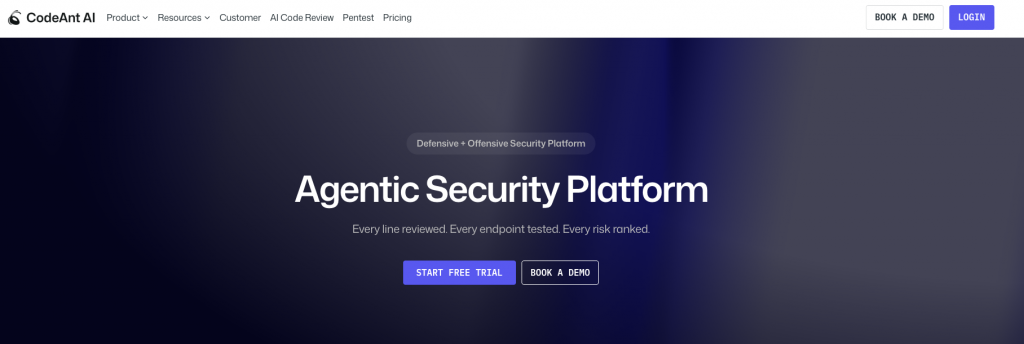
CodeAnt leans more toward security and code health than pure contextual review. The platform combines pull request review, IDE, CLI, and a unified view of code, dependencies, infrastructure, and secrets.
For Node.js teams, this makes sense when review needs to look more at risk, severity, and security posture than internal architecture conventions. The strong point is combining line-by-line comments with codebase context and a clearer layer of findings and prioritization. It also supports custom rules by repository and file glob, which helps apply specific policies to routes, services, or handlers.
In practice, I see CodeAnt working better for Node.js teams that want to use review as part of a broader security and quality pipeline. It seems more useful when the question is “which changes increased risk?” than when the question is “how do we apply the internal rules of our monorepo and service architecture?”.
For a Node.js API with a lot of public surface area, sensitive integrations, or compliance requirements, this approach can help. For a team that wants review more tied to boundaries and internal patterns, the result will depend a lot on the quality of the configured rules.
Graphite

Graphite has a slightly different approach. It is stronger as a PR workflow platform, especially for teams that live in GitHub and want to add automated review without changing much of their current process.
Graphite Agent focuses on fast setup, comments directly in the PR, concrete fix suggestions, custom rules, and acceptance analytics by rule. For Node.js, this helps when the main problem is review speed and feedback quality in pull requests, not deeper repository governance.
I would place Graphite as a good option for Node.js teams that already have strong PR discipline, want high-signal feedback on bugs, edge cases, security, and performance, and prefer to iterate quickly with custom prompts and exclusions.
The limit, compared with Kodus, is that the approach seems more centered on the GitHub PR flow and less on turning the repository into the source of truth for deeper operational and architectural rules. For day-to-day review, it may be enough. For Node.js teams that want to encode expected behavior by folder, boundary, service type, or internal domain policy, Kodus tends to be more interesting.
CodeRabbit

CodeRabbit sits in a good middle ground between broad coverage and convenience. It runs in PRs, IDE, and CLI, supports GitHub, GitLab, Bitbucket, and Azure DevOps, and detects guideline files like AGENTS.md, CLAUDE.md, and .cursorrules.
For Node.js teams, this helps reduce the gap between “the rules the team wrote in markdown” and “what the automated reviewer actually enforces”. The tool also seems well thought out for catching problems before the PR, which is useful in Node.js stacks with a lot of service, route, and integration code, where a simple mistake can spread quickly.
In practice, I see CodeRabbit as a good option for teams that want review across multiple surfaces and value the ability to use patterns that are already documented. It makes sense in Node.js when the goal is to increase review coverage without changing everything at once.
I would still put Kodus ahead when the team wants more control over the workflow, more model freedom, an open source posture, and the ability to bring external context through MCP plugins. CodeRabbit helps a lot with review distributed across PR, IDE, and CLI. Kodus tends to fit better when review needs to reflect how that repository and that team actually work.
Comparison of code review tools for Node.js
How I would introduce this process in a real team
I would start with a small checklist and a small set of rules. No blocking merges in the first month. No trying to automate every review habit at once. The goal at the beginning is to catch the problems the team already knows are expensive, then measure whether the feedback is actually useful.
For a typical Node.js service, I would probably start with three rule areas: runtime validation at public boundaries, timeout requirements for external calls, and tests for new endpoints or queue consumers. That already covers a large part of the expensive errors teams see in production.
After that, I would use real incidents to improve the checklist. If the team spends a day debugging a broken retry flow, a bad query, or a tenant isolation bug, that should become review knowledge. Good review systems get stronger because the team keeps feeding those systems with real failures, not because the checklist started big.
Frequently asked questions
How do you create a code review checklist for Node.js?
A good Node.js code review checklist should be short and focused on the points that most often create production problems. Instead of trying to cover everything, it is worth starting with higher-risk areas, such as runtime validation, authorization, async flow, external calls, queries, dependency changes, and tests. The best checklist is not the longest one. It is the one that helps reviewers avoid missing points that really matter in almost every PR. As the team learns from real bugs and incidents, that checklist can evolve with the codebase.
What should you review first in a Node.js code review?
Start with the points that most often break in production: runtime validation, authorization, async flow, external calls, queries, and dependency changes. In Node.js, a small PR can hide a route that trusts input too early, triggers unlimited concurrency, runs a heavy query, or calls an external service with no timeout.
What is the best code review tool for Node.js?
It depends on what the team needs. For quick adoption in the current PR flow, several tools can help. But if the team wants review with repository context, custom rules in natural language, external context through plugins, model choice, and more control over the workflow, Kodus is one of the most complete options for Node.js. This matters in codebases with routes, workers, queues, shared packages, and internal rules that do not show up just by looking at the diff.
Which AI code review tool is best for Node.js teams that need custom rules?
Kodus stands out here. Node.js teams often need rules that go beyond style, such as requiring runtime validation in public endpoints, checking tenant isolation, reviewing queue consumers with a focus on idempotency, or applying patterns by folder and service type. Kodus supports natural-language rules at the repository level, external context through plugins, and a model-agnostic flow, which gives the team more control.
Can AI code review catch async and promise problems in Node.js?
Yes. AI reviewers are often useful for missing await, weak timeout handling, broad concurrency patterns, and other async errors that can slip through a quick manual review.
Does TypeScript reduce the need for code review in Node.js?
TypeScript helps, but it does not replace code review. It catches many errors early and improves code structure, but it does not validate input at runtime, does not guarantee correct authorization, does not prevent event loop blocking, and does not make external integrations safe. In Node.js, many bugs appear exactly between the static type and the real behavior of the application.
Should package.json and lockfile changes be part of Node.js code review?
Yes. Dependency changes also need to be reviewed. A package upgrade can change installation, introduce security risk, change transitive dependencies, or create performance and maintenance cost. Reviewing only the application code and ignoring package.json or the lockfile lets too much risk through.
Should lockfile changes be part of code review in Node.js?
Yes. In Node.js, dependency and lockfile changes can affect security posture, installation behavior, and operational risk. They should be treated as part of the real review surface.
How should a team start improving code review in Node.js?
Start small. Use a short checklist, focus on the highest-risk areas, and add automation only where it clearly improves signal. A smaller review process the team actually follows is better than a perfect process nobody uses.