PHP Code Review: Best Practices + Tools (2026 Checklist)
 Edvaldo Freitas

Let’s be honest: most of us have a complicated relationship with code reviews. They can feel like a chore, a bottleneck, or even a personal critique. But when done right, a solid php code review process is the single highest-leverage thing you can do to improve your code, your team, and your product. It’s not about finding typos; it’s about collective ownership and building better software, faster.
For modern PHP—think PHP 8+, Laravel, or Symfony—the game has changed. We have powerful tools, strong typing, and mature frameworks. Our code reviews should reflect that maturity. This isn’t about nitpicking syntax that a linter can catch. It’s about a deep, collaborative analysis of what we’re building and how we’re building it.
Why Even Bother? (Seriously)
In a world of tight deadlines and mounting backlogs, it’s easy to see code reviews as a “nice-to-have.” I’d argue they’re the opposite. They’re a non-negotiable part of a high-performing team.
It’s your best defense against bad code – A review catches bugs, security holes, and performance sinks before they ever hit production. It’s exponentially cheaper to fix a problem in a pull request than it is to hotfix a live server at 2 AM.
It’s a knowledge-sharing machine – A junior dev learns framework idioms from a senior. A senior dev learns a new PHP 8.1 feature from a curious junior. Everyone gets a better understanding of the codebase, which kills knowledge silos. When someone goes on vacation, the project doesn’t grind to a halt.
It forces you to write better code – Just knowing someone else will read your code is a powerful motivator. You start thinking more clearly about variable names, method complexity, and the “why” behind your changes. Your first draft is instantly better.
The Anatomy of a Great Review
A great code review goes way beyond style guides. Your linter can handle PSR-12. A human reviewer should be focused on the things a machine can’t see. I like to think about it in layers, from the most abstract to the most concrete.
Logic & Architecture: The “Why” and “Where”
This is the most important part. Before you even read a line of code, ask yourself:
- Does this change solve the right problem? Look at the ticket or user story. Does the code actually do what was requested? It’s surprising how often there’s a disconnect.
- Is this code in the right place? Is a new business rule buried in a controller instead of a dedicated service class? Is a complex query living in a model instead of a repository? Good architecture is about putting things in the right buckets. This is your chance to enforce that.
- Is the approach sound? Is there a simpler way to do this? Is the developer using a design pattern correctly, or are they over-engineering a simple fix?
- How is this testable? If you look at the code and think, “I have no idea how I’d write a test for this,” that’s a huge red flag. It usually means the code is too tightly coupled. Encourage dependency injection and clear separation of concerns so testing isn’t an afterthought.
Security: Assume Malice
Every piece of code that touches user input or the database is a potential security risk. Your job as a reviewer is to be paranoid on behalf of your users.
Input is poison. Never trust it. Is all user-provided data being validated? That includes form data, URL parameters, and API inputs. In Laravel, are they using Form Requests? In Symfony, are they using the Validator component?
Output is dangerous. Are you preventing Cross-Site Scripting (XSS)? Frameworks like Laravel (with Blade’s {{ }} syntax) and Symfony (with Twig’s auto-escaping) do a lot of the heavy lifting, but be vigilant for places where raw output ({!! !!}) is used. Ask why.
Watch your queries. Are all database queries using the query builder or an ORM like Eloquent/Doctrine? This prevents most SQL injection attacks. If you see raw SQL with concatenated variables, hit the brakes immediately.
Performance: Avoid the N+1 Nightmare
A feature that works but grinds the system to a halt is a failure. Performance issues often creep in with small, seemingly innocent changes.
– The N+1 Query Problem. This is the classic PHP performance bug. A developer loads 100 posts, and then inside the loop, makes a separate query for each post’s author. Boom, 101 queries. Look for loops that perform database queries and check if eager loading (like Eloquent’s with()) can solve it.
– Algorithmic Complexity. You don’t need a CS degree to spot trouble. Is the code looping over a massive array inside another loop? That’s a potential performance cliff. Ask if a different data structure (like a hash map using array keys) could make the lookup faster.
– Caching Opportunities. Is the code calculating something expensive that doesn’t change often? Maybe it’s a candidate for caching. It’s a good time to ask, “Could we cache this result for a few minutes?”
Error Handling & Logging
Code that fails silently is a ticking time bomb. Good error handling isn’t just about `try/catch` blocks; it’s about what you do inside them.
- Are exceptions being handled gracefully? An empty `catch` block is a cardinal sin. At a minimum, errors should be logged.
- Are the log messages actually useful? A log that says “Error occurred” is useless. A good log message includes context: what user was affected, what data was being processed, and a stack trace. “Failed to process payment for user_id: 123 with order_id: 456. Exception: Stripe API connection timeout.” Now that’s a log you can work with.
The Human Element: Giving Good Feedback
How you communicate is just as important as what you communicate.
Ask, don’t tell. Instead of “Change this to a service class,” try “What do you think about extracting this logic into a dedicated service class? That might make it easier to test.” It opens a discussion instead of issuing a command.
Batch your comments. Don’t drip-feed comments over several hours. Do a full pass and submit your review all at once. It’s more respectful of the author’s time.
Praise in public. If you see a really clever solution or a clean piece of code, leave a positive comment! A good review isn’t just about finding faults.
PHP Code Review Checklist
Okay, theory is great, but what do you actually do when a new PR lands in your queue? Here’s a practical checklist. Don’t feel like you have to check every single box every time, but use it as a guide to train your eyes.
✅ First Pass: The Big Picture
- Clarity: Is the PR title and description clear? Do I understand what this change is for and why it’s needed?
- Scope: Is the PR focused on a single concern? Or is it a monster PR mixing a bug fix, a new feature, and a refactor? (Push for smaller, more focused PRs).
- Architecture: Does this code belong here? Is it following your application’s established patterns (e.g., Services, Repositories, Actions)?
✅ Logic & Correctness
- Functionality: Does the code do what it claims to do? Are there any obvious edge cases missed? (e.g., zero values, empty strings, nulls).
- Complexity: Is any method or function trying to do too much? Could it be broken down into smaller, more readable pieces?
- Readability: Are variable and method names clear and unambiguous? Could a new developer understand this code six months from now?
✅ Security
- Input Validation: Is all external input (POST, GET, API calls) being strictly validated?
- SQL Injection: Are all database queries using the ORM/Query Builder? No raw SQL with string concatenation?
- XSS Prevention: Is all output being properly escaped? Be extra suspicious of any `raw` or `!!` output.
- Authorization: Does the code check if the user is authenticated and authorized to perform this action?
✅ Performance
- Database Queries: Are there any loops making database queries? Check for potential N+1 problems and recommend eager loading.
- Data Handling: Is the code loading a huge amount of data into memory? Could it be processed in chunks or with a generator?
- Expensive Operations: Are there any slow operations (API calls, complex calculations) that could be moved to a background job or cached?
✅ Testing
- Test Coverage: Does the new code have corresponding tests? Do existing tests still pass?
- Test Quality: Do the tests actually assert something meaningful? Are they testing the happy path as well as failure cases?
- Testability: Does the code’s design make it easy to test? Or does it rely on global state and static methods that are hard to mock?
✅ Housekeeping & Style
- Linter/Static Analysis: Has the CI pipeline passed? (If not, the review shouldn’t even start).
- Comments: Are there comments explaining the “why,” not the “what”? Is there any dead or commented-out code that should be removed?
- Dependencies: Are new dependencies necessary? Have they been vetted?
PHP code review tools (2026)
A good PHP review process needs more than sharp reviewers. It needs a stack that catches repetitive problems early and lets humans focus on what actually requires judgment.
For a team using Laravel, Symfony, or plain PHP 8+, that usually means static analysis, formatting, tests, and a pull request review layer. These are different jobs. PHPStan or Psalm catch one class of problems. PHPUnit and Pest catch another. The review tool sits above that and answers a different question: does this change make sense in the codebase that already exists?
That is where the tools start to separate.
Kodus
Kodus is the first one I would put in place for PHP teams.
The reason is context. Many costly PHP mistakes are not syntax errors. They show up in validation flow, authorization checks, service boundaries, query behavior, framework conventions, and code that works, but will be painful to maintain in a few months.
Kodus was built for that kind of review. It looks at the pull request in the context of the repository, so the feedback does not get stuck in generic line-by-line comments.
The rule system matters too. Teams can write custom review rules in natural language, keep them in the repository, and sync rules they already use in tools like Copilot or Cursor. That makes a difference for PHP teams with their own framework patterns, internal architecture rules, or security conventions that linters do not fully capture. Besides creating your own, you can use the Kodus rule library with hundreds of rules created by the community.
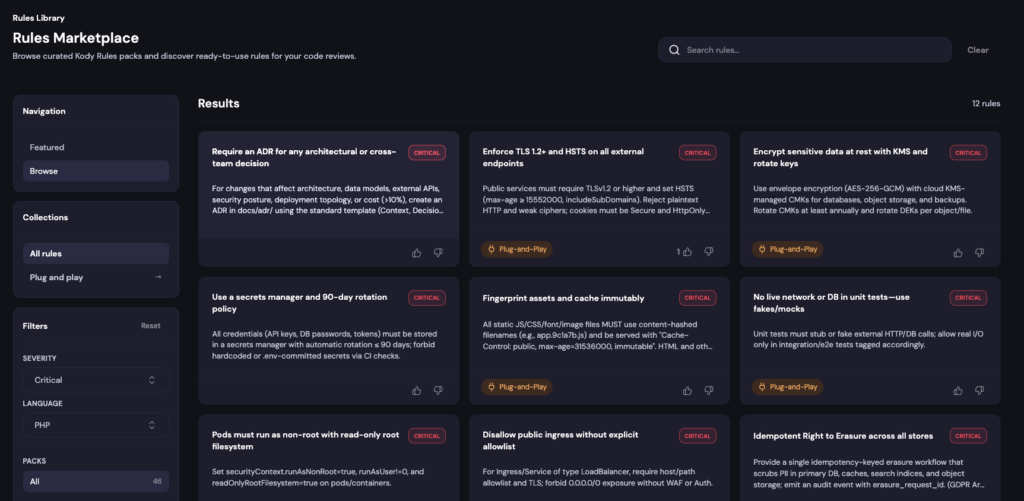
There is also a control question here. Kodus is open source, model agnostic, and works with BYOK. If the team cares about model choice, token cost, or having more control over how review works, that is a better setup than tools that hide the model layer.
For a PHP team that wants reviews aligned with the repository, the rules, and the team’s workflow, instead of adapting the process to the tool, Kodus is the best fit on this list.
CodeRabbit
CodeRabbit is a good choice when the main goal is to get fast AI reviews with little setup.
It reviews pull requests automatically, updates feedback on new pushes, and lets you adjust review behavior with configuration files, path-specific instructions, and commands. If the team already documents standards in files like AGENTS.md, .cursorrules, or Copilot instructions, CodeRabbit can use that during review.
For PHP teams, it makes sense when the problem is review volume. You want more eyes on every PR, early comments, and a bot that stays active as the pull request changes.
I still think Kodus has the edge when the team wants deeper control over rules, model choice, and review behavior inside the repository. CodeRabbit feels easier to switch on. Kodus gives you more room to shape the review process around how the team actually works.
GitHub Copilot
GitHub Copilot is the most obvious path if the team already does almost everything inside GitHub.
The review is integrated into pull requests, it can suggest ready-to-apply changes, and it supports repository-level or path-specific instructions. For many teams, that already solves a good part of the problem. If the idea is to add AI review without adding another tool to the stack, Copilot is the simplest path.
For PHP, convenience is the main strength. A Laravel or Symfony team centered on GitHub can start using it without much friction. It helps with readability, suspicious logic, and several small issues that still consume time in PRs.
The limit is not that it is weak. It is that it stays tied to the GitHub way of doing things. If the team wants more control over the model, rules, and repository adaptation, Kodus tends to be a better option.
Graphite
Graphite is more interesting when the biggest problem is not comment quality, but review flow.
It was built around stacked pull requests, a better PR inbox, merge queue, and AI review inside that flow. If the team has a habit of opening large PRs and waiting too long for review, Graphite attacks that problem directly. For some teams, that will matter more than the AI comments.
Its AI reviewer is good, and the documentation highlights codebase-context analysis and custom rules. So yes, it can help PHP teams catch bugs before merge. Still, Graphite feels more like a workflow platform with AI review alongside it than a tool built first around repository rules and engineering standards.
If the question is “how do we move PRs through GitHub faster?”, Graphite is worth a close look. If the question is “how do we review PHP in a way that reflects our repo, our rules, and how our team works?”, I would still choose Kodus first.
FAQ
What is PHP code review?
PHP code review is the process of reviewing a pull request beyond syntax and formatting. A good review looks at logic, architecture, security, performance, testability, and whether the change makes sense for the application. In PHP teams, review is where many issues show up that linters and static analysis tools cannot fully judge on their own.
What should a PHP code review checklist include?
A good PHP code review checklist starts with scope and architecture, then moves into behavior, security, performance, tests, and maintainability. Reviewers should check whether the PR solves the right problem, whether inputs are validated, whether queries are safe, whether there is any N+1 risk, whether the tests cover something meaningful, and whether the code will still be easy to understand a few months from now.
What is the best style guide for PHP code review?
For most teams, PSR-12 is the baseline, along with the framework’s own conventions. Laravel teams often use Laravel Pint, while PHP teams on other stacks may use PHP-CS-Fixer. Style guides help keep formatting debates out of review, but humans should still focus on logic, architecture, security, and code quality.
What are the most common PHP code review mistakes?
The most common mistakes are spending too much time on style, missing architectural issues, ignoring security risks, and treating performance as a minor detail. In PHP projects, it is also common to miss weak validation, raw SQL, careless output in Blade or Twig, oversized controllers, and code that is too tightly coupled to test well.
What is the best AI code review tool for PHP in 2026?
It depends on what the team needs. For static analysis and formatting, PHPStan, Psalm, and Pint already cover a lot. To improve feedback in pull requests, get suggestions with repository context, and have more control over review rules and workflows, Kodus is one of the strongest options for PHP teams.
How does Kodus help with PHP code review?
Kodus helps PHP teams review pull requests with repository context and publish inline suggestions directly in the review flow. This matters because many costly PHP issues do not show up as syntax errors. They appear in validation flows, authorization checks, service boundaries, query behavior, framework conventions, and code that becomes hard to maintain over time.