8 GitHub Copilot Code Review Alternatives (2026)
 Edvaldo Freitas

GitHub Copilot is one of the most widely used AI coding assistants, but it is not always the best fit for code review. Copilot Code Review works well for teams already inside GitHub, especially when they want quick feedback on pull requests. But teams often start looking for GitHub Copilot alternatives when they need deeper review customization, stronger repository context, BYOK, lower noise, review metrics, or support beyond the GitHub workflow.
This guide compares the best GitHub Copilot alternatives for AI-powered code review in 2026, including tools focused on pull request review, custom rules, security, repository context, team standards, and developer workflow.
Last updated: October 8, 2026
Best GitHub Copilot code review alternatives by use case
| Use case | Best option | Why it fits |
|---|---|---|
| AI code review with custom rules | Kodus | Reviews PRs directly, supports team-specific rules, BYOK, repository context, MCP plugins, feedback learning, and follow-up issue tracking. |
| Fast GitHub PR review setup | CodeRabbit | Easy to adopt for teams that want quick PR summaries, conversational comments, and low-friction review automation. |
| Deep repository context | Greptile | A good fit for teams that want codebase graph context and impact analysis beyond the changed lines. |
| IDE-to-PR workflow | Bito | Works across IDE, CLI, Git, and CI/CD for teams that want feedback before and during pull request review. |
| Cursor-native PR fixes | Cursor BugBot | Best for teams already using Cursor that want a short path from a PR comment to an editor-based fix. |
| Central rule system and on-prem/air-gapped | Qodo | Best when governance, Gerrit support, or isolated deployment (single-tenant, on-prem, air-gapped) matter more than ease of setup. |
| Quality gates plus AI review, one vendor | SonarQube + Gitar | Best for teams that already run SonarQube for static analysis and quality gates and want generative AI review from the same vendor. |
| Security-focused review | Snyk Code | Best when the main concern is vulnerabilities, dependency risk, and a developer-friendly AppSec workflow. |
When GitHub Copilot Code Review is not enough
Copilot Code Review is convenient because it lives inside GitHub and can review pull requests without adding another vendor to the workflow. It reviews code in any language, gathers context from the project, and can be requested from the pull request sidebar, the GitHub CLI, or the API.
The gap shows up on four specific points. It only reviews GitHub repositories (Azure DevOps support is in public preview, and GitLab or Bitbucket need a different reviewer entirely). You cannot choose the model: you pick an effort level, Lite or Balanced, and Copilot picks the model for you. Each review is billed on top of the seat price, consuming AI credits and, on private repositories, GitHub Actions minutes, with GitHub estimating $0.05 to $1 per review on Lite and $0.25 to $5 on Balanced. And the author of a pull request can edit the review instructions (.github/copilot-instructions.md, AGENTS.md) in that same pull request, since Copilot reads them from the head branch.
Dedicated AI code review tools usually go deeper on team-specific rules kept outside the author’s reach, repository-level behavior, review analytics, feedback history, model control, BYOK, and workflows outside GitHub. That is where Copilot alternatives become more relevant.
8 GitHub Copilot code review alternatives
1. Kodus

Kodus is an open-source GitHub Copilot alternative for teams that want AI code review to work closer to their real pull request process. Kody reviews PRs directly, applies team-specific rules, uses PR and repository context, supports BYOK, and can bring external context into the review through MCP plugins.
The main difference is that Kodus is built around review behavior, not just generic AI feedback. It is designed for teams that want review suggestions to reflect their standards, architecture decisions, business logic, and review history.
Why Kodus stands out:
- Kody Rules: teams can create custom rules at the file or pull request level. These rules can use PR metadata, complete PR diffs, file references, repository references, and MCP functions to validate standards that depend on team conventions or cross-file behavior.
- BYOK and model choice: Kodus supports Bring Your Own Key, so teams can use their own provider keys and choose the model that fits their cost, privacy, and performance needs. It connects to OpenAI, Anthropic, Google, OpenRouter, Novita, Moonshot, and Z.ai with just a key, plus custom OpenAI-compatible and Anthropic-compatible endpoints, Google Vertex AI, Amazon Bedrock, and Azure OpenAI, with no markup on token usage.
- MCP plugins: Kodus plugins can bring context from tools like Jira, Linear, Notion, Slack, Google Docs, or custom MCP servers. With business logic validation, Kody can compare the PR diff and metadata against linked specs, tickets, acceptance criteria, or inline requirements.
- Learning from feedback: Kody learns from team reactions, implemented suggestions, rejected suggestions, and preference patterns. Over time, this helps reduce comments similar to ones the team has already rejected.
- Kody Issues: Kodus can track suggestions that were not implemented and turn them into follow-up issues. That makes unresolved review feedback easier to manage instead of letting it disappear after the PR is merged.
Here is an example of a Kody Rule in practice. It keeps controllers as thin HTTP adapters and pushes authorization and business logic out into guards and use-cases, so a handler stays 3 to 10 lines of parse, delegate, return.

Kody flagged a real violation of this exact rule on a pull request in Kodus’s own repository: a controller method embedded an organization-ownership check directly instead of delegating it to a guard. See the review comment, which names the rule, explains why the check belongs in a guard instead of the controller, and shows how to extract it.
In a head-to-head benchmark across 38 real bugs from five open source projects (Sentry, Cal.com, Grafana, Discourse, and Keycloak), both tools reviewed the same pull requests and Kodus caught 79% of the bugs against Copilot’s 53%. The gap was widest on high-severity bugs, 81% versus 38%, and held even on critical ones, 69% versus 54%. In one Sentry pull request, for instance, Kodus flagged a negative offset in a cursor that let an attacker bypass pagination boundaries; Copilot’s review missed it. See the full comparison, including the bug-by-bug breakdown.

Best for: teams that want an open-source AI code review tool with custom rules, BYOK, repository context, MCP-based business context, and review feedback that adapts to how the team actually works.
2. CodeRabbit

CodeRabbit has gained a lot of popularity because it is easy to configure and feels natural inside pull requests. It does not feel like a linter. It feels more like a teammate leaving comments, summaries, and suggestions on your PR.
It is especially useful for teams that want fast GitHub PR review automation without changing much about their workflow. CodeRabbit can summarize changes, comment on specific lines, generate review feedback, and help developers catch issues before the review queue gets too long.
CodeRabbit now ships Quiet, Chill, and Assertive review profiles to tune how much it comments, and it verifies findings before posting to cut false positives. Teams with deeper standards around architecture, rules, review metrics, or long-term governance may still eventually need more control than those profiles give. If that is the case, comparing CodeRabbit alternatives can make the decision clearer.
Best for: small teams that want fast PR review adoption, summaries, conversational comments, and a low-friction GitHub workflow.
3. Greptile

Greptile takes a different approach. Instead of only looking at the git diff, it focuses on repository context and builds a graph of how the codebase connects. For large projects, that matters a lot.
Think of it this way: while a simpler reviewer sees a changed file, Greptile tries to see the map around it. That can help catch issues where a local change affects another module, API, or consumer elsewhere in the repository.
The watchout is that this depends on an initial indexing step, so the first review on a new repository takes longer to set up than a diff-only reviewer. Greptile works best when the codebase is large enough that local diff review misses important context. If your team is comparing repository-aware reviewers, looking at Greptile alternatives can help clarify the options.
Best for: teams that want repository graph context and impact analysis beyond the changed lines.
4. Cursor BugBot
Cursor BugBot takes a narrower path. It was built for teams already using Cursor and focuses on finding bugs in pull requests with a short path from comment to fix.
Its integration with the Cursor editor is the biggest advantage. If BugBot finds a problem, the fix can move naturally back into the editor where the developer is already working. For Cursor-heavy teams, that is a real workflow advantage.
The limitation is also clear: the value depends heavily on Cursor adoption. As a code review solution for entire teams, it may be too narrow if developers use different IDEs or want broader review metrics. On rules, BugBot now supports organization-wide and repository-specific rules, including a .cursor/BUGBOT.md file, plus rules it learns from team activity when someone writes @cursor remember in a comment, so configuration is no longer as thin as it once was. That is why teams still compare Cursor BugBot alternatives before adopting it as their main review layer, mainly over IDE lock-in and governance across the rest of the organization.
Best for: teams already using Cursor that want fast bug detection and a smooth path from PR comment to editor-based fix.
5. Bito
Bito is useful for teams that want AI assistance across more than one part of the workflow. It is not only about pull requests. Bito also works across the IDE, CLI, and Git workflow, which makes it interesting for teams that want feedback before code reaches formal review.
That broader workflow is the main reason to consider it as a GitHub Copilot alternative. Developers can get assistance earlier, then carry some of that review logic into pull requests and automation flows.
The watchout is that Bito’s code review capabilities tend to be less specialized than tools focused exclusively on pull request review. Teams that need advanced review rules, governance, deep repository context, or more control over review behavior may miss some of those capabilities. For teams evaluating this space, comparing Bito alternatives can help clarify the difference between a general AI development assistant and a dedicated code review solution.
Best for: teams that want AI feedback across IDE, CLI, Git, and pull request workflows.
6. Qodo

Qodo positions itself as a code quality and governance platform rather than a quick-setup reviewer. It supports GitHub, GitLab, Bitbucket, Azure DevOps, and Gerrit, and leans on a Codebase Intelligence Engine that maps relationships across repositories, not just the PR in front of it.
The reason teams add Qodo to a Copilot evaluation is usually deployment, not review quality on its own. It is one of the few tools on this list that documents single-tenant SaaS, on-premises, and air-gapped deployment, alongside a central rule system and cross-repository blast radius assessment.
Why Qodo stands out:
- Central rule system: engineering standards live in one place and apply at review time, with Rule Miner (beta) suggesting rules from comments your team already accepted on past PRs.
- Deployment flexibility: single-tenant SaaS, on-premises, and air-gapped deployment are all documented on Enterprise, alongside BYOK.
- Gerrit support: one of the few AI reviewers on this list that covers Gerrit, not just GitHub-family platforms.
The watchout is that most of what makes Qodo distinct (BYOK, SSO, on-premises deployment) sits behind an Enterprise plan, and a team above 30 users moves straight into a custom sales conversation. For teams weighing Qodo against lighter options, Qodo alternatives is a useful side-by-side.
Best for: organizations that have already decided governance, Gerrit support, or on-premises/air-gapped deployment is a requirement, not a preference.
7. SonarQube + Gitar

SonarQube built its reputation on static analysis and quality gates, not generative AI review. That changed in May 2026, when Sonar acquired Gitar, an AI-native PR reviewer that reads a pull request in full context, writes the fix, and iterates until CI passes.
Gitar still operates as a separate product under its own name, sold alongside SonarQube rather than folded into it. On the Team plan, SonarQube and Gitar AI Code Review are two separate line items; on Enterprise, Gitar is priced per pull request instead of per seat. For a team already running SonarQube for quality gates, it is a way to add a generative reviewer from the same vendor relationship instead of introducing a second one.
Why this combination stands out:
- Quality gates plus generative review: SonarQube’s static analysis and quality gates run alongside Gitar’s PR-level review and fixes, from one vendor.
- Fix and iterate: Gitar writes the fix and iterates on it until CI passes, rather than only leaving a comment.
- Multi-platform: GitHub, GitLab, Bitbucket, and Azure DevOps are all supported.
The watchout is that this is a recent acquisition, not a feature Sonar built from the ground up, and Gitar is billed as its own add-on rather than bundled into the SonarQube price. Teams evaluating this combination against a dedicated quality-focused option can also see our SonarQube alternatives guide.
Best for: teams that already use SonarQube for quality gates and want to add AI-generated fixes from the same vendor, instead of combining a quality-gate tool with a separate AI reviewer.
8. Snyk Code
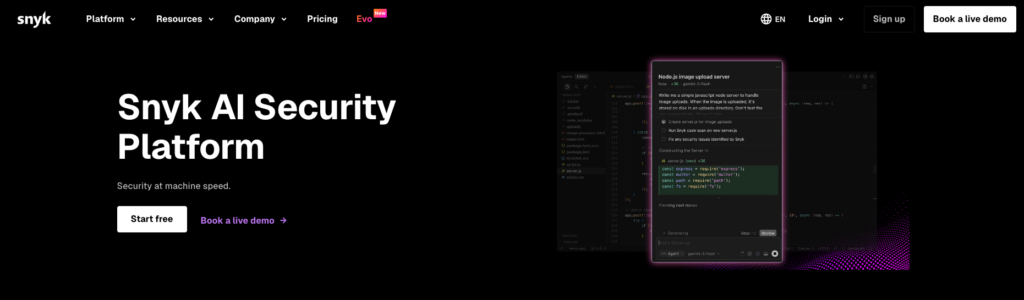
Snyk Code is not trying to cover the same space as a general AI reviewer. It makes more sense when the main problem is security. Snyk built its reputation around dependency security and expanded into SAST, container scanning, IaC, and broader AppSec workflows.
For teams that want AI-assisted development with stronger security checks, Snyk can be part of the stack. It helps bring vulnerability detection closer to developers through IDEs, CLI, pull requests, and security dashboards.
The watchout is focus. Snyk is better for security than for general review discussions about architecture, product behavior, or team-specific code standards. If the team wants similar AppSec coverage with a different workflow, pricing model, or code review experience, comparing Snyk alternatives is a natural next step.
Best for: teams that want vulnerability detection, dependency risk management, and developer-friendly AppSec workflows.
The Future Is Specialized
AI-powered code review is moving beyond generic feedback. GitHub Copilot helped make AI part of the development workflow, but code review has its own requirements: context, team standards, consistency, and the ability to reduce noise instead of adding more of it.
That is why specialized tools are becoming more important. The best fit is not always the most general assistant, but the tool that matches how your team actually reviews code.
For teams that treat code quality as part of their engineering culture, the right review layer needs to do more than suggest improvements. It should understand repository context, support custom rules, learn from feedback, and give teams control over models, cost, and workflow.
Each tool has its place. But as AI-generated code becomes more common, teams will need review systems that are transparent, configurable, and precise enough to grow with their process.
FAQ
Kodus is one of the best GitHub Copilot alternatives for code review because it focuses on pull requests, custom rules, BYOK, repository context, MCP plugins, team feedback, and follow-up issue tracking. It is a better fit when teams want AI review to reflect their own standards instead of generic comments.
Yes. Kodus is an open-source option for AI code review. It was built for teams evaluating GitHub Copilot from the pull request review side, especially when they need custom rules, BYOK, repository context, MCP plugins, and feedback that reflects how the team actually reviews code.
Teams usually look for GitHub Copilot alternatives when they need more control over review behavior, model choice, pricing, team-specific rules, repository context, security coverage, or workflows beyond GitHub. Copilot is convenient, but dedicated tools can be better for specific review needs.
GitHub Copilot Code Review is useful for fast feedback inside GitHub. It can review pull requests, leave comments, suggest changes, and use repository instructions. Teams may need a dedicated AI code review tool when they want deeper customization, BYOK, review analytics, cross-repository workflows, or stronger governance based on team standards.
Snyk Code is a good option when security is the main priority. It focuses on vulnerabilities, dependency risk, SAST, containers, IaC, and AppSec workflows. For teams that want security alongside day-to-day PR review, Kodus can work as the review layer while specialized security tools handle deeper vulnerability coverage.
Kodus and Greptile are both good options for larger codebases, but for different reasons. Kodus is useful when the team wants custom review rules, feedback learning, and business context inside PR review. Greptile is useful when repository graph context and impact analysis across a large codebase are the main priority.
Kodus is self-hosted. Qodo supports single-tenant SaaS, on-premises, and air-gapped deployment, alongside Gerrit. Both are worth evaluating if deployment location is a hard requirement rather than a preference.