6 Best Snyk Alternatives in 2026
 Edvaldo Freitas
Snyk is one of the best-known tools for application security, especially for teams that want to find vulnerabilities before they reach production. It helps identify risks in code, third-party libraries, container images, and infrastructure configurations.
For many teams, it works well as a broad AppSec layer, helping centralize alerts and give more visibility into risks spread across the development lifecycle.
But not every team looking for a Snyk alternative wants to replace one security platform with another just like it. Sometimes, the problem is not lack of coverage. It is too many alerts, too little context, low developer trust, or feedback that arrives outside the real workflow. In other cases, the team needs more specific rules, better pull request integration, more control over AI models, or a solution that better understands the repository’s internal patterns.
What is Snyk?
Snyk is a developer-focused application security platform. Its main job is to find and help manage security issues across four areas: your own code (SAST), your open source dependencies (SCA), your container images, and your infrastructure as code (IaC) configurations. It works with IDEs, repositories, and CI/CD pipelines to deliver feedback earlier in the development process.
Teams use Snyk to get a broad view of their security. It is good at creating a centralized list of vulnerabilities, especially in third-party libraries. For some teams, it starts to fall short when the volume of findings gets too high, developers lose trust in the alerts because of false positives, or the feedback lacks the context of the specific repository where it is running. Customizing the main scanning rules can also be limited, which creates problems for teams with specific internal standards.
Why teams look for Snyk alternatives
Teams start looking for Snyk alternatives when developers struggle to use the tool or when the security benefits are not clear.
- Alert fatigue. When a tool generates many findings with little context or low priority, developers start to ignore it. Important alerts get lost, and real issues can slip through.
- Lack of customization and control. Engineering teams have their own standards, conventions, and ways of building software. A security tool that does not allow custom rules capable of understanding those conventions will miss important issues or flag acceptable code as risky.
When evaluating alternatives, teams look at points like security coverage (SAST, SCA), the number of unnecessary alerts, fit with the PR workflow, customization options, repository understanding, deployment options (SaaS vs. self-hosted), and BYOK support for AI models.
Snyk pros and cons
Pros:
- Broad coverage across SCA, SAST, IaC, and container scanning.
- Good open source vulnerability database.
- Good for managing vulnerabilities and reporting from a central place.
Cons:
- Can generate many false alerts.
- Feedback may lack the context of the specific repository.
- The workflow can feel disconnected from the pull request review process.
- Limited ability to create detailed, custom rules for proprietary code.
Best Snyk alternatives
1. Kodus
Bias disclosure: we build Kodus. This is our honest view of how it can help a team looking for a Snyk alternative.
Kodus is an open source AI code review tool that works directly in the pull request. It was built to identify risky code changes, enforce team engineering standards, and make reviews more consistent. Unlike broad security platforms, Kodus focuses entirely on the quality and security of the code being changed inside a PR, using repository context to deliver relevant and useful comments.
Best for: Teams whose main problem is inconsistent or low-quality code review in pull requests, leading to bugs and security risks in production.
Strengths:
- Repository context. Kodus looks at your entire repository to understand architecture, coding patterns, and conventions. This makes its review comments much more relevant than context-free static analysis findings.
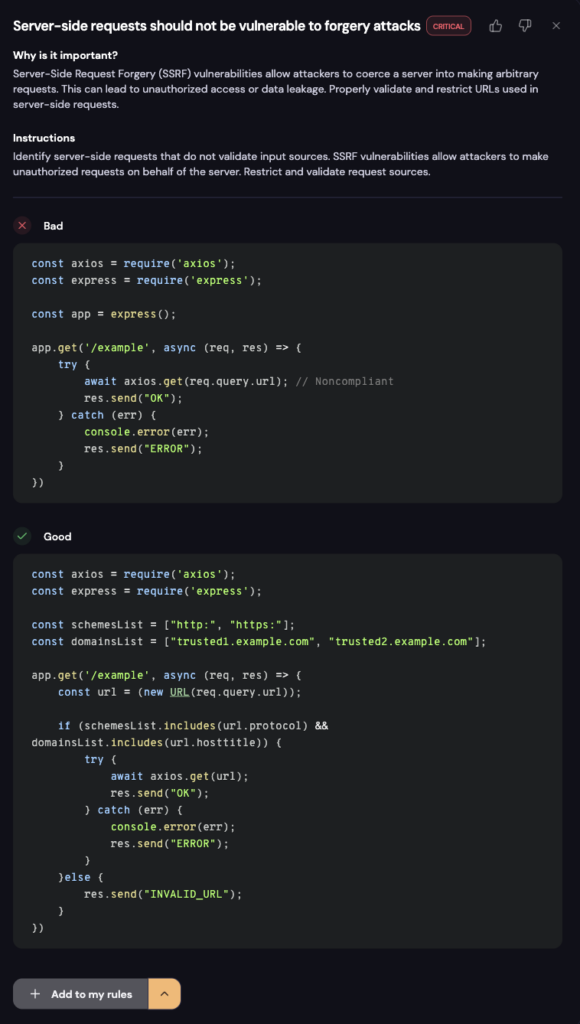
- Custom rules in natural language. You can write complex, team-specific security and quality rules using natural language. For example: “Make sure any new database query function is wrapped in a transaction and includes performance instrumentation.” In addition to letting you create rules, Kodus has a library with hundreds of ready-to-use rules you can use, such as:
- PR-native workflow. It comments directly on pull requests, like a human reviewer. This keeps developers in the flow and encourages engagement.
- Developer trust. By delivering clear and useful feedback that understands the “why” behind the code, Kodus helps build trust instead of creating friction.
- Flexible and controllable around models. BYOK support, allowing teams to use the LLMs they prefer, such as OpenAI, Claude, Gemini, or internal models, while keeping control over their data. A self-hosted option is also available.
Limitations:
- It is not a complete application security platform. It does not scan dependencies (SCA), containers, or IaC. The focus is the quality and security of your proprietary code inside the PR workflow.
Pricing: Free Community plan with BYOK and cloud or self-hosted deployment, a Teams plan at $10 per developer per month plus token costs, and Enterprise with custom pricing.
Verdict: Kodus is the best Snyk alternative if your main goal is to improve the quality and security of the code review process. It was built for teams that believe catching risky implementation details and enforcing specific engineering standards inside the PR works better than managing a long list of vulnerabilities in a separate dashboard.
2. SonarQube
SonarQube is an older tool for continuously checking code quality and security. It performs static analysis to find bugs, code smells, and security vulnerabilities. It is known for its “Clean as You Code” philosophy, which encourages developers to fix only issues in new or changed code.
Best for: Organizations that want to ensure consistent code quality and security standards across many projects and need good management and reporting.
Strengths:
- Great static code analysis (SAST), with support for many languages.
- Combines code quality metrics, such as bugs, smells, and duplications, with security findings.
- Offers quality gates that can block CI/CD pipelines if standards are not met.
Limitations:
- Its main strength is SAST; its Software Composition Analysis (SCA) features are not as developed as Snyk’s and often require extra plugins or specific editions.
- Managing the on-premises version can consume a lot of resources in large installations.
- The feedback loop can feel disconnected from the PR if it is not configured carefully, often directing developers to a separate SonarQube interface.
Pricing: Free for private projects up to 50k LOC, Team plan starting at $32 per month for up to 100k LOC, Enterprise with custom pricing, and separate pricing for self-managed servers by instance and LOC.
Verdict: SonarQube is a good choice for teams that see code security as part of code quality. It is less of a direct Snyk replacement for SCA and more of a static analysis engine with strong management features.
3. Semgrep
Semgrep is a fast, open source static analysis tool that is very good for creating custom rules. It was designed to find bugs and enforce code standards using a simple and intuitive rule syntax, similar to the code it is searching for.
Best for: Security-focused teams that need to quickly write and run custom static analysis rules across the codebase.
Strengths:
- Very fast scanning, good for running in CI on every commit.
- Easy to write custom rules without requiring deep knowledge of abstract syntax trees.
- Large open source registry of ready-to-use rules for common security and correctness issues.
- SaaS and self-hosted options are available.
Limitations:
- Although it can do SCA, its main strength is customizable SAST.
- Snyk has a broader vulnerability database for open source dependencies.
- Advanced features like reachability analysis are part of the paid offering.
Pricing: Free for up to 10 contributors, Teams starting at $30 per contributor per month, modular product pricing, such as Code at $30 and Secrets at $15 per contributor per month, and Enterprise with custom pricing.
Verdict: Semgrep is a great choice if your team’s main frustration with Snyk is the difficulty of creating custom rules that are specific to your context. It allows security and platform teams to turn their knowledge into code and apply it across the organization.
4. GitHub Advanced Security
GitHub Advanced Security (GHAS) is a set of security tools integrated directly into the GitHub platform. It includes Code Scanning, using CodeQL, Secret Scanning, and Dependency Review. Its main appeal is how well it works with the developer workflow inside GitHub.
Best for: Teams that use GitHub heavily and want a convenient, integrated security solution.
Strengths:
- Fully integrated into the GitHub interface, pull requests, and Actions.
- CodeQL is a strong and precise static analysis engine, good for finding complex vulnerabilities.
- Secret scanning and dependency review are included and work right away.
- A single security tab to view and manage alerts.
Limitations:
- Its value is almost entirely tied to using GitHub. It is not an option for teams using GitLab or Bitbucket.
- CodeQL can have a steep learning curve for writing custom queries compared with Semgrep.
- Dependency review features are not as complete as dedicated SCA tools like Snyk in areas such as license compliance and transitive dependency mapping.
Pricing: GitHub lists Secret Protection at $19 per active committer per month and Code Security at $30 per active committer per month, with some security capabilities available for public repositories at no additional cost.
Verdict: If your team lives in GitHub, GHAS is a great alternative. It reduces toolchain complexity by offering good-enough SAST, SCA, and secret scanning directly inside the platform you already use.
5. Checkmarx
Checkmarx is an application security testing platform focused on enterprises. It offers a complete set of tools, including SAST, SCA, DAST, and IaC scanning. It is known for its good SAST engine, broad language support, and features for large organizations with strict compliance requirements.
Best for: Large enterprises with established application security programs that need deep static analysis, detailed reporting, and compliance management.
Strengths:
- Strong and precise SAST engine, capable of tracing data flows to find complex vulnerabilities.
- Broad coverage of languages and frameworks.
- Enterprise-grade management features, including detailed reporting and access controls.
- Offers managed services and expert-led security assessments.
Limitations:
- Can be complex to set up, tune, and manage.
- Scan times can be slower than other tools, which may delay faster CI/CD environments.
- The cost is usually higher, reflecting its enterprise focus.
Pricing: Custom pricing
Verdict: Checkmarx is a good solution for organizations where security management and compliance are the main reasons. It is a Snyk alternative for teams that feel Snyk is not strong or broad enough for their enterprise needs.
6. Codacy
Codacy is an automated code review tool focused on code quality, security, and engineering metrics. It combines its own static analysis with other open source tools to deliver feedback on code style, complexity, duplication, and security issues, often directly in the pull request.
Best for: Teams that want to automate code quality checks and track engineering metrics alongside security scanning.
Strengths:
- Gathers findings from several static analysis tools into a single dashboard.
- Provides information on engineering metrics, such as technical debt and code complexity over time.
- Good integration with Git providers, with comments posted directly in pull requests.
Limitations:
- Its security scanning often just wraps other tools instead of being its own deep analysis engine.
- May not be as deep as dedicated SAST tools.
- The focus is split between quality, security, and metrics, so it may not be the best choice for a team with a serious security-first need.
- Rule customization can be limited to what the underlying tools expose.
Pricing: Free Developer plan, Team starting at $18 per developer per month annually or $21 monthly, Business with custom pricing, and free use for open source projects.
Verdict: Codacy is a good choice for teams looking for a broad code quality platform with security checks included. It competes more with SonarQube than directly with Snyk’s SCA-focused offering, but it is a valid alternative for teams focused on automating feedback in PRs.
Comparison table
| Tool | Best for | Primary workflow | Security coverage | AI code review strength | Customization | Deployment / control |
|---|---|---|---|---|---|---|
| Kodus | Improving PR review quality and developer trust | Pull Request | Proprietary code, similar to SAST | Very high, understands the repository | Very high, in natural language | SaaS, self-hosted, BYOK |
| SonarQube | Code quality management and static analysis | Quality gate in CI/CD | SAST, partial SCA | Low | Medium, plugin-based | SaaS, self-hosted |
| Semgrep | Fast and custom static analysis rules | CI/CD scanning | SAST, SCA | Low | Very high, rule syntax | SaaS, self-hosted |
| GitHub Advanced Security | Integrated security for teams on GitHub | Pull Request / Actions | SAST, SCA, secret scanning | Low | Medium, via CodeQL | SaaS, requires GitHub Enterprise |
| Checkmarx | Enterprise-grade AppSec and compliance | Scheduled scans / CI | SAST, SCA, DAST, IaC | Low | Medium | SaaS, self-hosted |
| Codacy | Automated code quality and engineering metrics | Pull Request | SAST, via aggregated tools | Low | Low | SaaS, self-hosted |
Why Kodus is the best Snyk alternative for PR-based security and code review
Teams usually look for a Snyk alternative because they want to fix the developer workflow. Broad vulnerability scans are good for creating lists, but they do not solve the main problem of stopping risky code from being merged. That is why the type of tool matters.
Here is our opinion: if your main problem is “we need broad AppSec coverage across dependencies, containers, IaC, and a central vulnerability management dashboard,” then Snyk, Checkmarx, or GitHub Advanced Security are probably closer to what you need. They were built for security teams that need to verify and report on the organization’s security.
If your main problem is “risky code is getting through PRs because reviews are inconsistent, unclear, or too dependent on senior engineers,” then Kodus is the best choice. It was built for engineering teams that want to improve the quality and security of the code itself, exactly where the code is written and reviewed.
Kodus works differently. It does not just run a set of generic rules. It learns the context of your entire repository to deliver specific and relevant feedback. You can define your team’s most important security and quality standards in natural language, and Kodus will apply them consistently across every PR. This focus on clear, contextual feedback inside the PR builds developer trust and actually changes behavior. Because it is flexible around models and offers self-hosting, it also gives teams full control over the code and review logic.
When Snyk still makes sense
It would not be fair to say Snyk is never the right choice. There are situations where its model works very well. Snyk may still be the right tool for your team if:
- Your main concern is managing vulnerabilities in open source dependencies (SCA). Its vulnerability database is one of the broadest in the market.
- You need a single platform to scan code, dependencies, containers, and IaC configurations.
- Your organization has an established AppSec program that needs a central dashboard to track and report vulnerabilities for compliance.
- Security management and reporting features are more important to your program than detailed customization of review rules inside the PR.
Conclusion
Choosing a Snyk alternative is not about finding an exact feature replacement. It is about finding the biggest problem in your current process and choosing a tool that solves it. Although Snyk offers broad security coverage, its weak point for many teams is unclear, low-context feedback that hurts developer trust and the workflow.
For teams whose main goal is to ship secure, high-quality code by improving the review process itself, Kodus is the best alternative. By focusing on repository context, custom rules in natural language, and a PR-native workflow, it delivers feedback that developers trust and act on. It fixes the main problem: inconsistent and incomplete code reviews. If your goal is to stop risky code from being merged, Kodus was designed for you. It helps prevent vulnerabilities instead of just cataloging them afterward.
FAQs
What is the best Snyk alternative?
The best alternative depends on your main need. For teams focused on improving code review quality and identifying risky code in pull requests with AI, Kodus is the best choice. For teams that need customizable static analysis, Semgrep is great. For broad enterprise-grade AppSec, Checkmarx is a strong contender.
Is Kodus a good Snyk alternative?
Yes, Kodus is a great Snyk alternative if your main problem is the quality, consistency, and security of the code review process. It is very good at delivering context-aware feedback inside the pull request. It is not a direct replacement if you need Snyk’s container scanning, IaC scanning, or broad SCA dashboards.
How is Kodus different from Snyk?
Snyk is a broad application security platform focused on finding vulnerabilities in dependencies, code, containers, and IaC. Kodus is a focused AI code review tool, built to improve the quality and security of your proprietary code inside the pull request workflow. Kodus uses repository context and custom rules in natural language to deliver feedback developers trust, while Snyk focuses on providing a centralized list of known issues.
What should teams look for in a Snyk alternative?
Teams should evaluate alternatives based on their specific problems. Important points include alert quality and how many unnecessary alerts the tool sends, how well it works with the pull request workflow, the level of rule customization, whether it uses repository context, and whether it builds or weakens developer trust.
When does Snyk still make sense?
Snyk is still a good choice for organizations that need a single, central platform for broad security scanning, especially because of its complete Software Composition Analysis (SCA) features. If your main need is a vulnerability management dashboard for dependencies, containers, and IaC for compliance and reporting, Snyk was built for that.