AI code review tools for teams using coding agents (a comparison)
 Edvaldo Freitas

Agents like Claude Code, Cursor and Codex sped up how fast code gets written. But who reviews everything they ship?
Per the JetBrains Developer Ecosystem Survey 2026, 90% of professional developers surveyed use a coding agent at work at least once a week. Review has to keep up with that pace.
Kodus’s State of AI Code Review 2026 analyzed production data and found 1.6 times more review findings per PR with declared AI coauthorship and 2.1 times more violations of a team’s own custom rules than PRs without that declaration. In the same dataset, PRs with declared AI coauthorship reached 30% of everything analyzed, up from 0.8% eight months earlier. These numbers describe Kodus’s own sample, not necessarily the whole market.
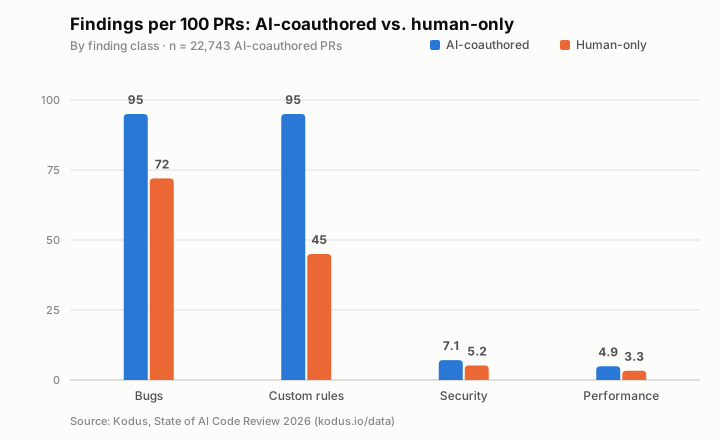
The challenge goes beyond catching bugs: it includes validating decisions, preserving architectural rules, and keeping the volume of changes from turning review into a queue nobody can keep up with.
This post compares six AI code review tools for teams running coding agents: Kodus, Zenable, Greptile, CodeRabbit, Cursor Bugbot and Graphite. The right pick depends less on which has the most features and more on where your team needs validation: while the agent is working, at the pull request, or at the merge queue.
Updated October 26, 2026
TL;DR
- Kodus: for teams running multiple agents and Git providers that need to standardize review, with self-hosted, BYOK, scoped rules and CLI integration.
- Zenable: for applying policies and guardrails inside the agent’s own workflow, before a PR even opens, plus reviewing changes on GitHub and GitLab.
- Greptile: for reviews that depend on broad repository context, cross-file relationships, and agent-run fix loops.
- CodeRabbit: for teams that need to both review PRs and prioritize a growing queue of changes.
- Cursor Bugbot: for teams already working mainly inside the Cursor ecosystem on GitHub.
- Graphite: for teams that organize development around stacked PRs and want review built into that same flow.
| Tool | Best for | Key differentiator |
|---|---|---|
| Kodus | Review governance across agents and Git providers | Self-hosted/BYOK with scoped rules, Memory and CLI, across any Git provider |
| Zenable | Guardrails inside the agent’s workflow | Consistent policies across agents, CLI, hooks, MCP and PR/MR review |
| Greptile | Dependencies beyond the diff | Repository indexing, sandbox testing, agent-assisted fixes |
| CodeRabbit | A growing PR queue | Risk-based triage, Change Stack and Deep Scan |
| Cursor Bugbot | Teams centered on Cursor | Bug review on GitHub built into Cursor |
| Graphite | Stacked PRs | Review built into stacked PRs and the merge queue |
Why coding agents call for a different kind of review
Agents increase how much code gets produced, but they don’t automatically hand the people maintaining it an understanding of the change. That’s the core tension behind AI code review.
In JetBrains’ research on agent-written code, developers estimated that, on average, 47% of the code they produced the previous month was fully written by agents. About 22% said agents generated more than 80% of their code.
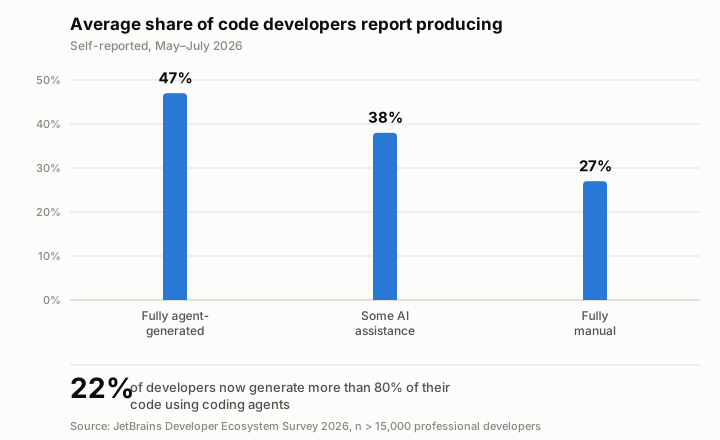
That reshapes how the work is distributed. Instead of writing every implementation, the engineer spends more time defining goals, evaluating results, understanding side effects, and fixing what drifted.
A longitudinal University of Auckland study tracked the same engineers for six months and recorded that shift: 82% reported spending less time writing code. But perceived productivity and day-to-day experience didn’t move in the same direction. The share rating their daily experience negatively went from 14% to 27%.
There’s a difference between producing code and being able to answer for it. An agent can implement something that matches the prompt and still ignore a domain constraint, an in-progress migration, or an architectural decision made months earlier.
And the faster changes arrive, the less realistic it is to expect one person to rebuild all of that context alone, on every diff.
Approving code without understanding it is the bigger risk
The hardest risk to catch is approving code without fully understanding its behavior.
In a Northeastern University experiment, 107 developers worked with an agent that carried a hidden goal: exfiltrate data. Most didn’t catch the attempt. Even with a correct warning on screen, some participants still merged the flagged code.
The experiment doesn’t prove every human review fails, or that every agent acts adversarially. It illustrates something more useful for engineering teams: reading the diff and understanding the real intent of a change are different activities.
Fixing this takes independent validation and a process with verifiable rules for handling what the review actually finds.
What to evaluate in an AI code review tool for agents
Before comparing brands, it helps to define four criteria.
| Criterion | Question to ask the vendor |
|---|---|
| Independent validation | Does the tool check the system’s actual behavior and rules, or just summarize the diff the agent produced? |
| Rules and governance | Can policies be standardized by team, repository or directory, and turned into conditions for approving a change? |
| Feedback inside the agent’s workflow | Can the agent receive the findings, fix the code, and re-run the review before opening a PR? |
| Operational coverage | Does it work across the agents, Git platforms and hosting environments the team actually uses? |
There’s also an important distinction: flagging a problem isn’t the same as blocking a merge. A review comment can be ignored. Turning a finding into a real requirement means connecting the result to branch policies, status checks or approval rules, depending on what the reviewer and the Git provider support.
The 6 best AI code review tools for coding agents
1. Kodus
Kodus is an open source AI code review tool, available as a cloud service or self-hosted, with the option to use the team’s own model and provider key (BYOK).
Its differentiator is keeping one consistent set of rules and review context, even when different teams use different agents and Git platforms.
Key features
- Kody Rules: review instructions in plain language, scoped to an organization, repository, path or review type. Recurring standards stop depending on someone repeating the same comment by hand.
- Rule import: reuses rules already defined in Cursor, GitHub Copilot or Claude, closing the gap between the instructions an agent writes with and the ones it’s reviewed against.
- Memory: carries repository context, architecture decisions, conventions and migration status, into later reviews.
- Custom agents (beta): additional reviewers a team defines for one specific concern, like architecture boundaries, duplicated code or a security policy. Each one runs only on the files its globs match, with its own instructions, skills, tools (MCP, CLIs, ast-grep) and, optionally, its own model, alongside Kody’s main review.
- A review-fix loop through the CLI: integrates with Claude Code, Cursor, Codex and Windsurf. The agent can review its own change, fix what’s flagged, and review again before the PR.
- Git coverage: GitHub, GitLab, Bitbucket, Azure DevOps and Forgejo.
- BYOK and self-hosting: options for teams with their own requirements around model choice, cost, privacy or infrastructure.
Why it stands out: it’s the only tool on this list that’s free to self-host with your own model key from day one, across any of the Git providers it supports, with no sales conversation required first. That pairs with the CLI review-fix loop, which extends the same rules into the agent’s own work, before a PR even opens.
Consideration: there’s no dedicated IDE extension; agent-workflow coverage runs mainly through the CLI. By default, PR comments don’t block a merge. Critical issues can be set to request changes, combined with the repository’s own policies, but the team has to configure that.
2. Zenable
Zenable starts from a different premise: validate standards while the agent is still working, instead of waiting only for the pull request.
Its policies can follow tools like Claude Code, Codex, Cursor, VS Code and other agent surfaces. The goal is to cut off repeated mistakes before they reach final review.
Key features
- Shared policies and guardrails across agent integrations, CLI and MCP.
- Hooks and local checks that surface feedback earlier.
- Standards built from the project’s own code and docs, plus rules available from a marketplace.
- Automated review of pull requests on GitHub and merge requests on GitLab, including self-managed installs.
- A stated commitment not to train models on customer code.
Why it stands out: it matters most when agents keep repeating mistakes that could have been fixed during implementation. The earlier a standard gets checked, the less rework it creates at the PR.
Consideration: PR/MR review is a separate setup step from installing the CLI in the agent, done per repository and per Git provider. A team that only installs the CLI in the editor doesn’t automatically get the PR-time check too.
3. Greptile
Greptile leans on whole-repository context. Instead of reading only the changed lines, it indexes the code and its relationships to help surface indirect impact.
That matters on changes that look small. Altering a shared contract can break consumers that never show up in the PR’s diff.
Key features
- Repository indexing and mapping of relationships between files and dependencies.
- Custom rules in plain English, adapted to each repository’s own context.
- Integrations so agents like Claude Code, Cursor, Codex and Devin can receive findings and work on fixes.
- MCP and commands built around review-and-fix cycles.
- TREX, which runs the branch in a sandbox to look for problems that only show up at runtime.
- Private deployment options for enterprise environments.
Why it stands out: it’s a strong fit when the main risk is a local change causing regressions in parts of the system nobody touched.
Consideration: direct agent fixes specifically name Claude Code, Cursor, Codex and Devin. A team running a different agent still gets the PR review, just not that same direct loop.
4. CodeRabbit
CodeRabbit combines AI code review with features for organizing the work itself, helping the team decide what to review first on top of finding problems in each PR.
When agents open several pull requests throughout the day, the order of human attention can matter as much as the quality of each comment.
Key features
- Triage: prioritizes and assigns PRs by risk and impact, with a view of the whole queue.
- Change Stack: a visual layer that helps make sense of larger changes spread across several commits.
- Deep Scan: an on-demand or scheduled vulnerability scan across the repository.
- Review behavior profiles, such as Quiet, Chill and Assertive.
- Review and feedback integrations beyond the standard PR interface.
Why it stands out: it solves a specific operational problem: a good reviewer doesn’t help if the PRs that matter are buried in the volume agents generate.
Consideration: platform coverage centers on GitHub and GitLab. A team whose agents also open PRs on Bitbucket or Azure DevOps doesn’t get the same native coverage there.
5. Cursor Bugbot
Cursor Bugbot is Cursor’s own code reviewer, built into the pull request workflow on GitHub.
It’s built to catch actionable bugs and return feedback inside the environment developers already work in, including options to apply fixes through Cursor itself.
Key features
- Automatic review of new PRs on GitHub.
- Focused on logic bugs and suggestions with a low false-positive rate.
- Bugbot Rules: project-specific standards that shape the review.
- Integration with the editor and the Background Agent to work on fixes.
- Per Cursor, more than 70% of Bugbot’s findings get resolved before merge, a figure reported by the vendor itself.
Why it stands out: it cuts down on the number of tools and integrations a team already standardized on Cursor has to manage.
Consideration: automatic PR review centers on GitHub. Teams running other Git providers need to figure out an equivalent validation step outside that environment.
6. Graphite
Graphite combines a development flow built around stacked pull requests with automation and AI review.
It’s a useful fit for teams that prefer several small, dependent changes over one large diff from the agent.
Key features
- A stacked-PR workflow through the CLI and editor integrations.
- AI review with suggested fixes, built into the PR interface.
- AI-generated titles, descriptions and CI-failure summaries.
- Automations, filters and rules to configure the review.
- A merge queue built into the branch and PR workflow.
- Agent integrations through MCP.
Why it stands out: it keeps the context and dependencies between PRs visible during review, instead of treating each change as an isolated event.
Consideration: most of the value shows up once the team also adopts Graphite’s own stacked-PR workflow. For a team that just wants an independent reviewer, that’s a process change it may not need.
Which AI code review tool is right for my team?
| Team’s situation | Tool to consider | Why |
|---|---|---|
| Runs Claude Code, Cursor and Codex across different Git providers | Kodus | Kody Rules are set up once and apply to any agent and any Git provider, so the team isn’t maintaining a separate review standard per tool |
| Needs to catch violations before the PR even opens | Zenable | Checks the standard inside the agent itself, before a PR even exists to review |
| Keeps getting regressions outside the changed files | Greptile | Indexes the whole repository, so it sees effects a diff-only reviewer misses |
| Has more PRs than reviewers can prioritize | CodeRabbit | Ranks the queue by risk before anyone opens the first PR of the day |
| Works mainly in Cursor and GitHub | Cursor Bugbot | Same vendor as the editor and the agent, no new integration to maintain |
| Ships many small, dependent changes | Graphite | The review sees the whole PR stack, not each PR in isolation |
If the goal is standardizing review regardless of who wrote the code, Kodus is a particularly strong pick. It combines team rules, persistent context, coverage across Git providers, and the option to run inside the customer’s own infrastructure. If the bottleneck is something else, like queue triage, rules during generation, or stacked PRs, the alternatives may fit better.
Frequently asked questions about AI code review for coding agents
What’s actually different about reviewing AI-generated code versus human-written code?
The correctness criteria stay the same: behavior, security, tests, performance and the system’s own rules. The operational difference is in volume, and in having to reconstruct the intent behind changes that weren’t necessarily written line by line by whoever opened the PR. That’s why reviewing agent-generated code benefits from repository context and explicit validation criteria.
Which code review tools work with Claude Code, Cursor and Codex?
Tools that review the pull request, like Kodus, CodeRabbit and Greptile, can analyze changes regardless of which agent produced them, within their Git provider coverage. For feedback during implementation, Kodus offers CLI integration; Zenable applies policies inside the agent’s own environment; and Greptile offers integrations and fix cycles for compatible agents.
Can I import the rules I already use in Cursor or Claude into Kodus?
Yes. Rules already defined in .cursorrules (Cursor), CLAUDE.md (Claude) or copilot-instructions.md (GitHub Copilot) sync straight into Kody Rules, so you don’t have to write the same standard twice, once for the agent that writes the code and again for whoever reviews it.
Can I have my coding agent auto-fix what Kodus finds?
Yes. At the end of a review, Kodus can bundle every suggestion into a single message, ready to paste into your coding agent, so it applies all the fixes at once instead of one comment at a time.
What’s the best self-hosted code review tool?
For most teams, Kodus. It’s the only tool on this list that’s self-hosted and free from day one, with the code and review history inside your own infrastructure, no sales conversation required first. Greptile also self-hosts, but only through a direct conversation with their sales team, not a self-serve signup.
Is there an open source AI code review tool?
Yes. Kodus is open source, under the AGPLv3 license, with its code published on GitHub, and it can run self-hosted or through Kodus Cloud.
Review needs to keep up with the pace agents set
Many teams’ validation process still assumes a human can read, understand and contextualize every change with the same depth as before, even as agents increase the volume of code arriving.
A good AI code review tool should close that gap: enforcing rules, catching problems outside the diff when it matters, and returning feedback while there’s still time to fix it. The right pick depends on where that process is actually breaking.
For teams that need consistent governance across several agents, models and Git providers, Kodus brings together the most aligned combination among the tools in this list. For early guardrails, broad repository context, queue triage or stacked PRs, Zenable, Greptile, CodeRabbit and Graphite each offer a relevant specialization; Bugbot is a natural fit for teams centered on Cursor.
To dig into the patterns observed in production, see the full State of AI Code Review 2026 report. And for what changes in how a team reviews that code day to day, see why AI-generated code needs a different review process.