AI Code Review: A Complete Guide for Engineering Teams
 Edvaldo Freitas

AI has increased the volume of code teams produce, but it has not made merge decisions any easier. PRs arrive faster, are often larger, and may already have passing tests, but someone still needs to understand whether the change follows the system’s rules and what could break afterward.
AI code review tools can help with that validation work. Not by commenting on style, suggesting variable names, or repeating what the linter already checks. That only adds noise. The value comes from analyzing a change in the context of the system and finding risks that are not obvious from the diff.
A PR can be well written, include tests, and still introduce a behavioral, architectural, or security issue. Those are the kinds of risks a contextual review needs to surface before the merge.
In this guide, you will learn what AI code review is, how it works, which problems it can identify, where its limitations are, and what to evaluate before adopting a tool for your team.
What Is AI Code Review?
AI code review is the use of artificial intelligence to analyze pull requests, find bugs, identify security risks, verify internal rules, and suggest fixes before the merge.
The definition is straightforward. What changes from one tool to another is the depth of the analysis.
A superficial review looks only at the changed lines and searches for local issues in that file. This can work for some errors, but it misses risks that depend on other parts of the system.
A more complete review looks for related files, follows calls and dependencies, considers existing contracts, and accounts for the rules the team has defined for that part of the codebase.
That is why the quality of an AI code review depends less on how polished the comment sounds and more on the context used to produce it.
Why AI-Generated Code Has Increased the Pressure on Code Review
AI has made it faster and cheaper to produce code. The cost of reviewing, testing, and maintaining those changes, however, has not fallen at the same rate.
In the Kodus State of AI Code Review 2026, we analyzed 22,743 PRs containing code declared as AI-generated. Those PRs were 2.6 times larger than human-written PRs and received an average of roughly 2 findings per PR, compared with 1.3 for human-written PRs.
We also found that 33% of suggestions were implemented and that the implementation rate increased from 25% to 48% over eight months.
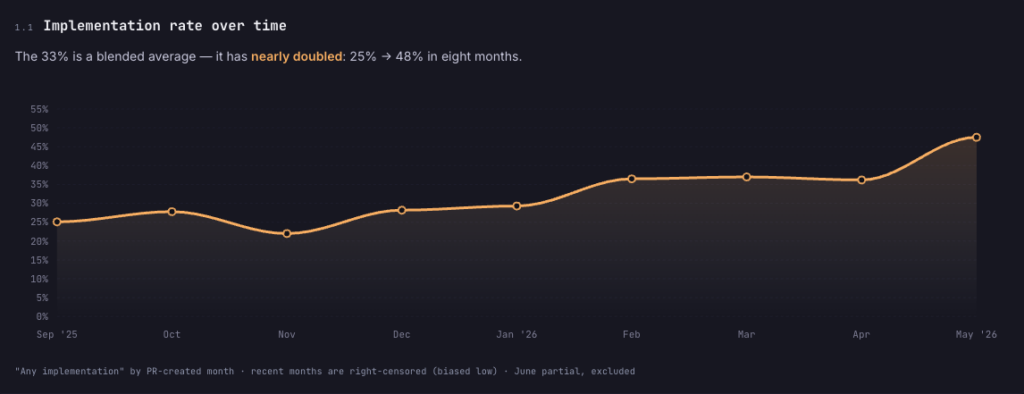
I think this matters because it shows that the comments were not simply noise. A meaningful share of the issues found during review led to real changes in the code.
Google’s DORA report points in a similar direction by describing AI as an amplifier. According to the study, 90% of the professionals surveyed already use AI at work, but the outcome depends heavily on the quality of the systems, processes, and platforms the team already has.
AI increases production speed. That also increases the pressure on everything that follows: review, testing, validation, and maintenance.
This is where many teams begin to feel the problem. PR volume grows, but review capacity does not keep pace.
The Diff Does Not Tell the Whole Story
A common mistake when evaluating an AI code review tool is to look only at the quality of its comments on an isolated piece of code.
That says very little about its actual review capability. The most important problems are rarely contained in a single line. They appear when a local change breaks an assumption somewhere else in the system.
A schema change, for example, may work correctly in the modified service while breaking a consumer that relies on the previous response.
A useful review needs to find that relationship. Checking the syntax of the diff is not enough. The tool needs to understand how the change affects the behavior of the system.
How an AI Code Review Tool Works
An AI code review tool cannot simply take the diff, send it to a model, and publish the first response in the pull request. That is the fastest way to generate comments that sound polished but provide little value.
A high-quality review needs to combine the intent behind the change, repository context, and a strong filtering process that separates real risks from observations that only add noise.
Understanding the Intent Behind the Change
First, the tool needs to understand what the PR is trying to accomplish.
In addition to the changed code, it can consider signals such as:
- the PR title and description;
- the files involved;
- modified tests;
- related tickets or specifications;
- the type of change being proposed.
This context helps distinguish a bug fix from a feature, a refactor, a contract change, or a security update.
Without that understanding, the tool may evaluate the code correctly while still misinterpreting the purpose of the change.
Finding Context Outside the Diff
Next, the tool needs to look for parts of the system related to the changed code.
This may include:
- functions called by the modified code;
- shared types and schemas;
- existing tests;
- configuration files;
- dependencies between modules;
- contracts between services;
- technical repository documentation.
The risk is often not located in the file that changed. It may appear in a consumer of that function, in a flow that depends on the schema, or in a configuration that is no longer compatible.
Accounting for Team Rules
Not all context is explicitly documented in the code.
Every team builds up decisions about how authorization should be validated, where errors should be handled, which API patterns to follow, which types of dependencies to avoid, and which areas of the repository require more care.
Some tools allow teams to turn those decisions into rules that are applied during review, with scopes at the organization, repository, or directory level. In Kodus, this feature is called Kody Rules.
This allows the review to consider not only general engineering practices, but also criteria that are specific to that codebase.
How the Tool Filters and Prioritizes Suggestions
Finding a possible issue is not enough. The tool needs to determine whether there is sufficient evidence in the code, whether the comment duplicates another issue that has already been identified, and whether the risk can actually affect the behavior of the system.
When every possibility becomes a comment, the team quickly learns to ignore the tool.
Useful feedback should make the following clear:
- what the problem is;
- under which conditions it can happen;
- which part of the change creates the risk;
- how to fix or validate the behavior.
Without that explanation, the person receiving the comment has to reconstruct the tool’s reasoning before they can even decide whether the suggestion makes sense.
Comment volume is therefore a poor measure of an AI code review tool’s quality. What matters is how many relevant problems it can identify with enough context for the team to make a decision before the merge.
AI Code Review Example in a Pull Request
In this PR, the change added tenant protection to the Cockpit. The flow used an organizationId from the query string to determine which organization the user was allowed to access.
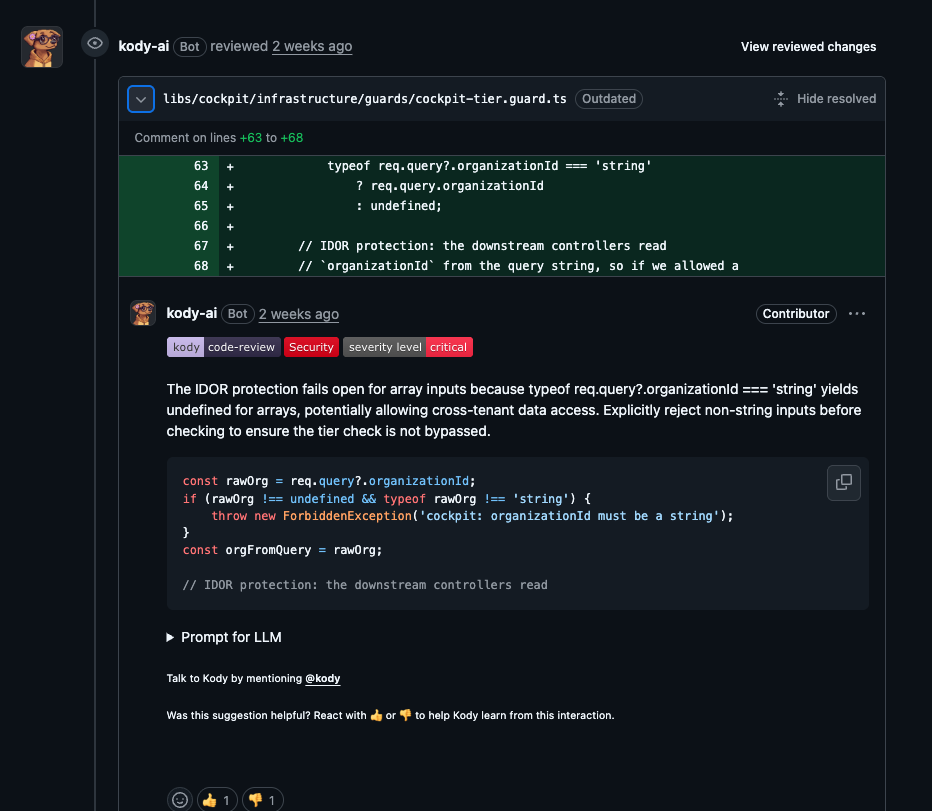
At first glance, the code looked correct:
typeof req.query?.organizationId === "string"
  ? req.query.organizationId
  : undefined;
The intent was to use the organizationId only when the received value was a string. Any other format would be treated as missing.
The problem is that the same query string parameter can appear more than once. In that case, organizationId may arrive as an array, and the check turns that value into undefined.
The risk appears because the rest of the flow does not rely only on the validated value. Downstream controllers were still accessing the organizationId directly from the query string.
In practice, the local protection discarded the organization reference, but the raw value sent by the client remained available in other parts of the system.
This created a possible authorization bypass, with a risk of IDOR and cross-tenant access.
Kody suggested explicitly rejecting any value that was not a string before allowing the request to continue:
const rawOrg = req.query?.organizationId;

if (rawOrg !== undefined && typeof rawOrg !== "string") {
  throw new ForbiddenException(
    "cockpit: organizationId must be a string",
  );
}

const orgFromQuery = rawOrg;
This is the kind of finding I consider genuinely useful because it has nothing to do with a style preference.
Finding it required connecting the actual request format, the parser’s behavior, the validation performed in the guard, and the use of the same data elsewhere in the flow.
The changed file did not appear to contain a vulnerability when viewed in isolation. The risk only became clear after following the data through the system.
Benefits of AI Code Review
As the volume of changes grows, it becomes harder to maintain the same level of attention across every PR. Not because the person reviewing the code no longer knows what to look for, but because each review requires them to remember repository rules, security risks, architectural decisions, and relationships with other parts of the system.
AI code review can help with that growing set of checks.
The person reviewing the code can discuss intent, trade-offs, and architectural decisions. The problem is expecting that same person to also remember every internal rule, security exception, and repository-specific detail in every change. As PR volume increases, it becomes easier for something to slip through.
This support is especially valuable when a PR involves:
- runtime bugs, such as null access, race conditions, and schema incompatibilities;
- security issues involving authentication, authorization, external input, logs, and command execution;
- internal team rules, such as API patterns, error handling, domain naming, and architectural decisions;
- large PRs, where relationships between files become harder to track;
- AI-generated code, which often arrives in greater volume and with assumptions that are not always clear from the diff;
- changes made by multiple teams, especially when different teams work on related parts of the same system.
These checks should not depend only on the memory and attention of the person reviewing the PR. A tool can help apply the same criteria across changes and surface risks that might otherwise be missed.
Data from the Kodus study helps illustrate this. PRs containing code declared as AI-generated were 2.6 times larger and received an average of roughly 2 findings per PR, compared with 1.3 for human-written PRs.
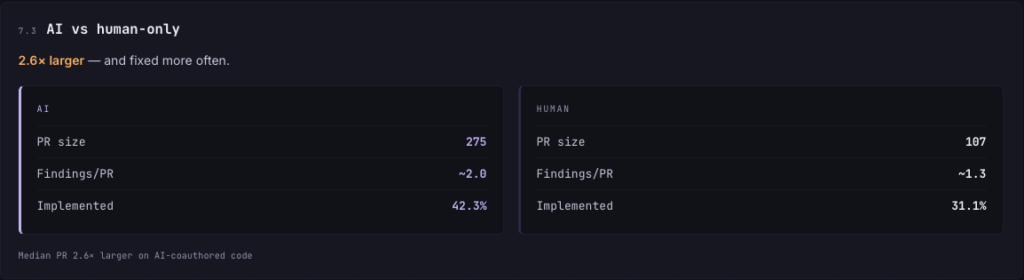
To me, the most relevant result is the custom rules data. For every 100 PRs, changes containing AI-generated code received 95 findings related to internal rules, compared with 45 for human-written PRs. This suggests that the challenge is not only finding bugs in generated code, but also making sure that it follows the architectural, security, and domain decisions the team has already adopted.
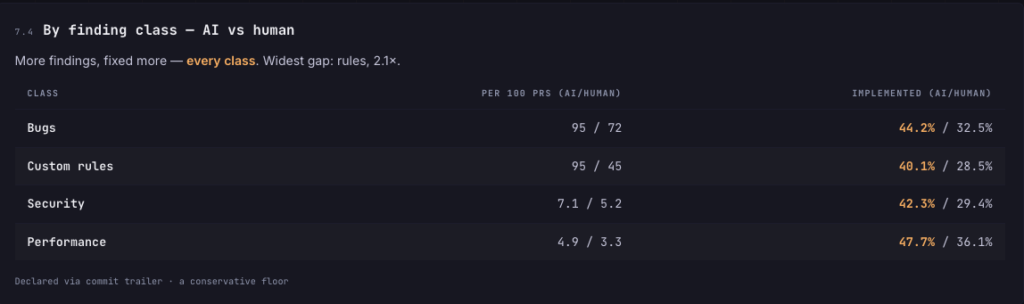
This is where AI-assisted review can provide more value: consistently checking technical risks, repository rules, and system decisions even as the volume of changes increases.
Limitations of AI Code Review
Even with context, a tool may interpret a change differently from the team.
It may overstate the severity of an issue, flag a risk that cannot occur in the real execution flow, or suggest a solution that looks correct in theory but does not fit that codebase.
To me, the more serious problem is not one incorrect comment. It is what happens when those comments begin to accumulate and the team starts paying less attention to the review. At that point, even an important finding loses impact.
That is why the tool needs to support adjustments to volume, severity, scope, and context.
Teams using Kodus typically start by limiting the number of suggestions, deciding which severity levels deserve a comment, ignoring files that do not require the same level of analysis, and recording repository-specific rules or exceptions.
The intent behind the change also needs to be part of the review. When a PR is connected to a ticket, specification, or business rule, evaluating the code alone may not be enough.
Some teams connect these sources through MCP or add business context directly to the review. This allows the analysis to compare what was implemented with the behavior that was supposed to be delivered.
These adjustments address two common causes of low-value comments: missing context and criteria that are too generic. The review becomes more relevant when it considers each team’s rules, exceptions, and priorities.
How to Implement an AI Code Review Tool on Your Team
If I were implementing an AI code review tool on a team today, I would start with a limited scope and clearly defined criteria.
I would not enable every type of analysis across every repository on day one. I would also avoid using the tool to enforce personal preferences, because those comments lose value quickly and add noise to the PR.
I would start with problems that have a clear impact:
- authorization failures;
- external input handling;
- exposure of sensitive information;
- null access;
- schema incompatibilities;
- contract-breaking changes;
- internal standards related to security or architecture.
Then I would roll it out in stages:
| Stage | What to do | Why it matters |
|---|---|---|
| Control the noise | Set the minimum severity to medium, limit suggestions per PR, and group similar comments | Prevents Kody from filling the PR with minor observations at the beginning |
| Narrow the scope | Ignore lockfiles, generated files, .env files, release PRs, and WIP PRs | Keeps the review focused on changes that actually require context |
| Create the first rules | Start with security, architecture, contracts, and rules that commonly prevent bugs or rework | Makes the review reflect what the team already considers important |
| Separate context by area | Use directory-level configuration in monorepos | Avoids applying the same criteria to frontend, billing, infrastructure, and background jobs |
| Track implementation | Measure how many suggestions led to actual code changes | Shows whether comments are useful instead of simply increasing review volume |
In Kodus, these steps can be configured through severity filters, suggestion limits, rules with different scopes, directory-level settings, and exclusions for files or branches.
In addition to the implementation rate, I would track:
- which categories generate the most noise;
- which rules need to be adjusted;
- which types of suggestions are frequently ignored;
- which findings remain open after the merge.
I would not use comment volume as a success metric. More comments may simply mean that the tool is taking up more space in the PR.
What matters most is how many suggestions were useful enough to change the code.
How to Choose an AI Code Review Tool
To me, the best way to choose an AI code review tool is to test it in the team’s actual repository. Comment quality is a good starting point, but it does not show on its own how the tool will perform in day-to-day use.
I would also look at how it retrieves context outside the diff, applies rules across different parts of the repository, responds to feedback, and gives the team control over models, costs, data, and infrastructure.
CodeRabbit, Greptile, Qodo, and Kodus all automate pull request reviews, but each tool handles these areas differently. I would evaluate them using criteria such as the following:
| Criterion | What to evaluate |
|---|---|
| Suggestion quality | Do the comments identify a specific risk, explain why it matters, and recommend a clear action? |
| Codebase context | Does the analysis consider calls, dependencies, schemas, tests, and related files, or is it limited to the diff? |
| Internal rules | Can the team turn architectural, security, and domain decisions into criteria applied at the organization, repository, or directory level? |
| Noise control | Can suggestions be limited, grouped, and prioritized to avoid repetitive or low-value comments? |
| Models and costs | Can the team choose the model, use its own key, and understand the actual inference cost? |
| Data and infrastructure | Where is the code processed? Is self-hosting available when required by security or compliance policies? |
| Requirements integration | Can the tool compare the code with tickets, specifications, or business rules in addition to evaluating the technical implementation? |
| Impact on the code | Are the suggestions relevant enough to be implemented before the merge? |
I would pay close attention to the implementation rate.
A suggestion creates value only when it helps the team identify a risk, understand why it matters, and decide whether the change needs to be corrected before the merge.
During an initial test, several tools may deliver a similar experience. The differences become more visible when reviews start covering more repositories, rules, models, and sources of context.
How Kodus Works as an AI Code Review Tool
Kodus is open source and allows teams to choose the model, use their own key, define rules with different scopes, and opt for self-hosting. Reviews can also combine repository context with tickets, specifications, and business rules related to the change.
The goal is to combine more contextual analysis with control over the criteria, costs, and infrastructure used during review.
Frequently Asked Questions About AI Code Review
What is AI code review?
AI code review uses artificial intelligence to analyze pull requests, identify bugs and security risks, check a team’s internal rules, and suggest fixes before merge. Unlike tools that only check syntax or formatting, it can also consider the intent behind a change and how it relates to other parts of the codebase.
What is the difference between AI code review, linting, and static analysis?
Linters check deterministic rules related to syntax, formatting, and local code patterns. Static analysis tools look for known classes of defects and vulnerabilities. AI code review adds another layer by considering the purpose of the PR, relationships between files, and engineering rules specific to the team.
How can teams reduce false positives in AI code review?
The best approach is to start with high-impact categories, set a minimum severity level, exclude generated files, and create rules that reflect how the codebase actually works. Team feedback should also be used to refine rules, exceptions, and the types of suggestions that genuinely deserve a comment.
Is it safe to use AI code review on private repositories?
It depends on how the tool processes and stores code. Teams should evaluate data retention, model providers, encryption, access controls, training policies, and cloud or self-hosting options. These considerations become even more important for companies working with sensitive code or strict compliance requirements.
What are the leading AI code review tools?
Kodus, CodeRabbit, Greptile, and Qodo are among the leading AI code review tools. They differ in the depth of context they analyze, how rules can be customized, the level of cost control they provide, and their infrastructure options.
Kodus stands out for being open source, offering BYOK so teams can use their own model keys, and supporting self-hosting. It also gives teams greater control over rules, review scopes, and inference costs. Even so, the best way to compare these tools is to test them on real PRs and evaluate the relevance of their suggestions, the amount of noise they generate, and how often their comments lead to code changes.
How should teams choose an AI code review tool?
Test the tool on real PRs from your own repository. Evaluate whether it can identify risks beyond the diff, apply team-specific rules, control comment volume, and explain each suggestion with enough context. You should also compare Git provider support, available models, inference costs, data handling, and cloud or self-hosting options.
How should teams start implementing an AI code review tool?
Start with risks that have a clear impact and rules that are easy to verify. Authorization, external input handling, exposure of sensitive data, contract changes, schema compatibility, and recurring internal standards are usually strong first targets.
Why choose Kodus for AI code review?
Kodus is built for mid-sized and enterprise engineering teams that need more control over how AI-assisted review works. The platform is open source, supports BYOK so companies can use their own model keys, and offers self-hosting for teams with security, privacy, or compliance requirements.
Teams can also define rules at different scopes, adapt reviews to specific repositories or areas of the codebase, and track inference costs. These capabilities become especially useful in organizations with multiple teams, repositories, and engineering standards, where consistency, governance, and infrastructure control are an important part of the review process.