Key benefits of AI for Code Review
 Edvaldo Freitas

When the team is still small, code review usually works in a pretty improvised way. The PR goes up, someone replies when they can, a few standards stay in the heads of the people who review the most, and overall, the flow keeps moving. But that changes when the team grows. Little by little, the PR queue gets longer, the same comments start showing up again, and review becomes too dependent on the availability of a few people.
That is when AI starts to make sense in code review.
It does not replace human analysis, and it does not solve everything on its own. In practice, the gain appears when it takes over part of the work that repeats in almost every pull request. With that, feedback arrives earlier, the team spends less time on the basics, and human review is freer to look at what really requires context.
This shift is no longer the exception. In a GitHub survey with 2,000 professionals from large companies in markets such as Brazil, the United States, India, and Germany, almost all respondents said they had used AI tools for development at some point. In addition, in Stack Overflow’s survey, 13.2% of developers who already use AI said they currently apply it to commit and review, and 40.9% said they are interested in using AI for this in the next year. Sources: GitHub and Stack Overflow.
Still, the most useful point is not just knowing that adoption has grown. For anyone looking at the team’s day-to-day work, what matters is understanding where AI actually helps in code review and why that starts to matter when the team can no longer solve everything through manual effort.
Feedback is faster
One of the most annoying problems in code review is not just the quality of the comment. Often, the problem starts earlier, with the time it takes to get the first response.
When a PR sits waiting for review, the author loses context, switches tasks, and later has to return to that change almost from scratch. If this happens once in a while, it is already annoying. When it becomes the norm, it starts slowing down the whole team.
This is exactly where AI helps. As soon as the PR is opened, it can already point out a broken pattern, inconsistency, or recurring issue without depending on a reviewer’s schedule. This gives the author feedback while the context is still fresh, and the review does not start too late.
This gain may seem small when looking at a single PR. But added up over the week, it changes the team’s pace quite a bit.
The team stops repeating the same comments
Once review volume increases, one thing starts getting tiring fast: repeated comments.
Every team goes through this. The reviewer asks again to move some logic, reuse a helper, follow an agreed convention, or avoid duplication the team already knows well. The author fixes it, but the whole process spends energy on a problem that has already appeared many times before.
When AI fits well into the flow, it takes over this more predictable layer. This way, the author gets the alert early and can adjust before human review.
With that, manual review stops being stuck on the basics. And that alone already improves the conversation inside the PR quite a bit.
Review becomes more consistent across people and teams
As the team grows, another friction point starts to appear. Each reviewer pulls the analysis in a different direction. One pays more attention to organization. Another is more careful with risk. Another gets stuck on style and lets structural issues pass.
Up to a point, this is normal. But in larger codebases, this variation starts creating noise. In practice, the result of the review starts depending too much on who picked up that PR that day.
AI does not solve differences in technical judgment, and it should not. What it helps with is keeping a more stable layer in the process. It reinforces known rules, applies repeatable checks, and reduces variation in points the team had already decided to treat as standards.
This kind of consistency makes an even bigger difference when several squads contribute to the same code. In that situation, any small misalignment tends to spread quickly.
The team becomes less overloaded
This may be one of the most concrete benefits in day-to-day work.
When the PR queue grows, a lot of review starts getting stuck for a simple reason: lack of time. And when there is not enough time, even obvious issues slip through. Not because the team does not know how to review, but because nobody can maintain the same level of attention on everything.
This point connects with a Microsoft study on code review that analyzed 1.5 million comments across five projects. One of the findings was that the more files included in a change, the lower the proportion of comments that tend to be useful to the author. Source: Microsoft Research.
This data helps because it matches a feeling many teams already know. When the change is large and the reviewer is at their limit, review quality drops.
In this context, AI works best when it catches early what should already follow a standard. It can point out simple inconsistencies, repetition, team rules, and recurring operational issues. By doing that, it frees human review for more important questions, such as architecture, technical tradeoffs, product impact, and maintenance risk.
It does not take meaningful work away from the reviewer. It removes noise.
People joining the team learn faster
Part of the friction in code review comes from a very common problem: late onboarding.
The person opens the PR, receives several comments about local standards, and only then finds out what the team already expected from that type of change. This happens a lot when the project grows and several conventions are no longer so visible to someone who just joined.
When AI points out this type of deviation as soon as the PR is opened, part of that learning happens before human review. Of course, this does not replace mentorship. It also does not replace a good technical conversation. Still, it shortens the path between “I wrote it my way” and “now I understand how this team usually does it.”
In teams with a lot of onboarding, this makes a difference faster than it may seem.
Fewer things slip through unnoticed
Even good teams let issues slip through. That is part of it. Sometimes it is volume, sometimes it is rush, sometimes it is just context switching.
That is why a good initial review layer already helps a lot. AI can increase coverage by looking at repeated patterns, inconsistencies, broken rules, and some types of operational issues that easily slip through when review is rushed.
At the same time, it is worth keeping expectations in the right place. A study on LLM-generated review comments in a real environment showed that a small portion of those comments were accepted directly, but another portion was still considered useful as review or development guidance. The same work also shows that comments related to refactoring tend to be accepted more often than functional comments.
This kind of data is useful because it avoids exaggeration. It does not sell the idea that AI reviews everything better than a person. What it shows is something more realistic: it helps a lot as a first support layer, especially when the problem is repetitive, operational, or easy to recognize.
The tool improves when it starts understanding the team
This point is often underestimated.
A generic tool commenting on a generic PR almost always creates noise. That is why the gain starts to become clearer when the tool begins working with repository context, team rules, and decision history.
From there, review starts to feel different. AI stops looking like an external layer dropping random observations into the code and starts working as support for the process the team has already built.
In practice, this means fewer false positives, fewer irrelevant comments, and more alignment with how that codebase actually evolves.
The best scenario is not automating everything
This, to me, is one of the most important points.
A lot of bad AI adoption starts by trying to push everything into automation. But code review does not work well that way. In most teams, what tends to work is separating roles more clearly.
AI helps best with repeated patterns, simple inconsistencies, team rules, recurring operational issues, and comments that show up in many PRs.
Human review remains more important for architecture, technical tradeoffs, product impact, legitimate exceptions, and medium-term maintenance.
When this separation is clear, review moves better. And the gain is not just speed. The whole process becomes less tiring and more useful.
AI code review tools worth watching
There are already many AI code review tools on the market today. The point is that they do not solve exactly the same problem.
Some make more sense when the team wants AI to better understand repository context and follow its own review rules. Others fit better when security is the priority. There are also good tools for teams that just want to get started quickly, with automatic pull request review and little change to the current process.
That is why you need to look at each one based on the type of problem it solves best. I’ll leave you with 3 tool recommendations.
Kodus
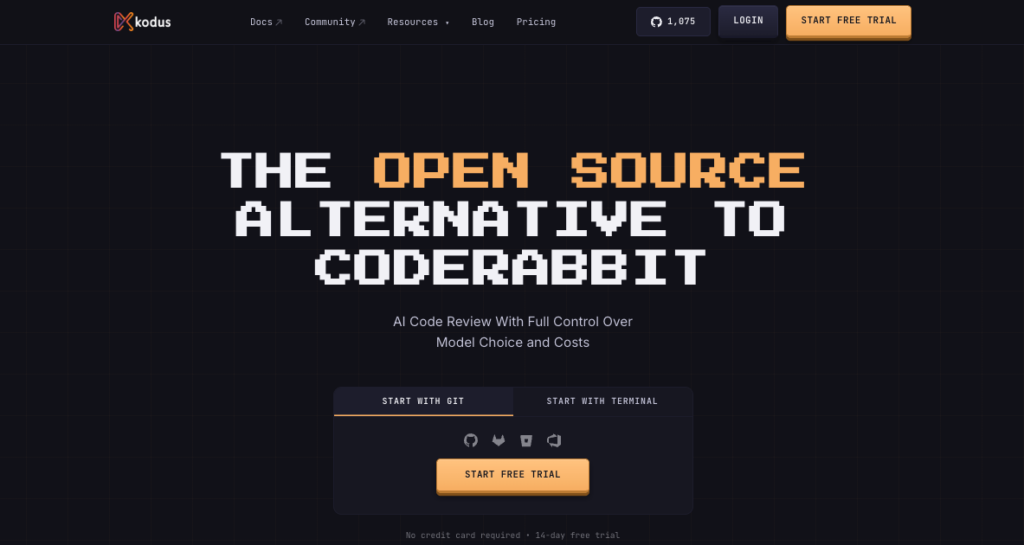
Kodus is an open source AI Code Review tool and makes more sense for scale-ups and larger companies, where code review has already become a problem of consistency, governance, and scale. It is a good option when the team wants review to be closer to the way it already works. The most interesting point here is not just putting AI in the PR. It is being able to turn review rules into something that runs in the team’s flow.
Kodus lets you write rules in markdown with scope by file, folder, language, and severity. In addition, it can also reuse rule files that the team already maintains for tools like Cursor, Claude, Copilot, and Windsurf.
In practice, this greatly reduces the risk of generic feedback. Review starts to reflect the rules, conventions, and decisions that already exist in the repository, instead of being stuck with a broad package of best practices that applies to any code.
Another important point is infrastructure flexibility. Kodus is model-agnostic and supports BYOK, so the team can use its own key and choose the provider or model that makes the most sense for cost, latency, privacy, or analysis quality. This includes OpenAI, Anthropic, Google, and endpoints compatible with the OpenAI API.
In addition, Kodus also offers a self-hosted option. In this model, the review pipeline runs in the team’s own infrastructure, the code does not need to leave the company environment, and controls such as audit, retention, and access follow internal policies.
To me, Kodus is the best option when the team’s challenge has moved beyond simply receiving comments in the PR. It makes more sense for scale-ups and companies that need to keep consistency across squads, reduce repeated comments, and turn standards that today live only in the heads of a few reviewers into clear rules inside the review flow.
CodeAnt AI
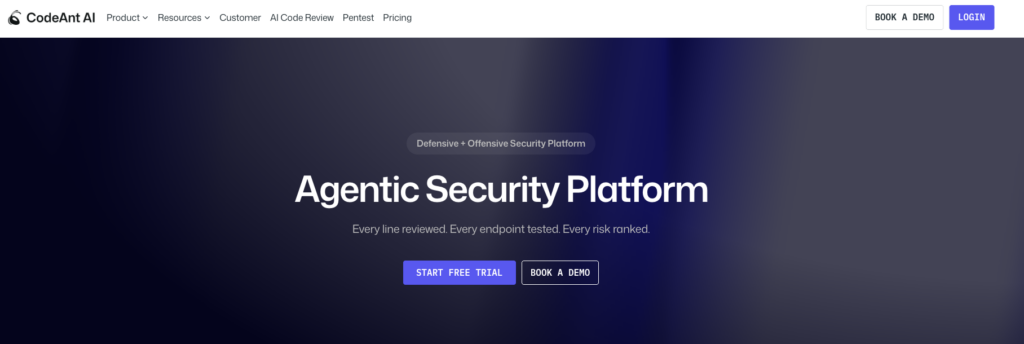
CodeAnt seems like a good option when the team wants to combine code review with a broader security layer. The official proposal mixes AI code review with SAST, SCA, secrets, IaC, SBOM, and even pentesting.
On the review side, CodeAnt works with inline comments that include severity, suggested fixes, reproduction steps, and quality gates. It also allows reviews to run through CLI, IDE, and pull request, which can be useful for teams that want feedback in the local flow before sending everything to remote review.
I see CodeAnt as a good alternative for teams that want to use AI review together with a stronger AppSec routine.
CodeRabbit
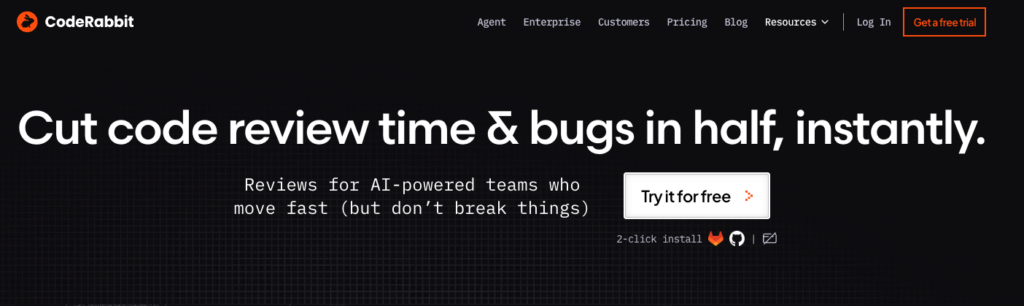
CodeRabbit works well for smaller teams that want to automate review directly in the pull request without changing the process too much. It covers automatic and incremental review, contextual comments, one-click fixes, and learning from team feedback.
Beyond the PR, the tool also already appears in IDE, CLI, Slack, and planning workflows, which slightly expands its use beyond review in the Git provider.
The downside is that, for teams with more specific architecture, convention, and business context standards, it can start to feel more generic. It helps teams get started quickly, but it may not be the best choice when the team needs to turn internal rules into a central part of review.
I think CodeRabbit makes more sense for smaller teams or for teams that want a polished PR experience early on, without needing to define many rules of their own. But when the need is to adapt review to the real way the repository evolves, the comparison starts to change.
How I would separate the three
If the priority is getting AI review running quickly in PRs, CodeRabbit is a good option.
If the priority is combining code review with a broader security layer, I would maybe use CodeAnt.
Now, if the team wants AI to reflect real architecture rules, conventions, and repository context, Kodus seems like the most complete option among the three. Not because it makes more comments, but because it fits better when the problem is already operational: repeated comments, standards that live only in the heads of the most senior people, and inconsistent review across squads.
Conclusion
The best benefits of AI in code review do not appear because it “does review by itself.” They appear when it reduces feedback delays, repeated comments, reviewer overload, and loss of consistency across PRs.
When it enters the process this way, review changes pace. The team spends less time on the basics and can make better use of the human review step.
Even the perception of quality points in that direction. In GitHub’s 2024 survey, 61% of respondents in Brazil said they perceived improved code quality with AI tools, with even higher numbers in other markets from the survey.
In the end, the most useful gain is not fully automating code review. It is making review more sustainable as the team grows, the code increases, and the process starts demanding more than it should.