Best Cubic Alternatives in 2026
 Edvaldo Freitas

Cubic is a useful tool for automated code review, but many teams notice that it starts to show limits as their needs grow. If you are looking for Cubic alternatives, you have probably run into problems like pricing, limited flexibility, limited platform support, or the difficulty of getting truly contextual analysis instead of generic comments on the diff.
In this guide, I compare the best Cubic alternatives in 2026. The focus here is practical: what actually changes in day-to-day engineering, how much control you have over the AI, how well the tool understands the code, which platforms it supports, and which type of team each option makes the most sense for.
TL;DR
| Tool | Best for | Main advantage over Cubic | Public starting price |
|---|---|---|---|
| Kodus | Teams that want more control, deep context, and multi-SCM support | Open source, BYOK, self-hosting, and custom rules | Free; Teams starts at $10/dev/month + tokens |
| CodeRabbit | Teams that want a direct switch with fast adoption | Good platform coverage and simple setup | Free; Pro starts at $24/user/month on the annual plan |
| Qodo | Companies that want governance and multi-repo context | More structure for organizational standards and complex environments | Free; Teams starts at $30/user/month |
| Bito | Teams that want a pragmatic rollout with good value for money | PR, IDE, and CLI workflow with system context | Starts at $12/seat/month on the annual plan |
| GitHub Copilot Code Review | 100% GitHub teams that want convenience | Native review inside GitHub, with little adoption friction | Starts at $10/user/month |
| Graphite | GitHub teams that use stacked PRs | Improves the entire PR workflow, not just review | Starter starts at $20/user/month on the annual plan |
| Greptile | Complex codebases that need deep technical context | Graph-based context with analysis beyond the diff | $30/seat/month with 50 reviews included |
| CodeAnt AI | Teams that want review + security in the same platform | Full codebase context with unified AI review and SAST | $24/user/month |
| Snyk | Teams whose main priority is AppSec | Security in PRs, dependencies, containers, and IaC | Starts at $1,260/year per contributing developer |
| SonarQube | Teams focused on quality gates, compliance, and static analysis | Strong governance and deterministic analysis in PRs and branches | Free; paid plans start at $32/month |
Why teams are moving away from Cubic
Teams usually adopt a tool like Cubic to speed up code reviews and find common mistakes. At first, that already helps a lot. But over time, some limitations keep showing up, and that is when engineering leaders start looking for alternatives.
The most common reasons for looking for Cubic alternatives today are these:
- Limited platform support: Cubic is still very centered on GitHub. That works well for some teams, but it becomes a real limitation for companies that use GitLab, Bitbucket, or Azure DevOps in part of their stack.
- Little control over model and cost: in many companies, the team wants to decide which LLM to use, wants to work with BYOK, or at least wants more predictability around how review quality and cost evolve.
- Need for self-hosting or compliance: when security, data residency, or internal governance enters the conversation, more closed tools start to lose ground to options with more flexible deployment.
- Review is only part of the problem: in many cases, teams move away from Cubic because the real pain is bigger. They also want quality gates, SAST, cross-repository context, analytics, or a better PR workflow layer.
- Less tolerance for “black box” tools: the more mature the team, the less it accepts a reviewer that leaves comments without respecting architecture, internal standards, or domain-specific details.
Top 10 Cubic alternatives in 2026
We analyzed ten tools that teams are using to automate and improve the code review process. Here is a look at each one, with a focus on how they work in the real world.
1. Kodus
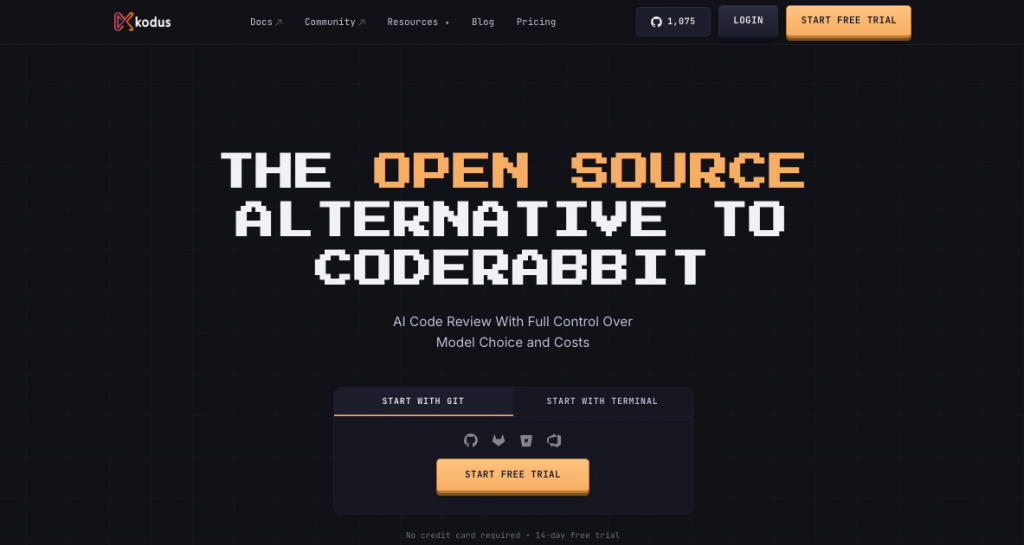
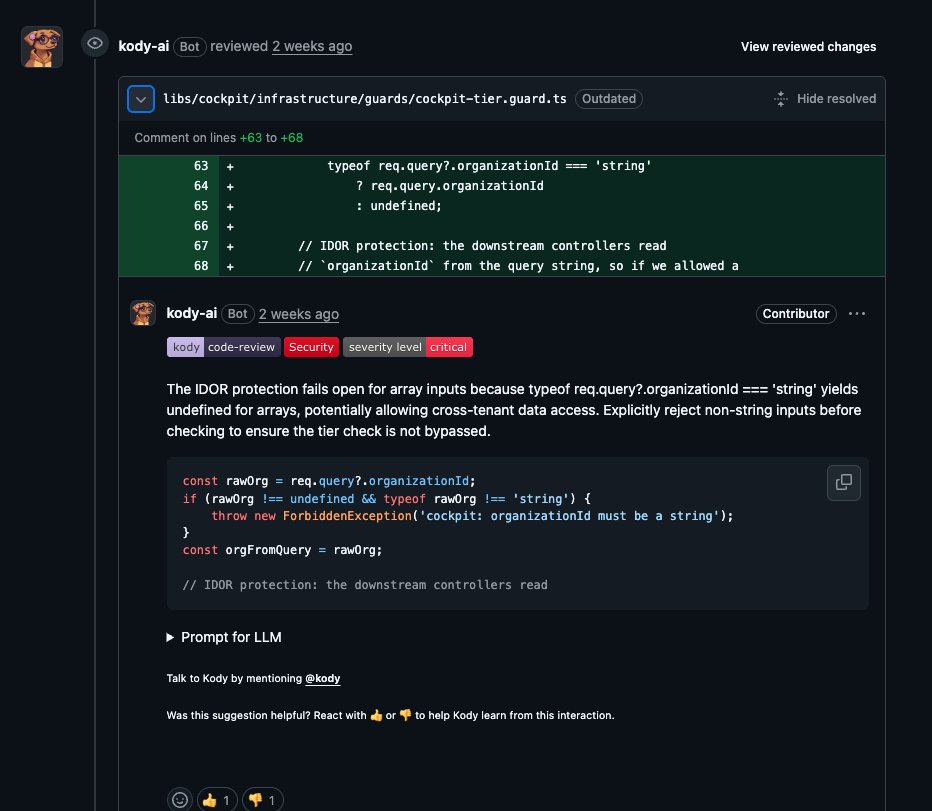
Kodus is an open-source AI code review tool built for teams that want more control over how review works. Instead of only commenting on the diff, the platform works with codebase context, team rules, accumulated feedback, and the freedom to choose the model. That changes review quality a lot in larger or more specific projects.
It is the best Cubic alternative when the team wants to move away from a more closed reviewer and toward a more configurable approach. The main difference here is not being locked into a single model, a single deployment, or a single way to review code.
Pros:
- Full repository context: it looks at the whole repository. This helps find issues with architecture patterns, dependencies across files, and common rules that tools focused only on the diff miss.
- Custom rules: you can write your own review rules in natural language. This helps enforce team-specific standards without being stuck with generic rules.
- Works with different models and supports BYOK: Kodus does not depend on a single LLM provider. You can choose the model that makes the most sense for you, such as OpenAI, Gemini, Anthropic, or an internal model.
- Open source + self-hosting: it is one of the few options in the category that gives real infrastructure control.
- Broad SCM support: GitHub, GitLab, Bitbucket, and Azure DevOps.
Cons:
- Because it does more, it can take more time to configure all features compared with simpler tools.
Pricing: free Community plan; Teams starts at $10 per dev per month + tokens.
Best for: teams that want code reviews to follow their architecture and their specific rules. It works well for platform teams, principal engineers, and companies where review quality matters more than just speed.
2. CodeRabbit
CodeRabbit is a very natural Cubic alternative for teams that want a reviewer with fast adoption and good platform coverage. It has evolved beyond PR comments, including CLI, IDE, issue integrations, and linked repository analysis.
Pros:
- Very simple setup: onboarding is usually fast and low-friction.
- Line-by-line comments: it leaves feedback directly on changed lines, the way a human reviewer would.
- Pull request summaries: it helps reviewers quickly understand the goal of the changes.
- Good platform coverage: supports GitHub, GitLab, Azure DevOps, and Bitbucket.
- Chat interaction: lets you continue the conversation in the PR to ask for clarification or new suggestions.
Cons:
- Even with better context than older tools, it still does not offer the same level of architecture and rules control as a more open platform like Kodus.
- It does not offer the same public level of model and cost control as BYOK tools.
- In very large PRs, it can still create too much noise if it is not configured well.
Pricing: Pro starts at $24 per user per month on the annual plan; Pro Plus starts at $48 per user per month on the annual plan.
Best for: small and mid-sized teams that want an easy-to-adopt tool to speed up reviews and find common issues without a lot of configuration overhead.
3. Qodo
Qodo is a strong Cubic alternative for teams that want more governance and more structure in review. The product works with multiple agents, repository context, PR history, and a rule system designed to represent organizational standards.
In larger companies, that can be an important differentiator. Instead of only commenting on bugs, the tool also helps stabilize engineering practices and make review more predictable across repositories and squads.
Pros:
- Multi-repo context: it makes more sense in environments with microservices, shared libraries, and dependencies across teams.
- Good governance layer: it helps turn review into a more consistent process across squads.
- Strong enterprise options: includes cloud, on-prem, air-gapped, and self-hosted PR-Agent.
- Good platform coverage: supports GitHub, GitLab, Bitbucket, and Azure DevOps.
Cons:
- It can be too much platform for small teams that only want a simple reviewer.
- It is not the best option for teams that want BYOK and full freedom over the model.
- The real value appears more in larger-scale and governance-heavy scenarios.
Pricing: Teams starts at $30 per user per month.
Best for: teams that want a mix of AI, governance, multi-repo context, and stronger organizational structure in review.
4. Bito
Bito follows a more pragmatic path. It combines Git review, local review in the IDE and CLI, plus signals from other tools. That makes it a good option for teams that want to improve review without completely changing the way they work.
Compared with Cubic, it tends to be a good choice when the team values simple rollout, workflow coverage, and good value for money. It is not the most open tool on the list, but it is usually easy to justify for teams that need to get started quickly.
Pros:
- Good entry cost: it is one of the more accessible commercial options to start with.
- Broad workflow: it works in PRs, IDE, and terminal.
- Good Git provider coverage: GitHub, GitLab, and Bitbucket, including self-managed options.
- Better context than pure diff: with AI Architect, it can bring more understanding of the system and dependencies.
Cons:
- It does not offer the same level of open model and infrastructure control as Kodus.
- The strongest features are concentrated in the higher plans.
- For heavier governance scenarios, other options scale better.
Pricing: starts at $12 per seat per month on the annual plan.
Best for: small and mid-sized teams that want to improve review with good value for money and simple adoption.
5. GitHub Copilot Code Review
As part of the GitHub Copilot subscription, this feature puts AI code review directly inside GitHub pull request workflows. It can automatically add comments to pull requests, suggest changes, and summarize what the code does. The main benefit is that it is a native part of GitHub.
Pros:
- Smooth GitHub integration: it is built directly into the pull request interface.
- Custom instructions: you can adapt review with instructions by repository and by path.
- Pull request summaries and applicable suggestions: helps reduce friction in the workflow.
- Included in the Copilot ecosystem: if the team already pays for Copilot, adoption becomes simpler.
Cons:
- Locked into one provider: it only works with GitHub.
- Limited customization: even with instructions, the level of control is still lower than more open platforms.
- No self-hosting or BYOK: for some companies, that is a real blocker.
- The context has improved, but it is still closer to repo-scoped than deep architectural understanding.
Pricing: available in paid Copilot plans, starting at $10 per user per month on the Pro plan.
Best for: teams that have already centralized everything on GitHub and want AI review without adding a new platform to the stack.
6. Graphite

Graphite is on this list because, for many teams, the problem is not only comment quality. The problem is the entire PR workflow. Its approach combines stacked PRs, merge queue, review inbox, metrics, and AI review. That changes team throughput, not just the feedback layer.
It is especially good for GitHub teams that struggle with large PRs, merge queues, and review bottlenecks. On the other hand, it delivers more value when the team buys into the Graphite workflow as a whole, not just the reviewer.
Pros:
- Great for stacked PRs: this is one of the product’s biggest differentiators.
- Improves the whole review flow: combines AI review, merge queue, and PR organization.
- Review customizations: rules, filters, and automations appear in higher plans.
- Good for reducing large PRs: it helps a lot with review throughput.
Cons:
- It is very centered on GitHub.
- It works best when the team adopts the Graphite workflow, not only the reviewer.
- If the team’s problem is not PR flow, part of the platform’s value is lost.
Pricing: Starter plan starts at $20 per user per month on the annual plan; Team is $40 per user per month on the annual plan.
Best for: GitHub teams that use or want to adopt stacked PRs as a central part of their review process.
7. Greptile
Greptile stands out by working with a repository graph to understand dependencies, impact, and broader context. That makes it an interesting Cubic alternative for teams that have been frustrated by reviewers that get the syntax right but miss the architectural context.
It also works well with external agents and assisted-fix workflows, which helps a lot for teams that want to reduce the distance between detecting a problem and starting the fix.
Pros:
- Deep repository context: this is the tool’s main technical differentiator.
- Strong self-hosting: it is a good answer for environments with higher control requirements.
- Integrates well with fixing agents: helps with the flow between review and fix.
Cons:
- More focused on GitHub and GitLab: it does not cover the broader multi-provider scenario as well.
- Cost can rise with high review volume: it needs to be tracked in larger teams.
Pricing: $30 per seat per month, with 50 reviews included; additional reviews are charged separately.
Best for: teams with complex codebases on GitHub or GitLab that need deeper context.
8. CodeAnt AI
CodeAnt AI is an AI review and security platform that works with GitHub, GitLab, Bitbucket, and Azure DevOps. It delivers automated feedback in pull requests, IDE and CLI integrations, and combines review with a broader quality and security layer.
Pros:
- Supports multiple platforms: works with GitHub, GitLab, Bitbucket, and Azure DevOps.
- Codebase context: the product positions itself around full codebase context to review PRs with less noise.
- Custom rules: you can configure rules in the repository or through the dashboard.
- Review + security: makes sense for teams that want to combine quality and SAST in the same purchase.
Cons:
- It can be more platform than necessary for teams that only want a pure reviewer.
- The level of model control is not as publicly clear as it is in BYOK solutions.
- For small teams, the approach may feel heavier than the problem requires.
Pricing: $24 per user per month.
Best for: teams that want to combine AI review with security and quality in a single platform.
9. Snyk
Snyk is a developer security platform, not a general code review tool. It finds and fixes security issues in your code, open-source dependencies, containers, and infrastructure as code. It is a Cubic alternative only if security is the main reason you are switching.
Pros:
- Excellent security analysis: it is very good at finding security issues in code and dependencies.
- Developer-focused approach: it gives useful guidance on how to fix the issues it finds.
- Works in PRs and CI/CD: helps block merges with serious security issues.
- Good SCM integration: supports GitHub, GitLab, Bitbucket, and Azure Repos.
Cons:
- It is not a general code review tool.
- It can generate many alerts, especially in dependencies.
- It usually works better as a complement than as a replacement for a general AI reviewer.
Pricing: starts at $1,260 per year per contributing developer in entry-level enterprise-grade plans.
Best for: any team that cares a lot about security. It does not replace a tool like Kodus or CodeRabbit for general review, but it can work well alongside them.
10. SonarQube

SonarQube is a well-established static code analysis tool. It analyzes code in depth to find bugs, security issues, and code smells. It is a good tool for enforcing quality standards and keeping a codebase clean over time.
Pros:
- Deep static analysis: it goes far beyond simple linting to find complex bugs and anti-patterns.
- Many rules: it has thousands of ready-made rules for many languages.
- Cloud or self-managed: it is a good option for teams that need more control.
- Quality gates and PR analysis: it works very well for governance and policy-based blocking.
Cons:
- It is not an LLM-based tool like Kodus, CodeRabbit, or Greptile.
- A full analysis can increase pipeline time.
- Configuring quality profiles and gates requires more initial work.
Pricing: paid plans start at $32 per month.
Best for: companies that need a self-managed or policy-governed tool to enforce strict quality and security standards through static analysis.
Full comparison table
| Tool | Best for | Key differentiator | SCM coverage | Context depth | Rules / Governance | Deployment | Pricing |
|---|---|---|---|---|---|---|---|
Kodus |
Teams that want deep context, multi-SCM support, and real control over AI cost and behavior. | Open source, BYOK, model-agnostic, zero markup on tokens, Kody Rules, and plugins/MCPs. | GitHub, GitLab, Bitbucket, and Azure DevOps. | Codebase-wide. Combines repository context, learnings, memory, and team rules. | Strong. Natural language rules, rule library, plugins, and standardization. | Cloud or self-hosted. | Teams: $10/dev/month + tokens |
CodeRabbit |
Teams that want a managed, mature, multi-platform experience. | Linked repository analysis, MCP connections, polished PR, IDE, and CLI workflow. | GitHub, GitLab, Azure DevOps, Bitbucket Cloud, and Data Center. | Good depth at the repo level, with extension to linked repositories. | Good. .coderabbit.yaml, org/repo-level settings, and use of guideline files. |
Cloud; self-hosted. | Pro: $24/user/month |
Bito |
Teams that want a pragmatic rollout with system context and good value for money. | AI Architect with a knowledge graph across repos, modules, APIs, and history. | GitHub, GitLab, and Bitbucket. | Cross-repo and system-aware when combined with AI Architect. | Good. Custom review guidelines and Jira/Confluence integration. | Cloud or on-prem. | Team: $12/seat/month |
GitHub Copilot |
GitHub-first orgs that have already standardized on Copilot and want the lowest friction. | Native review inside GitHub, with ready-to-apply changes. | GitHub. | Repo-scoped. Understands the diff and uses repository instruction files. | Medium. Supports repository instructions and AGENTS.md. |
GitHub Cloud. | Pro: $10/user/month |
Qodo |
Multi-repo systems and teams that want heavier governance. | Context Engine with multi-repo awareness and specialized agents. | GitHub, GitLab, Bitbucket, and Azure DevOps. | Cross-repo, system-aware, and oriented around shared architecture. | Strong. PR-Agent, compliance checks, and organizational standards. | Cloud or self-hosted. | Teams: $30/user/month |
Graphite |
GitHub teams that use stacked PRs and want to improve the whole workflow. | AI review connected to stacked PRs, merge queue, and inbox. | GitHub. | Strong inside the Graphite workflow. | Good on Team+. Review customizations and automations. | SaaS. | Starter: $20/user/month |
Snyk |
Teams whose main pain is AppSec in the PR workflow. | PR checks focused on SAST, SCA, and vulnerability prevention. | GitHub, GitLab, Bitbucket, and Azure. | Deep for security, less oriented toward semantic review. | Strong in security policies and thresholds. | SaaS. | Ignite: $1,260/year/dev |
SonarQube |
Teams focused on quality gates and deterministic static analysis. | Explainable code verification and quality gates in PRs. | GitHub, GitLab, Bitbucket, and Azure. | Strong for quality analysis, less conversational. | Very strong. Quality Profiles and Quality Gates. | Cloud or self-managed. | Cloud Team: $32/month |
Greptile |
Complex codebases that need very deep context. | Repository graph index and swarm of agents. | GitHub and GitLab. | Very deep. Graph-based, with impact beyond the diff. | Strong. Directory-level configuration and rules. | Cloud or self-hosted. | Base: $30/seat/month |
CodeAnt AI |
Teams that want to consolidate review, quality, and security. | Full codebase context + unified AI SAST in PR, IDE, and CLI. | GitHub, GitLab, Bitbucket, and Azure. | Full codebase context, focused on security + quality. | Strong. Rules through dashboard and configs through .codeant. |
Cloud or On-Prem. | Premium: $24/user/month |
How to choose your Cubic alternative
The right tool depends on the problem you are trying to solve. Here is a simple way to help with the decision.
- If your main problem is lack of context and noisy reviews: you need a tool that understands the whole repository. Kodus or Greptile are the best choices.
- If you need to make sure specific team standards are followed: you need strong support for custom rules. Kodus stands out here with natural language rules. SonarQube also works well if you are willing to configure quality profiles and gates more deeply.
- If security and self-hosting are mandatory: your options get smaller. Kodus and SonarQube have strong answers. Greptile, Qodo, and CodeAnt also enter the conversation in enterprise scenarios.
- If you only want something simple and fast: and you are not trying to enforce complex architecture rules, consider CodeRabbit or GitHub Copilot.
- If the budget is small: start with the SonarQube Community Edition, Kodus Community, or the free/trial options from the other platforms.
Usually, you need to choose between control and convenience. Simpler tools are easy to use, but give you less control. Stronger tools require more setup at the beginning, but let you shape the review process exactly the way your team needs.
Frequently asked questions
Is Kodus a good Cubic alternative?
Yes, Kodus is a very strong Cubic alternative, especially for teams that feel limited by the lack of context and customization. If your main problems are generic feedback and the difficulty of applying team-specific standards, Kodus’s repository-level context and plain-language rules were built to solve exactly that.
What is the cheapest Cubic alternative?
The cheapest option is usually a tool with a free or open-source plan. SonarQube Community Edition is free if you host it yourself. For AI review, Kodus and CodeRabbit also have accessible entry options to get started.
Can I migrate from Cubic to Kodus?
Yes. To migrate, you install the Kodus app in your Git provider and remove the Cubic integration. Then, you adjust the review rules to reflect your team’s standards. Because Kodus accepts rules in natural language, this adaptation tends to be more direct than in more rigid solutions.
Are there Cubic alternatives that can be self-hosted?
Yes. Kodus, SonarQube, and Greptile are strong examples. Qodo, CodeRabbit Enterprise, Bito, and CodeAnt also offer more controlled deployment paths in enterprise scenarios.
Final verdict
No tool works best for every team. The right choice depends on your workflow, your main problems, and the level of control you want.
If you want a simple and easy way to get automatic feedback in pull requests, tools like CodeRabbit and GitHub Copilot are great choices. They are quick to configure and start helping right away. For teams focused on security or static analysis, Snyk and SonarQube are still relevant for good reason.
But if your team needs a Cubic alternative because it is tired of generic feedback with no context, then Kodus was built for that. It can understand the whole repository and, with custom rules, you can create an automated review process that follows the way your senior engineers think. For teams that need to guarantee architectural consistency and keep high standards as they grow, that level of control is essential.